Why elephant corridors matter and what happens when they are disrupted
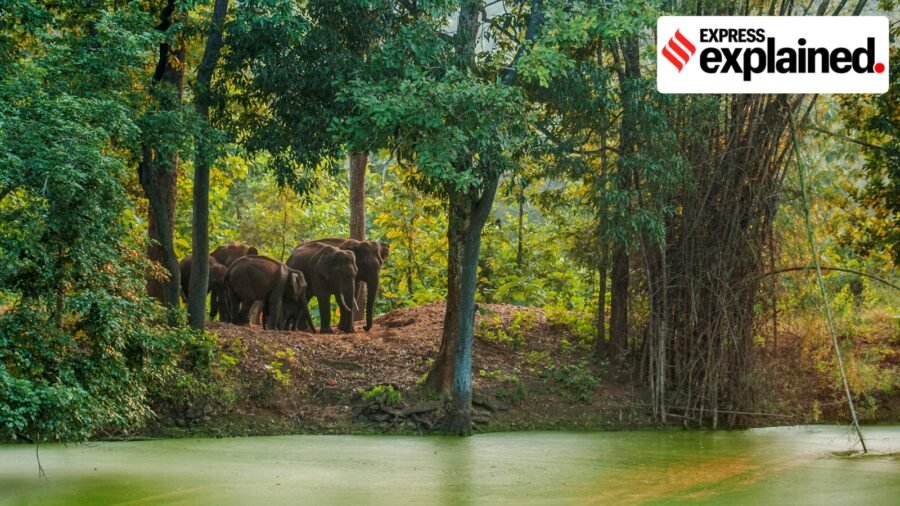
On August 17, a Supreme Court bench presided by Chief Justice of India Surya Kant directed the Union government to conduct a fresh survey of elephant corridors. It said these corridors cannot be blocked fearing crop damage as elephant herds, by nature, travel long distances.
The bench was hearing an ongoing writ petition on managing human-elephant conflict. The petition, in the past, had also sought to prevent the use of fireballs, spikes and other such materials to drive away elephants. In its August 17 order, the bench asked the Centre to indicate steps taken to prohibit the use of such methods or any other “coercive measure” to divert the natural movement of elephants.
Elephant corridors, or movement pathways connecting two natural habitats, have been well defined and identified by the Environment Ministry. They are crucial to facilitating elephant movement, and disrupting them can not only spark human-elephant conflict but pose a threat to the animals themselves. Here’s a look at the role they play.
But first, why do elephants move long distances?
Story continues below this ad
Asian elephants are highly mobile and social mammals. A male elephant’s average home range — the area it typically uses for food, water and shelter — extends between 50 and 300 square kilometres, but can increase depending on the availability of resources. Elephants can move through their range in herds or individually. These home ranges can also vary depending on habitat type, food availability, water sources, population density and human disturbances.
Elephant movements are strongly influenced by seasonal and spatial distribution of food, water and habitat, according to studies by the National Centre for Biological Sciences and Wildlife Institute of India. For instance, seasonal migrations into Kerala are common during the dry months as elephants seek water and food in the relatively moist forests of the Western Ghats, said a recent Environment Ministry report on human-elephant conflict in South India.
Historically, climate change and drought, too, have played a role in forcing migration.
In all this, corridors play a crucial role, allowing elephants to move for food, for natural dispersal and everyday movement. Now, the migratory routes are also increasingly being influenced by infrastructure construction, mining and farm lands.
Fragmentation of corridors and habitats
Story continues below this ad
The directions given by the CJI-led bench pertained to this specific issue of the blocking or obstruction of elephant corridors passing through different states, and the related issues of human-elephant conflict it creates.
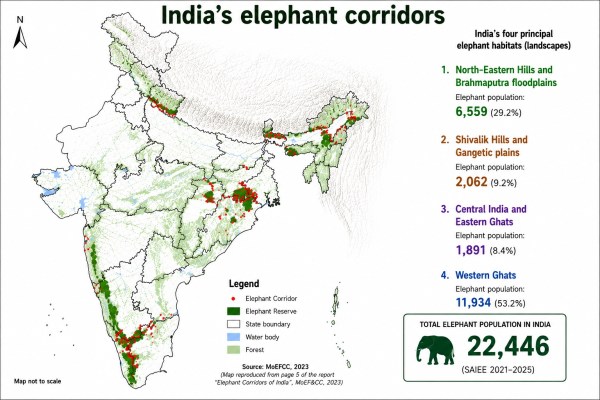 Elephant corridors of India (red dots) as of 2023. Map reproduced using AI from Environment Ministry report.
Elephant corridors can get disrupted for a number of reasons. The major issues in recent times are infrastructure construction, and industrial and mining activity. Linear infrastructure — such as highways, existing and new railway lines, canals and power lines — can push elephants towards farmlands and human settlements, triggering conflict.
India has four principal elephant population landscapes — the Western Ghats; North-Eastern Hills and Brahmaputra floodplains; Shivalik Hills and Gangetic plains; and Central India and Eastern Ghats. More than 50% of India’s 22,446 elephants are distributed in the Western Ghats across Karnataka (6,013), Tamil Nadu (3,136) and Kerala (2,785).
But the habitat of the once-contiguous Western Ghats population is rapidly getting fragmented owing to changing land use, coffee and tea plantation, invasive plants, and farmland fencing. This was prominently noted in the last all-India elephant population estimation report released last year.
Story continues below this ad
Similar disruptions to traditional corridors and fragmentations of habitat were recorded in the Shivalik and Brahmaputra plains area. Chief among the reasons cited were railway lines, roads, power infrastructure and other land-use changes.
View this post on Instagram
The biggest challenge to elephant conservation, however, lies in the Central India and Eastern Ghats landscape. India’s numbers have risen in this landscape over the years. Starting mid-to-late 1980s, this region has seen a gradual increase in herd movement, initially due to an El Nino-linked drought in erstwhile southern Bihar, and later due to iron ore mining in Jharkhand and Odisha.
Chhattisgarh has witnessed the arrival of elephants from Jharkhand and Odisha over two decades owing to habitat loss and mining pressures. Subsequently, elephants have also expanded their range into Umaria and Shahdol in Madhya Pradesh, and Gadchiroli in Maharashtra.
Corridor mapping
Corridors not only provide elephants crucial connectivity between fragmented habitats, but also allow genetic exchange or dispersal which helps in maintaining diversity in their population pool. Well-conserved corridors also provide them access to food and water in natural habitats during seasonal changes, preventing them from entering crop lands.
Story continues below this ad
The government’s last major elephant corridor mapping exercise in 2023 documented 150 elephant corridors across 15 states in the four major landscapes. The recent report on managing human-elephant conflict in Southern India mapped bottlenecks in corridors, giving an idea of the challenges elephants face.
The report identified a number of bottlenecks across the 32 corridors in the southern region — highways, railway projects such as the Bengaluru-Chennai railway line, hydel projects, high-tension power lines, electric fences, quarries, narrowing of corridor, tea and coffee estates, resorts and ashrams.
West Bengal had the highest number of corridors, with 26 identified across its northern and southern parts. The extent of these corridors varies, but some crucial ones, such as the Charmar-Jingol corridor, largely situated in Chhattisgarh, is 20 km long and 2.5 km wide. It is an ecologically important corridor, facilitating the movement of an estimated 80-100 elephants from Odisha to the interiors of Chhattisgarh.

Microplastics in bottled water: What 240,000 particles per litre means for your health
By Sohail Khan · 28 Sep
Women’s safety falls through the gap between intention and policy
By Sohail Khan · 28 Sep
Give India’s poor cash. But don’t stop there
By Sohail Khan · 28 Sep