US’ Javelin missiles to be made in India in partnership with Tata firm
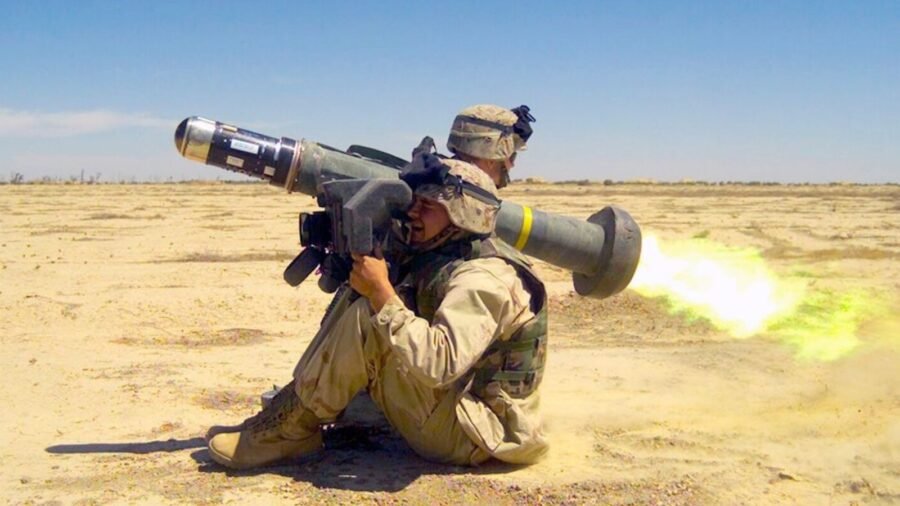
The US’ Javelin anti-tank missile system – a shoulder-launched, fire-and-forget weapon – will be co-produced in-country. A pact was signed to this effect between Tata Advanced Systems Limited and American defence contractors Raytheon and Lockheed Martin, the companies said in a statement on Monday.
Operating as the Javelin Joint Venture, the two American companies have manufactured over 55,000 missiles and more than 12,000 reusable launch units so far. The JJV will now work with Tata Advanced Systems to “explore the establishment of a final assembly and integration facility for the Javelin AUR and component production capabilities in India”, a joint statement said.
This will ‘support future in-country production of the Javelin missile system while providing unique opportunities (for India) and strengthen regional stability in the Indo-Pacific’, the three companies said.
Story continues below this ad
What this means is that the sub-assembly kits and GEUs, or guidance electronic units, i.e., the on-board computer that guides the missile to its target once fired, will be produced separately in the US and then shipped to India for assembly and integration.
In line with the Indian government’s ‘aatmanirbhar Bharat’ vision, this should create ‘high-tech jobs (in India) and advance local manufacturing expertise, as well as support global supply chain resiliency due to increased worldwide demand’, the statement said.
From a regional security standpoint, localised production of the Javelin missile will ensure a reliable and steady supply of a proven weapons system, both for the US and its allies in the Indian Ocean Region as well as the wider South East Asia region.
Sukaran Singh, CEO and MD of Tata Advanced Systems, made that point.
Story continues below this ad
He said the deal with the JJV ‘brings critical assembly expertise and knowledge transfer into India’s defence industrial ecosystem while strengthening self-reliance’, and that ‘local assembly of the Javelin will enhance operational readiness and ensure timely access to proven, combat-ready capability for the Indian armed forces’.
Equally significantly, localised manufacturing ensures interoperability, i.e., it allows Indian, US, and allied militaries to share weapons in scenarios where individual nations’ defence priorities align with the broader Indo-Pacific partnership objectives.
And finally, though no less important, shifting production, or at least assembly, outside the US means Washington makes each Javelin ATG system less expensive.
Last week the Indian Army said it had finalised the deal to buy the Javelin anti-tank missile via the US Foreign Military Sales process.
Story continues below this ad
What is the Javelin
The Javelin first entered service with the US military in 1996.
It is an anti-tank guided munition with a standard effective range of 2.5 km. A single person can carry this missile system and fire it from their shoulder. Alternatively, it can also be fired from a remote launcher mounted on an unmanned ground vehicle.
The Javelin’s biggest selling point is that it is a man-portable, ‘fire-and-forget’ missile – i.e., its infrared guidance system allows it track a target once fired. This means operators can move to cover after firing one round or reload to fire again.
That combination makes it particularly lethal.
Story continues below this ad
The Javelin is designed for use against a wide array of targets, including armoured vehicles and fortified positions, and is used by the US Army and the Marines. It also has numerous international customers – including Ukraine in its ongoing war with Russia.
How does the Javelin work?
The soldier carrying a Javelin missile locates a target through an infrared sight built into the launcher.
Then, they set a square around the target using a cursor.
This target is then sent to a guidance computer that is located on the missile itself.
Story continues below this ad
All that is left to do is press the trigger.
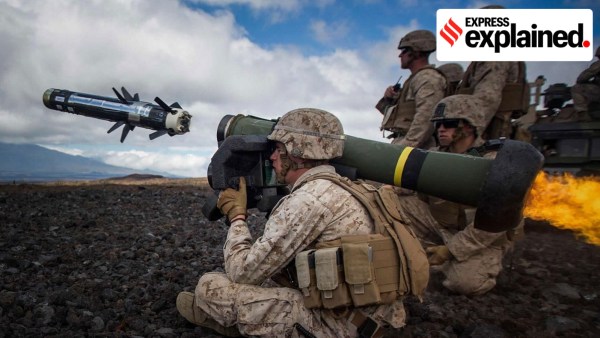 The Javelin missile system can be fired by a single person from their shoulder. (Raytheon)
But what about recoil and exhaust? The Javelin system, after all, weighs about 22 kg, with the missile itself making up 8.4 kg of this weight. The Javelin takes care of this problem with a clever innovation called a “soft launch” mechanism.
In lay terms, this means that when an operator presses the trigger, an initial motor within the missile produces just about enough force to launch the missile out of the tube.
But that’s not the only innovation that the Javelin offers – it has two firing modes.
Story continues below this ad
In the first, the missile flies straight at a target. This mode is meant for targets such as fortified bunkers and helicopters. The second mode is the top attack mode. The missile flies upward to an altitude of 150 m before diving towards its target at a steep angle.
This is particularly useful against tanks, which have vulnerable roofs.
Battle-tested
US and allied forces used the Javelin extensively during wars in Iraq and Afghanistan.
But perhaps its most effective use was seen in 2022, when Russia invaded Ukraine.
Story continues below this ad
The numerically inferior Ukrainian military used the missile to devastating effect against Russian main battle tanks and other armored vehicles. Indeed, some observers have credited the Javelin system with helping Ukraine repel the full-scale invasion.
Such was the weapon’s popularity that an image of Mary Magdalene holding an FGM-148 missile, dubbed “St. Javelin,” became a symbol of Ukrainian resistance.

Ganpati special trains 2026: Over 1.17 lakh tickets booked, Railways issues advisory
By Sohail Khan · 31 Aug
Jaipur lawyers protest against Acting Chief Justice, Jodhpur bodies announce strike
By Sohail Khan · 31 Aug
‘Civilians must not be harmed’: PM Modi meets Iranian President Pezeshkian in Bishkek
By Sohail Khan · 31 Aug
Leave a Reply