US is world’s top oil producer. Why does it want Venezuela’s crude?
The US says it will gain majority control over more than 65 billion barrels of Venezuelan oil — or 20% of its proven oil reserves — under an agreement with the South American country.
US President Donald Trump said this “biggest oil deal in world history” will be implemented through a partnership involving private companies “at no cost to the American taxpayer”.
Venezuela has the world’s largest proven oil reserves, estimated at about 300 billion barrels, but produces and sells only about 1% of the crude the world is using. After the US captured Venezuela’s President Nicolás Maduro in January, Trump declared that Washington would take control of Caracas’s oil sector and that American majors would invest billions of dollars to revive the Venezuelan oil industry.
Story continues below this ad
All these months later, it would seem he is getting his wish. The announcement represents an ambitious attempt to combine American capital and technology with Venezuela’s massive but dilapidated oil production infrastructure.
The US is the largest oil producer in the world. It is also a top exporter of the black gold. So why does it want to have a high degree of control of Venezuelan crude?
Some reasons are self-evident — energy market dominance, reducing international oil prices amid the Strait of Hormuz crisis and building up reserves. But a key reason is the very nature of Venezuelan oil — highly viscous, sticky and “sour”.
Big announcement, few details
At this stage, the precise legal and commercial structure of the US-Venezuela agreement remains unclear. While Trump said that the US would effectively obtain majority control over 65 billion barrels of Venezuelan oil reserves, Venezuela presented the pact as a major investment programme for reviving its petroleum industry.
Story continues below this ad
According to some international news reports, the proposed structure of the deal would likely involve a new private company jointly owned by US interests and an operator, with the US side holding a 55% operational share. The company would develop 17 oil fields, while US buyers would purchase oil at cost. The Venezuelan government, meanwhile, has put the potential economic impact at roughly $100 billion in private investment and more than $209 billion in tax revenues.
Venezuela has historically maintained strong state control over its oil industry. A deal giving foreign companies significant ownership or operational control of its oil producing assets could become politically contentious.
 President Nicolas Maduro on board the USS Iwo Jima after his capture by the US. Wikimedia Commons
Moreover, there are questions over whether Venezuela’s interim administration has the authority to commit to long-term oil agreements. Reports indicate that opposition leaders in Venezuela are already up in arms against any deal giving control to American companies.
Story continues below this ad
The legal structure of the new agreement will, therefore, be crucial. Production-sharing contracts being handed out to US oil majors is one thing, but a long-term concession or an outright majority stake in oilfields is another.
Why does the US want Venezuelan oil?
Crude oil is not exactly a fungible commodity in practice because of the differences in quality of various types or grades of oil. And which type of crude is likely to be easily available in adequate volumes is a key factor in refinery configurations.
As mentioned above, a key reason for the US interest is the grade of Venezuela’s oil.
The bulk of Venezuelan crude is classified as “heavy sour” crude — “heavy” because it is thicker and denser than the lighter crude oil grades, and “sour” because of its high sulphur content.
Story continues below this ad
By contrast, the majority of US oil production is “light” and “sweet” — denoting low viscosity and sulphur content.
However, much of the American refining infrastructure — particularly the US Gulf Coast refineries — were specifically engineered to process heavy crudes from Latin America and Canada.
The US is also not on the best of terms with other countries that have significant heavy crude reserves, such as Iran and Russia. That was also the case with Venezuela, until January this year.
Story continues below this ad
Therefore, the US still has to import heavy sour crudes to feed these refineries, even as it exports massive volumes of its own “light sweet” oil.
But what’s behind the mismatch between what the US can produce and what it can refine? For that we have to go back several decades.
The American refining infrastructure
Many of these US Gulf Coast refineries were built in the last century. At that time, heavy sour crudes were the most easily available oil for the US — from the country’s own domestic conventional oil fields, and later from nearby countries like Venezuela, Mexico, and Canada.
For the better part of the last century, major American oil companies invested billions of dollars in Venezuela’s oil industry, helping feed the US refineries with Caracas’s heavy sour crude.
Story continues below this ad
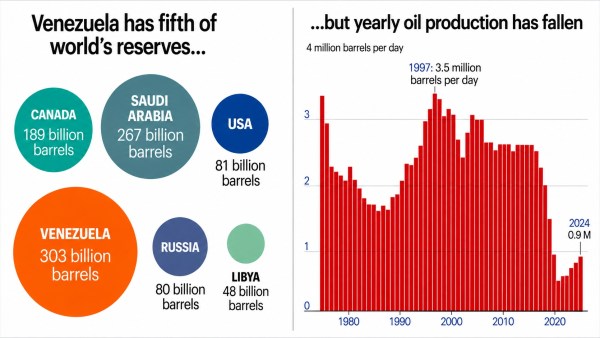 Venezuela has massive oil reserves but minuscule production
It was only in the next century that new drilling and fracking techniques made it possible to extract unlocked vast amounts of oil trapped in shale rock, triggering a surge in domestic oil production. This is known as the US shale oil revolution.
So why didn’t the US build new refineries or retrofit its existing ones?
Setting up refineries, particularly the highly complex ones that are geared to process heavy crudes, is a highly capital-intensive exercise. Reconfiguring them significantly is usually not a financially viable undertaking.
Story continues below this ad
Hence, maintaining the primary crude diet for which a refinery was originally designed becomes important for the unit to function at high efficiency and utilisation levels. This is a key reason for the US interest in Venezuelan crude.
There are also geopolitical considerations. The Trump administration wants a reliable and nearby supply source after its war on Iran prompted Tehran to choke oil supplies through the Strait of Hormuz — the narrow waterway that used to see a fifth of the world’s energy flows in peacetime.
And Venezuela, as mentioned above, has historically been a big supplier of crude to the US. How did all that change?
The Venezuela-US oil dynamic
Venezuela was a major source of crude oil for the US till the early 2000s, and American oil majors heavily dominated the sector there. Then the Latin American country’s oil production and exports started dwindling in a period marked by an increase in state control of Venezuela’s oil industry under Hugo Chavez. Nationalisation of assets saw US oil giants such as ExxonMobil and ConocoPhillips exit Venezuela in 2007. The country’s national oil company increasingly grappled with corruption and mismanagement.
Story continues below this ad
The period also saw a deterioration in Venezuela’s oil infrastructure, which was plagued by extreme underinvestment. The relationship between Washington and an increasingly socialist Caracas also deteriorated further over the years. By 2018, imports of Venezuelan crude into the US had crashed to around a fourth of the late-1990s peak of 2 million barrels per day (bpd), when the US accounted for more than half of Venezuelan oil exports.
Then, with the full US sanctions against Venezuela taking effect in 2019, Caracas’s oil supply stopped completely. Some volumes started flowing again in early 2023 after Washington granted a specific licence to US oil major Chevron to resume oil production from Venezuela and import it into the US.
The challenges for the US
Although Venezuela is estimated to hold a fifth of the proven oil reserves globally, it produces less than 1% of the global output. Venezuela’s oil production is only a third of its output at the turn of the century. Notwithstanding Trump’s highly optimistic outlook for Venezuela’s oil industry, scaling up production again will be no mean task.
Norway-based energy research and intelligence firm Rystad Energy had estimated in January that Venezuelan oil production can return to late 1990s levels by 2040 if the new investment cycle starts as early as 2026. And for this to happen, over $180 billion would have to be invested over the next 15 years.
With US sanctions on Venezuela greatly constraining the flow of Venezuelan crude in the international oil market, China became its leading destination. Over the past couple of decades, China also poured billions of dollars into Venezuela, including in the oil sector, filling the vacuum left by American oil majors. Russia has also invested heavily in the Venezuelan petroleum industry.
And this is where the agreement between Washington and Caracas becomes geopolitical. The outlook for the significant Chinese and Russian investments in Venezuela is now uncertain. In that context, Trump’s declaration of taking over Venezuela’s oil sector can also be seen as an attempt by Washington to cut Chinese and Russian influence in the Americas.
The deal could mark the beginning of a reorientation of Venezuela towards the US. For decades, Venezuela was one of Washington’s most determined opponents in Latin America, and its oil industry became intertwined with relationships with China, Russia, and other US rivals.

Turmeric, honey, and yoghurt: Decoding Ananya Panday’s glow secret
By Sohail Khan · 28 Sep
SpaceX puts Starship megarocket in orbit for first time
By Sohail Khan · 28 Sep
‘What’s for lunch when your restaurant is travelling at 28,000 km/h?’
By Sohail Khan · 28 Sep