US again eyes $100k H-1B fee: How Indian workers, IT firms will be hit
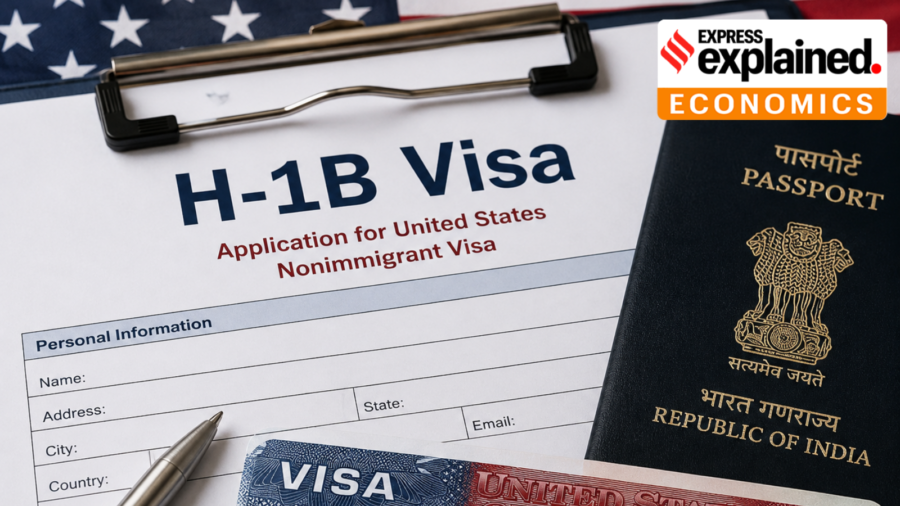
Barely two months after a US federal court struck down the Donald Trump administration’s $100,000 charge on new H-1B visa petitions, the administration is trying again. This time, through a formal rulemaking process and under a different provision of immigration law.
The Department of Homeland Security (DHS) has proposed an additional $103,265 fee on every H-1B petition subject to the annual visa cap. The amount would be paid by the sponsoring employer at the time of filing, on top of existing H-1B fees. The proposal is not yet in force, and has been opened for public comments for 30 days, after which DHS would have to consider submissions and issue a final rule.
US Vice President J D Vance backed the move, saying: “If an American corporation needs workers, it should hire and train Americans.”
Story continues below this ad
The H-1B programme has come under heightened scrutiny in the US amid a wider debate among its critics over whether it is being used for its original purpose — allowing companies to fill specialised jobs for which sufficiently skilled American workers are unavailable — or as a route to access cheaper foreign labour.
The Trump administration has argued that some companies, particularly in the technology sector, have continued to hire H-1B workers even while laying off US employees, and that the programme can suppress wages and reduce opportunities for American graduates.
Indians, who are the biggest beneficiaries of the visa programme, stand to lose the most if the current proposal goes through. We explain why.
What exactly is being proposed
The H-1B programme allows US employers to hire foreign workers in “specialty occupations”, typically jobs requiring at least a bachelor’s degree. The US Congress caps new H-1Bs at 65,000 a year, with another 20,000 available to people with a master’s or higher degree from a US university.
Story continues below this ad
The new $103,265 charge would apply to these cap-subject petitions, including the advanced-degree category. It would not apply to cap-exempt H-1B petitions, including many filed by universities, non-profit research institutions and government research organisations.
DHS estimates the fee would raise about $8.8 billion annually, assuming 85,000 fee-paying petitions. Unlike a normal visa processing charge, the money is meant to support costs across the wider immigration system.
The proposal also makes clear that the policy has a labour-market objective. DHS says a six-figure charge would make employers less likely to choose an H-1B worker over a qualified American unless they genuinely need the foreign worker’s specialised skills.
Why the earlier $100,000 fee was struck down
Trump had imposed the earlier charge through a September 2025 presidential directive, relying on provisions of the Immigration and Nationality Act that allow the president to restrict the entry of foreigners deemed detrimental to US interests.
Story continues below this ad
This June, a US federal court ruled that the $100,000 payment functioned as a tax, not merely an entry restriction. Since the Constitution gives Congress the power to levy taxes, the court held that the immigration provisions cited by Trump did not clearly authorise the President to impose such a charge. The court also found the agencies’ implementation unlawful under the Administrative Procedure Act and vacated the policy.
The administration has appealed, but the First Circuit Court of Appeals in July refused to pause the lower court’s order while that appeal proceeds.
The biggest difference in the new approach is the legal route. Instead of relying primarily on presidential authority to restrict entry, DHS is invoking its statutory power under Section 286 of the Immigration and Nationality Act to set fees that recover the costs of immigration adjudication and naturalisation services. It is also going through notice-and-comment rulemaking rather than imposing the fee directly by proclamation.
That does not necessarily insulate the policy from another lawsuit, however. DHS itself acknowledges that it has not historically charged one narrow class of immigration applicants to fund such broad costs across multiple agencies, including programmes with which H-1B employers may have no direct connection.
Story continues below this ad
Impact on Indian workers
The stakes are particularly high for Indians. US Citizenship and Immigration Services (USCIS) data show that people born in India accounted for 71% of all approved H-1B petitions in FY2024. People born in China come a distant second, hovering at the 12-13% mark since 2018.
Between October 2022 to September 2023, 72% of the nearly 4 lakh visas issued under the H-1B program went to Indian nationals. During the same period, top four Indian IT majors with a presence in the US — namely Infosys, TCS, HCL, and Wipro — got approval for around 20,000 employees to work on the H-1B visa, as per USCIS data.
Industry body Nasscom has urged Washington to weigh the programme’s role in filling short-term skills gaps, while pointing out that Indian technology companies have expanded local hiring in the US and reduced their dependence on H-1B workers.
“The H-1B visa programme has long served an important purpose in addressing short-term skill gaps in the US,” Nasscom said in a statement. “A proposed increase in visa fees must therefore be viewed in the context of the programme’s original purpose of enabling access to temporary skills where there is a shortage in the US,” it added.

Light on truth: on the Tamil Nadu G.O. and RTI
By Sohail Khan · 29 Sep
Tackling food loss and waste — India’s opportunity
By Sohail Khan · 28 Sep
Revisiting the farmer question
By Sohail Khan · 28 Sep