Two visible signs your insulin sensitivity may be improving
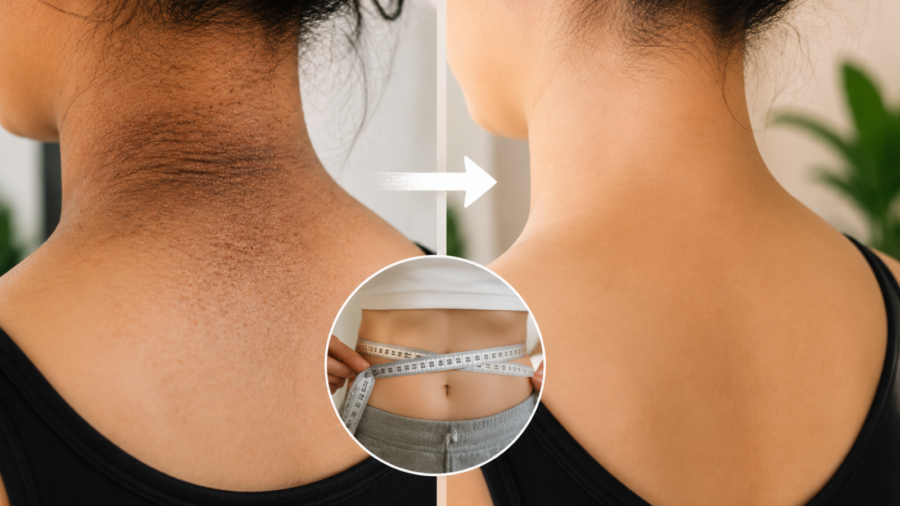
When insulin sensitivity starts improving, the changes may not always show up immediately in a blood test. Sometimes, the body also starts giving visible cues. One such indicator lies in your skin and waist size.
According to Dr. (Col) Vijay Dutta, Director, Internal Medicine & Respiratory Services, ISIC Multispecialty Hospital, Delhi, skin and weight-related changes can indeed offer useful signs that the body is responding better to insulin.
Story continues below this ad
Watch for changes in dark, velvety skin
One noticeable skin change is acanthosis nigricans, a condition that causes dark, thickened, velvety patches of skin, commonly around the neck or underarms.
Dr Dutta explains that these “dark, velvety spots on the neck or underarms (acanthosis nigricans) can subside over time as insulin concentration returns to normal.”
In simpler terms, as insulin sensitivity improves and insulin levels become better regulated, these darkened patches may gradually become less prominent.
The skin may also change in other ways. Dr Dutta notes that it “might also become clearer with fewer breakouts of acne since hormonal balance is enhanced.”
Story continues below this ad
That means clearer skin or fewer acne breakouts may sometimes accompany improvements in metabolic health, although these changes should not be treated as a standalone measure of insulin sensitivity.
Your waistline may be more telling than the weighing scale
 “Any slight decrease in the waist size is indicative of improved metabolic wellbeing,” says Dr Dutta
When it comes to weight, it is not simply about watching the number on the scale. Where the body stores fat matters too, particularly fat around the abdomen.
Dr Dutta highlights that “the decrease in belly fat is solely essential, which is closely associated with insulin resistance.” He adds that “any slight decrease in the waist size is indicative of improved metabolic wellbeing.”
This is because better insulin sensitivity helps the body use glucose more efficiently. As the body handles glucose more effectively, there may be less tendency towards fat accumulation and a healthier distribution of body fat.
Story continues below this ad
“The increased insulin sensitivity will assist the body in utilizing glucose more efficiently, which will decrease fat accumulation and lead to a more healthy distribution of weight. ”
So, if your weight has barely changed but your waist measurement is gradually coming down, that can still be a positive sign.
Why these changes matter
Improved insulin sensitivity means the body is becoming better at responding to insulin and using glucose for energy. Over time, this can be reflected in changes such as reduced abdominal fat and improvements in certain insulin-related skin changes.
Dr Dutta says these visible improvements can be “boosting” and may also serve as a motivating reminder that lifestyle changes are having an effect.
Story continues below this ad
However, skin changes or a smaller waist cannot confirm on their own that insulin sensitivity has improved. They are physical clues rather than a substitute for appropriate medical evaluation and blood tests.
Moreover, “The period of visible changes depends on an individual and differs based on things such as lifestyle, dietary, physical activity and general health of an individual among other things.”
Thus, progress may not always mean a dramatic drop on the weighing scale or a cinematic skin transformation. Sometimes, a slightly smaller waist or gradual improvement in the appearance of insulin-related skin changes can be one of the body’s quieter signs that things are moving in the right direction!

Microplastics in bottled water: What 240,000 particles per litre means for your health
By Sohail Khan · 28 Sep
Women’s safety falls through the gap between intention and policy
By Sohail Khan · 28 Sep
Give India’s poor cash. But don’t stop there
By Sohail Khan · 28 Sep