The recruitment controversy in Andhra Pradesh
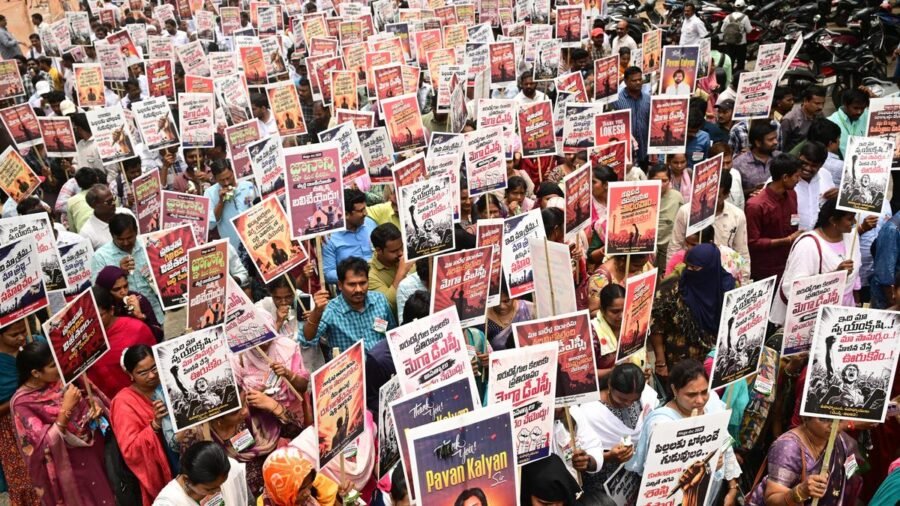
The success of the student-led protest at Jantar Mantar has altered the political vocabulary of the moment. Examinations, paper leaks, recruitment, and the anxieties of an entire generation have suddenly moved from the margins of public discourse to its centre. Andhra Pradesh too is now witnessing its own version of this churn.
Two recruitment controversies, the ‘Mega’ District Selection Committee (DSC)-2025 teacher recruitment and the Andhra Pradesh Public Service Commission (APPSC) Group-I 2018 examination, have become competing political narratives. However, the candidates themselves are less interested in which party gains political mileage and more concerned about knowing if the system is/was fair. That question is bigger than both the ruling Telugu Desam Party (TDP) and the main Opposition party, the YSR Congress (YSRCP).
Through the Mega DSC-2025, the government notified 16,347 teacher posts, attracting more than 5.7 lakh applications. The exams were conducted between June 6 and July 2, 2025. Eventually, 15,941 candidates received appointment orders, leaving 406 posts vacant for want of eligible candidates in respective categories. The government has maintained that the recruitment followed the notified rules, reservation rosters and government orders. Senior education department officials also pointed out that despite hundreds of legal challenges, no court stayed the examination or held that the recruitment process as a whole violated prescribed norms.
Tit-for-tat exam scandals
However, the controversy has not emerged from thin air. The High Court has been repeatedly approached over various aspects of the recruitment. As of August 2026, the court was told that 335 petitions had been filed, with 69 related to the sports quota.
The YSRCP has sought to turn the DSC controversy into a broader youth mobilisation campaign, trying to appeal to the anxieties of the Gen Z youth. It has alleged irregularities in the recruitment process and has demanded accountability from Education Minister Nara Lokesh.
Among the issues raised by the Opposition is the decision to entrust a single institutional set-up with both question-bank preparation and the conduct of the DSC examinations. The case of P. Naveen, an outsourced employee of the State Council of Educational Research and Training, whose name figured in the first merit list before disappearing from the revised list, also become a political flashpoint. His initial inclusion in the merit list led to allegations that persons associated with the examination system could have had access to question banks.
The sports-quota controversy has added another layer. The coalition government had issued orders enhancing reservation for meritorious sportspersons to 3%, providing horizontal reservation in direct recruitment without a competitive examination. The subsequent restoration of the mandatory exam, after the recruitment process had progressed, drew sharp criticism. The Opposition has also alleged inaction against those involved in attempts to trade teacher posts.
Meanwhile, the TDP and its allies have responded by bringing up the Group-I 2018 recruitment controversy. A notification, issued in 2018, to fill 169 Group-I posts, became embroiled in litigation over the evaluation of the mains examination. A single judge in March 2024, when the YSR Congress was in power, held that the second and third valuations of the Group-I mains papers were illegal and directed the mains examination be conducted afresh.
But governance cannot be reduced to competitive accounting. If DSC candidates have legitimate grievances, they deserve answers, irrespective of which government conducted the recruitment. Similarly, if Group-I candidates were subjected to an unfair evaluation process, they too deserve justice.
Attempts to politically link the two controversies may prove counterproductive. The youth may be angry, but they are also watching whether political parties are genuinely standing with their concerns or merely attempting to appropriate their anger.
The political class may continue to fight the DSC and Group-I battles in courtrooms and Assembly debates. But the more consequential battle is taking place in the minds of thousands of young people deciding whether the next government recruitment notification is worth believing in.
pothuri.varma@thehindu.co.in

Kochi Is changing the way it dates, talks about sex and relationships
By Sohail Khan · 26 Sep
Post-World War II norms cannot fix today’s problems
By Sohail Khan · 26 Sep
A bronze medal, quiet gains in table tennis
By Sohail Khan · 26 Sep