Shashi Tharoor writes: The youth found their voice. Opposition needs to find its own
As commentators analyse threadbare the significance of the Gen-Z revolt in Indian politics, the signals sent by the ensuing by-elections in Bankipur and Datia, and the unsettling indications that the seemingly invincible BJP cannot take its electoral assumptions for granted anymore, not even in the Hindi heartland, it’s time to also examine the lessons the rest of us can learn from the events of recent weeks.
The Cockroach Janta Party movement emerged not from the traditional bastions of caste or communal solidarity, nor even from the more modern phenomenon of the laptops of established political strategists, but from a moment of condescension that struck a raw nerve across India. When Chief Justice of India Surya Kant seemingly dismissed unemployed youth and social media activists as “cockroaches and parasites” he unwittingly handed a frustrated generation its defining label.
Advertisement
Conceived as a satirical digital counter-offensive, the movement swiftly evolved into a nation-spanning political force. By channelling the deep-seated anguish of millions of young Indians over rampant exam paper leaks, arbitrary test cancellations, and chronic underemployment, the CJP achieved what mainstream political coalitions had struggled to accomplish for years: It seized the national narrative, ignited similar protests across the country, and forced a major government retreat, culminating in the resignation of the education minister.
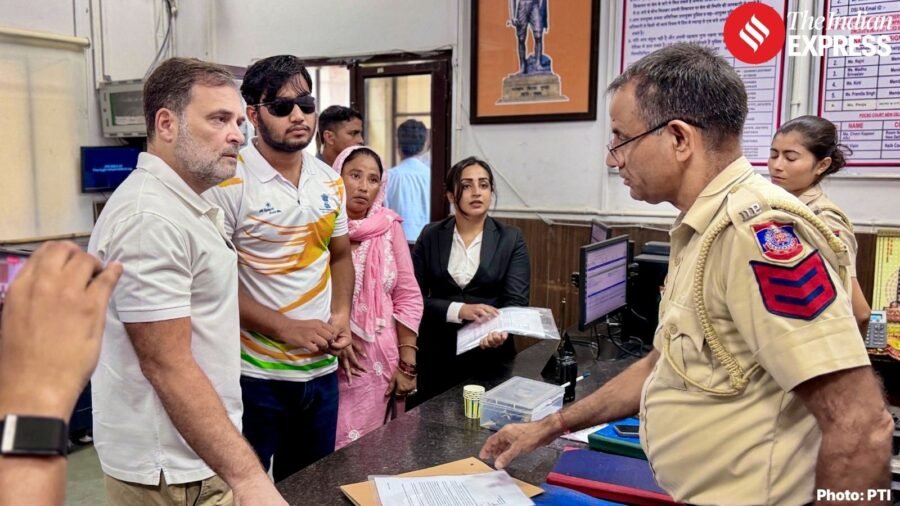
For India’s institutional opposition parties, this episode serves as a wake-up call for our current strategies to mobilise the young, offering us object lessons in modern civic mobilisation. We have all tried to seize the moment, and the stirring sight of Rahul Gandhi accompanying a pellet-gun victim to a police station to demand the filing of an FIR shows that he has heard the call. His current campaign among the youth has seized the national imagination.
The earlier slowness of mainstream opposition parties to tap into this groundswell reveals a persistent blind spot in traditional Indian politics. For over a decade, opposition rhetoric has oscillated primarily between caste-based electoral arithmetic and abstract defences of secular constitutionalism. While both remain crucial axes of political struggle, they missed the immediate, material anxieties of India’s growing middle class and aspiring youth. The young people who filled protest spaces like Jantar Mantar and flooded digital platforms were not animated by high-level political posturing. Instead, they were anguished by a specific breakdown that touched their daily lives: Years of lost educational effort, the mounting financial strain placed on their families by a predatory coaching ecosystem, and a climate of official apathy that routinely dismissed their frustrations as lazy internet outpourings. When traditional leaders attempted to raise these issues, their critiques were largely discounted as standard partisan opportunism, whereas the CJP spoke not as a power-seeking party (in fact, despite its name, it is not a party at all), but as the authentic collective voice of the aggrieved.
Advertisement
At the root of the Opposition’s inability to capture this energy lie severe institutional bottlenecks, particularly the gatekeeping inherent to top-down, quasi-feudal party hierarchies. For an ordinary, talented young person without a political lineage or financial resources, like most in Jantar Mantar, there is no clear path to entering mainstream politics via the Opposition, and even entry through established students’ organisations or youth wings of such parties rarely offers meaningful agency. Young workers in established parties are frequently reduced to staging pre-approved photo opportunities in which they stand behind the entrenched leadership, amplify senior leaders on social media, or supply attendance numbers and logistical muscle for rallies. The top-down “high command” culture in all Opposition parties denies them any substantive role while they are still young and “junior”.
We also must acknowledge the psychological barrier for aspirational youth, who naturally assume their own talents will always be circumscribed by the advantages enjoyed by legacy heirs and entrenched leaders, bearing well-known names and commanding political patronage networks. The CJP bypassed these barriers entirely by lowering the entry threshold to zero, embracing satirical eligibility criteria that “gamified” civic participation, and allowing young citizens to feel like co-creators of a movement rather than mere foot-soldiers. Furthermore, while most opposition parties remained limited by their conventional approaches, public relations processes and hierarchical decision-making, the CJP operated with digital agility, reclaiming an insult and turning it into a badge of honour through cultural fluency and relentless, meme-driven irony.
If India’s Opposition wishes to translate the widespread discontent exposed by this movement into effective political mobilisation, we must undergo fundamental structural and operational change. First, all parties must democratise their internal workings by establishing genuine pathways for young leaders, creating open talent incubators where young organisers and policy researchers are given real decision-making authority based on merit rather than political pedigree.
Second, the Opposition needs to switch from largely abstract slogans or those espousing specific sectoral interests (like caste), toward concrete governance issues that impact the everyday lives of all Indians, grounding our platforms in tangible demands such as strict criminal liability for paper leaks, statutory timelines for public job recruitment, and real economic security for gig workers and students. Congress came closest to this approach during the recent crisis.
Third, rather than attempting to hijack or disparage organic civil-society movements like the CJP, opposition parties should act as force multipliers, offering parliamentary questioning, legal aid, and logistical support without demanding that activists subordinate themselves to, or march under, a specific party banner.
Finally, opposition leaders must abandon over-familiar speeches in favour of a direct, authentic, and culturally resonant language that acknowledges systemic failures without resorting to outdated rhetoric. To their credit, leaders like Rahul Gandhi and Akhilesh Yadav have been doing this increasingly.
The CJP movement demonstrated that India’s youth are far from politically indifferent; they possess an immense reservoir of democratic energy, waiting for outlets that respect their intelligence, reflect their culture, and address their aspirations. Unless established Opposition parties open up hierarchies and adapt to this new reality by providing channels for their energy, future waves of mobilisation will continue to pass us by. It cannot be our epitaph that we became irrelevant because we failed to listen.
The writer is a fourth-term Congress MP (Lok Sabha) from Thiruvananthapuram

Light on truth: on the Tamil Nadu G.O. and RTI
By Sohail Khan · 29 Sep
Tackling food loss and waste — India’s opportunity
By Sohail Khan · 28 Sep
Revisiting the farmer question
By Sohail Khan · 28 Sep