SC reconstitutes bench to hear review pleas challenging 2022 PMLA verdict
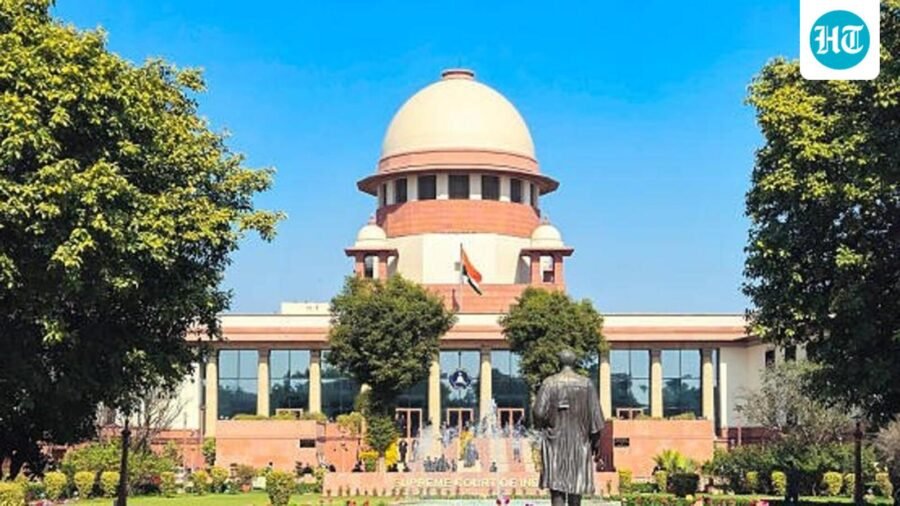
The decision to place the review petitions before the new bench was taken on Thursday after the parties consented to the change in bench composition
Published on: Aug 20, 2026, 14:53:22 IST
Prefer HTon Google
Share via
Copy link
A new three-judge bench of the Supreme Court will hear the review petitions challenging its July 2022 judgment in the Vijay Madanlal Choudhary case, which upheld the constitutional validity of several sweeping powers of the Enforcement Directorate (ED) under the Prevention of Money Laundering Act (PMLA).
The bench will comprise Chief Justice of India Surya Kant and justices Joymalya Bagchi and V Mohana. The decision to place the review petitions before the new bench was taken on Thursday after the parties consented to the change in bench composition.
The matter was earlier listed before a bench comprising CJI Kant and justices Ujjal Bhuyan and N Kotiswar Singh. However, the CJI told the parties that listing the matter before the original bench would require breaking up three other benches as justices Bhuyan and Singh are now sitting on different benches.
“If we list it before the original Bench, then three benches will have to be broken. I have only listed this matter so that your consent can be recorded for the bench allocation,” the CJI said.
Solicitor General Tushar Mehta, appearing for the ED, and senior advocate Kapil Sibal, representing the petitioners, consented to the new composition.
“Owing to the element of urgency, let this matter be heard by a three-judge Bench of this composition, that is, CJI Surya Kant, Justice Joymalya Bagchi and Justice Mohana,” ordered the court, adding that a date for hearing would be fixed.
The review petitions, including one filed by Congress MP Karti P Chidambaram, seek reconsideration of the Supreme Court’s 2022 verdict, which upheld the validity of key provisions of the PMLA dealing with the ED’s powers of arrest, search and seizure, the reverse burden of proof, non-supply of the Enforcement Case Information Report (ECIR) to an accused and stringent conditions for bail.
The petitioners have contended that the judgment significantly diluted constitutional safeguards available to persons facing money-laundering proceedings.
The ED has, however, raised preliminary objections to the maintainability of the review petitions. It has argued that the petitioners have failed to demonstrate any “error apparent on the face of the record” in the 2022 judgment and that the review petitions effectively seek to reopen the case as an appeal, which is impermissible within the limited scope of review jurisdiction.
The agency has also relied on the Supreme Court’s August 25, 2022 order to contend that the review was confined to two aspects of the judgment — the supply of the ECIR and the reverse burden clause relating to bail.
The petitioners, led by senior advocates Sibal and Abhishek Manu Singhvi, have sought reconsideration of a wider set of issues. They have placed before the court a list of 13 questions, including the retrospective application of the PMLA, the classification of ED officials as non-police personnel and the validity of provisions that enable the recording of statements before ED officers which, according to the petitioners, can have the effect of compelling self-incriminating disclosures.
They have argued that the cumulative effect of these provisions undermines fundamental rights and basic requirements of fair procedure.
The question of maintainability is expected to be the first hurdle for the petitioners.
In July 2025, the court had indicated that it would first determine whether the review petitions were maintainable before examining the substantive grounds seeking reconsideration of the Vijay Madanlal Choudhary judgment. The bench had emphasised that review jurisdiction operates within defined parameters and that a party seeking reconsideration of a judgment must first satisfy the court that the case meets those parameters.
The 2022 Vijay Madanlal Choudhary judgment has since become central to the Supreme Court’s jurisprudence on the powers of the ED under the PMLA. Its reconsideration could have significant implications for several contentious aspects of money-laundering investigations, particularly arrest, disclosure of the ECIR, the evidentiary burden on accused persons and the threshold for grant of bail.
See Less



Leave a Reply