Sajjan Kumar dies: What Nanavati Commission said about his role in 1984 riots
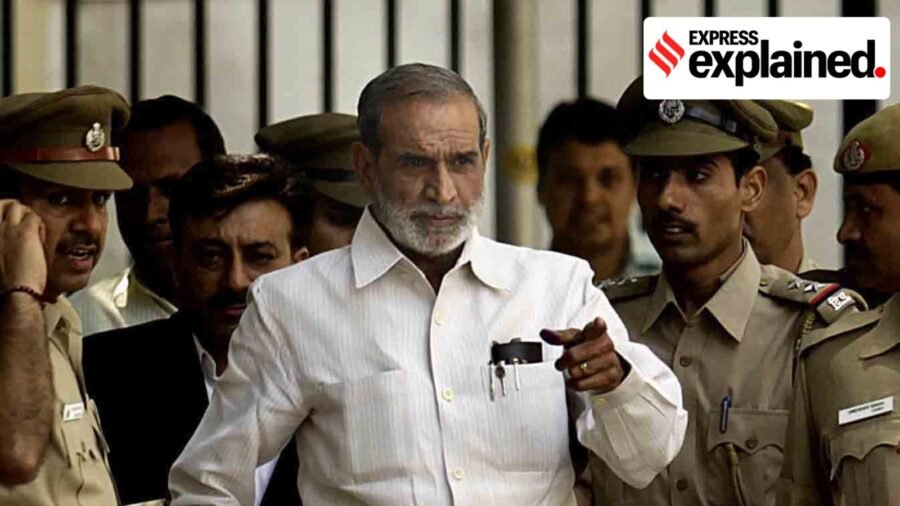
Sajjan Kumar, the former Congress MP convicted in a 1984 anti-Sikh riots case, died at Safdarjung Hospital on Thursday while serving a life sentence. Kumar was convicted in February 2025 by a Delhi court for the murders of Jaswant Singh and his son Tarundeep Singh in Saraswati Vihar on November 1, 1984.
His death came four decades after the violence that followed the assassination of Prime Minister Indira Gandhi on October 31, 1984. The Justice Nanavati Commission of Inquiry, which examined the riots and the failure of the authorities to investigate them, had recorded “credible material” against Kumar and concluded that he was “probably involved” in the attacks described by several witnesses.
The commission’s finding
The report examined affidavits, police records and testimony concerning attacks on Sikhs and their properties across Delhi. It offered one of the most detailed official accounts of allegations against Kumar, describing him as a powerful local Congress leader who was allegedly present at, addressed or directed mobs in parts of west Delhi, including Palam Colony, Raj Nagar, Mangolpuri and Sultanpuri.
A key witness, Jagdish Kaur of Raj Nagar, told the commission that she heard Kumar tell people gathered near Mandir Mangla Puri: “Sardar saala koi nahi bachna chahida (no Sikh should be spared)”.
The commission also recorded evidence that Kumar addressed a crowd in Mangolpuri and said Sikhs had killed “their Maata”, after which people raised slogans calling for Sikhs to be killed. The report said three Sikh men were subsequently burnt alive in an attack on a gurdwara in the locality.
In its assessment of Kumar’s role, it said: “Many witnesses have stated about the involvement of S/Shri Sajjan Kumar, Balwan Khokar, Pratap Singh, Maha Singh and Mohinder Singh.”
Its final conclusion on Kumar and Balwan Khokhar was: “The Commission is, therefore, inclined to take the view that there is credible material against Shri Sajjan Kumar and Shri Balwan Khokhar for recording a finding that he and Shri Balwan Khokhar were probably involved as alleged by the witnesses.”
Story continues below this ad
The commission did not merely rely only on allegations but considered evidence of mobs moving through neighbourhoods, the availability of petrol and kerosene, the use of buses to transport people and the involvement of local Congress workers.
The commission recommended that authorities examine cases in which Kumar had been named by witnesses but had not been chargesheeted, or cases that had been closed as untraced.
Accounts from Palam Colony
A significant portion of the report concerned the Delhi Cantonment police station area, which included Palam Colony, Raj Nagar, Sadh Nagar, Sagarpur and Mahavir Enclave. The commission recorded that the area was among the worst affected during the riots.
It cited police records showing that 246 Sikhs were killed in the area between October 31 and November 5, 1984. It also referred to other estimates, including the Ahuja Committee’s figure of 341 deaths. According to the report, six gurdwaras, 385 houses, 110 shops and 45 vehicles were burnt in the area.
Story continues below this ad
The commission said the police had recorded only five FIRs despite the scale of the violence.
Sudershan Singh, a resident of Raj Nagar in Palam Colony who described attacks on Sikh homes in the locality, told the commission that Kumar was seen near a mob and was supervising the operation. Singh also said Kumar was giving directions to Balwan Khokhar.
The commission recorded a more direct allegation from Amarjit Kaur, a resident of Chand Nagar. She said Kumar led the mob that killed her husband, Captain Nazar Singh Mangat, by burning him alive.
Evidence from Mangolpuri
The report separately examined allegations from Mangolpuri, where violence continued over several days.
Story continues below this ad
Niranjan Singh, a resident of Mangolpuri, filed an affidavit stating that Kumar, his personal assistant Hardwari Lal, Hardwari Lal’s two sons and a hotel worker came to the G-Block gurdwara. According to the affidavit, the Guru Granth Sahib was burnt and the gurdwara was then set on fire.
The commission said Harnam Singh also filed an affidavit regarding the attack. His account, as recorded in the report, attributed the leadership of the mob to Hardwari Lal and alleged that his two sons participated in looting the gurdwara and setting it on fire.
Allegations from Sultanpuri
Sultanpuri was another area where the report recorded allegations against Kumar. The report said Kumar had addressed a meeting of Congress workers and allegedly made statements blaming Sikhs for the assassination. It recommended that the cases connected with the witnesses’ allegations be examined again.
The commission also cited the evidence of Didar Singh, who alleged that Kumar had called a meeting of Congress workers from Patiala and Nawada villages. This evidence was considered in connection with a Mangolpuri case in which, according to the report, no chargesheet had been filed against Kumar.
The police investigation
Story continues below this ad
Kumar’s defence before the commission relied heavily on his acquittals in criminal cases. In his reply to the commission’s notice, he argued that witnesses who had filed affidavits had either not named him before the police or had not supported the allegations in court. He also produced judgments in eight cases and said that he and Balwan Khokhar had been acquitted.
The commission, however, said those acquittals could not by themselves prevent it from assessing the wider material before it. It observed that the inquiry had uncovered evidence of poor investigation, non-registration of complaints and failure to record the names of influential alleged assailants.
“There is ample material to show that no proper investigation was done by the police even in those cases which were registered by them,” the commission said.
The report said victims were often asked to provide details of looted or burnt property but were not given a proper opportunity to name the attackers. It also said many complaints were not registered, eyewitnesses were not examined, and the names of alleged assailants were omitted from statements and chargesheets.
Story continues below this ad
“One witness has specifically stated that he had named Shri Sajjan Kumar as one of the assailants yet his name was not noted in his statement by the police,” it said.
“Why so many persons had named him and attributed acts like addressing meetings and inciting people to kill Sikhs and to loot and destroy their properties remains unexplained by Shri Sajjan Kumar,” it added.
The commission said the failure to properly investigate allegations against influential political figures had contributed to the collapse of cases and made it impossible to assess the evidence through a fair criminal trial at the time.
From inquiry to conviction
For decades, the 1984 riots remained associated with the gap between the scale of the violence and the limited number of convictions. The Nanavati report’s account of Kumar’s role was central to that history: it preserved allegations that had not initially been properly investigated and formally recommended that some of those cases be reopened.
Story continues below this ad
Kumar’s later conviction came in a separate criminal prosecution. In February 2025, a Delhi court convicted him for the murders of Jaswant Singh and his son Tarundeep Singh in Saraswati Vihar during the 1984 riots and sentenced him to life imprisonment.

Malaika Arora, 52, reveals a dietary staple she refuses to skip: ‘I can’t have salads’
By Sohail Khan · 28 Sep
A smoke and mirrors summit in which Xi emerged with the upper hand
By Sohail Khan · 28 Sep
Why must a woman always trade curiosity about the world for safety?
By Sohail Khan · 28 Sep