Parandur project dropped by Vijay govt: What now for Chennai’s second airport?

Amid a slew of announcements, Tamil Nadu Chief Minister C Joseph Vijay said in the state Assembly on Monday (August 24) that Chennai’s proposed second airport at Parandur had been dropped. “Works are underway to identify an alternative site,” he said.
The site, located in Kancheepuram district and approximately 68.5 km from the heart of Chennai, was announced in August 2022 by the previous M K Stalin-led Dravida Munnetra Kazhagam (DMK) government. It had led to protests by villagers and farmers living in and around the proposed site, which continued for months on end.
Former CM Stalin, in a post on X, called the announcement “an irreversible setback for Tamil Nadu’s growth”. “Tamil Nadu’s interests cannot be mortgaged for petty political considerations…. Taken without foresight, planning or consultation, this decision by the TVK government is a devastating blow to the employment dreams of Tamil Nadu’s youth,” he said.
Story continues below this ad
So, how was Parandur chosen as the site for Chennai’s second airport, why did residents protest against the government’s decision, and where does the project stand after Vijay’s latest announcement? We explain.
Chennai’s second airport
The search began as early as 1999, with the state government identifying and approving a potential 4,000-acre site near Sriperumbudur — an industrial hub located some 40 km from Chennai in Kancheepuram district — in 2007. Although successive governments considered different locations over the years, no progress was made in terms of construction.
The proposal gained pace when the DMK formed the government in 2021. By then, the Sriperumbudur proposal had been shelved owing to the government unable to acquire the required amount of land, made more difficult after the 2013 land acquisition law raised compensation and rehabilitation requirements.
This time round, four locations were shortlisted — Padalam, Pannur, Parandur, and Tiruporur — of which Parandur was eventually chosen by the Union Ministry of Civil Aviation in 2022 after clearances from both the Centre and the Airports Authority of India. Its proximity to the industrial belt along the Chennai-Bengaluru highway was cited as a factor.
Story continues below this ad
“The site was carefully selected after evaluating all available alternatives, and the land acquisition process has been almost completed. With several stages of preparatory work and approvals already completed, we had drawn up plans to ensure that construction could begin at a rapid pace once we returned to office. If the new government now starts all over again, identifies another location and goes through the entire process before work can even begin, Tamil Nadu’s growth trajectory itself will DROP,” Stalin said on X.
As to questions over whether Chennai even needs a second airport, state governments in Tamil Nadu have maintained that there’s a need for additional capacity with growing passenger and cargo traffic, besides various industries being dependent on air connectivity. Industry and real estate bodies have also concurred on the medium- to long-term need for a second airport even as they support expanding the existing airport’s infrastructure. Earlier this month, P Ravichandran, deputy chairman of the Confederation of Indian Industry – Southern Region, said that Chennai will need a second airport within five to 10 years to support the city’s economic growth and its emergence as a major global manufacturing hub.
Proposed site at Parandur, the protests that followed
The project was planned as a greenfield airport, meaning that a new airport was to be built from scratch on previously undeveloped or agricultural land where no prior aviation infrastructure existed.
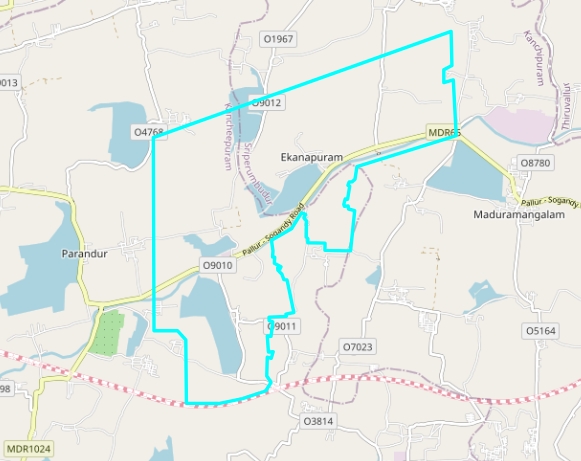 Boundary map of the proposed Parandur airport site.
The new airport was to be developed over 5,746 acres across 13 villages, with the estimated cost being Rs 29,144 crore. Construction was planned and slated to be completed in four phases. Projects such as an air freight village, widening and construction of road corridors, and a new Metro line connecting Chennai’s western suburbs to the proposed airport were also in the pipeline.
Story continues below this ad
The announcement in August 2022 evoked protests almost immediately, with residents claiming that fertile agricultural tracts would be impacted. According to them, the issue was more of displacement rather than compensation as entire villages would have to be relocated.
Ekanapuram, a village of 1,500-2,000 residents in Kancheepuram district that lay on the proposed runway, became the centre of the protests. Environmental activists also argued that the new airport would affect water bodies and wetlands across the lands to be acquired. Although the state government offered compensation at 3.5 times the market value of the land and promised resettlement houses to displaced families, the protests continued for close to four years.
In January 2025, Vijay also marked his first major on-ground protest for his fledgling party Tamilaga Vettri Kazhagam (TVK) against the then incumbent DMK government, siding with the residents of Parandur and neighbouring villages in demanding that the airport site be shifted elsewhere. Although he stressed the need for a second airport, Vijay turned this demand for relocation into an election promise.
What next
With Monday’s announcement, Vijay seems to have fulfilled one of his earliest and most politically consequential promises. “The location selected for establishing the new airport must be one that does not affect farmers on a large scale and does not require the removal of a large number of residential settlements,” he said.
Story continues below this ad
To bridge the years before an alternative airport can be built, Vijay announced that the existing Chennai airport would be expanded substantially. The TVK-led government will work with the AAI to develop a new Terminal 5 in the north-western section of Meenambakkam, capable of handling an additional 20 million passengers annually, along with an access road and flyover. The CM said that once the ongoing Terminal 3 work is completed, the airport’s annual capacity would rise to 35 million passengers — with Terminal 5, it would eventually rise to 55 million passengers a year.
In the meantime, all stakeholders remain on the same page in terms of building a second airport. But any new location would need to meet the same set of challenges: proximity and connectivity to road and railway lines, speedy land acquisition, minimal displacement, and securing necessary environmental approvals.

‘What’s for lunch when your restaurant is travelling at 28,000 km/h?’
By Sohail Khan · 28 Sep
How South Africa’s new exchangeable pitches could shape the 2027 Cricket World Cup
By Sohail Khan · 28 Sep
The mindset shift Virat Kohli is talking about: ‘Promised myself…to play more freely’
By Sohail Khan · 28 Sep