NRI life insurance: Buy in India or abroad?
Synopsis
NRIs can buy life insurance in India to protect financial obligations. Additional KYC and underwriting requirements apply for non-resident Indians. Premiums are paid through NRE, NRO, or FCNR accounts, and currency fluctuations matter. Country of residence impacts premiums and underwriting due to risk assessments. The location of financial responsibilities guides the decision for buying insurance.
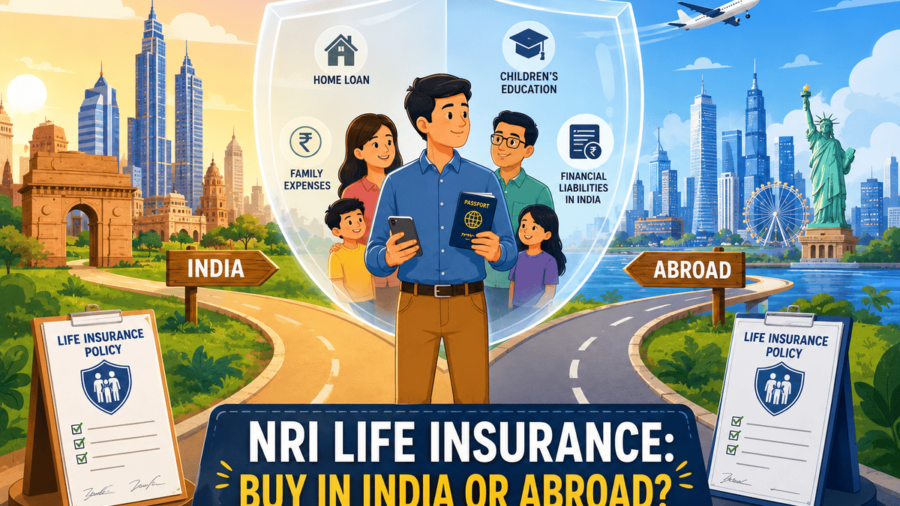
If you are an NRI with major financial liabilities in India, buying a life insurance policy here can be an effective way of protecting those obligations. Indian insurers allow NRIs to buy life insurance, but the process involves additional KYC, underwriting and payment requirements compared with resident Indians.
Here is what NRIs should know before buying a life insurance policy in India.
NRIs can buy life insurance in India, but additional documentation may be required
NRIs can purchase life insurance in India, subject to applicable regulations and the insurer's underwriting guidelines.
“The process is broadly similar to that for resident Indians, with additional KYC requirements such as proof of overseas residence, passport, TIN/SSN and income details, where applicable,” says Kamlesh Rao, MD & CEO, Aditya Birla Sun Life Insurance.
Depending on the insurer and the applicant's profile, additional documentation can include a passport, overseas address proof, FATCA/CRS declarations and a standard NRI questionnaire.
The insurer may also ask for details about the applicant's occupation, country of residence and source of income, particularly when a high sum assured is sought.
Buying an NRI term plan can even be done remotely
An NRI does not necessarily have to travel to India to complete the entire purchase process.
Many insurers now offer digital application journeys and, in some cases, virtual tele-medical examinations through video calls.
“Some insurers let you complete the whole thing remotely from abroad, while others prefer you do it in person during a visit to India,” says Sarita Joshi, Head of Health and Life Insurance, Probus.
Whether a medical examination can be completed remotely depends on the insurer, the applicant's country of residence, age, health profile and the sum assured being sought.
“Premiums usually get paid through NRE, NRO, or FCNR accounts or other approved channels, and since the policy is issued in rupees, it's worth thinking through how currency fluctuations might affect things over the years,” explains Joshi.
NRIs should also remember that an Indian policy is generally denominated in rupees unless a foreign-currency policy is specifically offered. This makes the impact of exchange-rate movements an important consideration when planning long-term premiums and future financial needs.
Does the NRI’s country of residence affect premiums and underwriting?
The country where an NRI lives can influence the underwriting process and, depending on the insurer, the premium, medical requirements, sum assured or availability of cover.
“Insurers evaluate country-specific considerations such as geopolitical stability, healthcare standards, occupation-related risks, and local regulations, which may influence medical requirements, premium rates, acceptance terms, or available coverage,” says Rajesh Krishnan, Chief Operations & Customer Experience Officer, Bajaj Life Insurance.
According to Joshi, underwriters officially classify countries into different risk zones (ranging from Zone 1 to Zone 4). They look at the general risk profile of the country you're based in, your occupation, local political stability, and how good the regional medical infrastructure is.
For example, someone in a stable office job in a low-risk country (Zone 1) will sail through underwriting. On the other hand, living in a high-risk zone or having a high-stakes job like oil rig engineering could lead to automatic premium increases, reduced coverage limits, or even the insurer deciding to defer or deny coverage for that particular profile.
Therefore, two NRIs living in the same country can still receive different quotes or underwriting decisions based on their age, health, occupation, income, and other risk factors.
Indian life insurance can be cheaper, but there are trade-offs
Affordability is one of the main reasons NRIs consider buying life insurance in India.
Policybazaar’s analysis has found Indian life insurance protection plans for NRIs to be around 50–60% more affordable than international term plans in some markets, although the actual difference varies by country and individual profile.
According to Vivek Jain, CBO of Life Insurance at Policybazaar, there are several other compelling advantages.
First is the ability to protect financial commitments in India. Many NRIs continue to have parents, spouses or children in India, home loans, property or other liabilities here. An Indian life insurance protection plan can provide a straightforward financial safety net for these responsibilities.
Second is the quantum of cover available at an affordable price. Because term insurance is a pure protection product, a customer can secure a substantial sum assured without having to commit a large portion of their income towards premiums.
Third is convenience. Digital purchase journeys, online documentation and tele/video medicals have made it possible for NRIs to buy Indian life insurance protection plans without necessarily travelling to India.
Additionally, following recent landmark tax reforms, all individual life insurance policies in India now attract 0% GST, completely removing the previous 18% tax burden for both residents and NRIs alike, explains Joshi.
This is a massive cost advantage if most of your liabilities like family, property, or loans are still based in India.
However, NRIs should not choose an Indian policy solely because the premium is cheaper. Currency movements, tax treatment in the country of residence, claim procedures and the location of the family's financial needs also matter.
When does it make more sense for an NRI to buy life insurance in India?
The location of the NRI's financial responsibilities should be one of the biggest factors in deciding where to buy life insurance.
If the NRI's parents, spouse or children live in India, or if the individual has a home loan, property or other major liabilities here, an India-based life plan may provide a better fit.
“Conversely, if the NRI’s family and financial commitments are predominantly in the country of residence, particularly where expenses and liabilities are in a foreign currency, a local policy may provide better alignment with those needs,” says Rao.
The decision should therefore be based on where the financial obligation ultimately sits, rather than simply where the NRI earns their income, he adds.
For those with financial responsibilities in both countries, a combination of policies may provide more comprehensive protection.
The key is to buy enough cover for the family's actual financial needs and compare the complete cost, underwriting terms, currency implications, and claim process, not just the headline premium.
(Join our ETWealth WhatsApp channel for all the latest updates)
Add 

(Catch all the Personal Finance News, Breaking News, Budget 2025 Events and Latest News Updates on The .)
…more

BRICS bets on diverse energy mix, critical minerals
By Sohail Khan · 12 Sep
BRICS pushes cheaper cross-border payments
By Sohail Khan · 12 Sep
Canada disability benefit supplement coming soon
By Sohail Khan · 12 Sep