Mohan Bhagwat’s NYC visit is about power, not culture
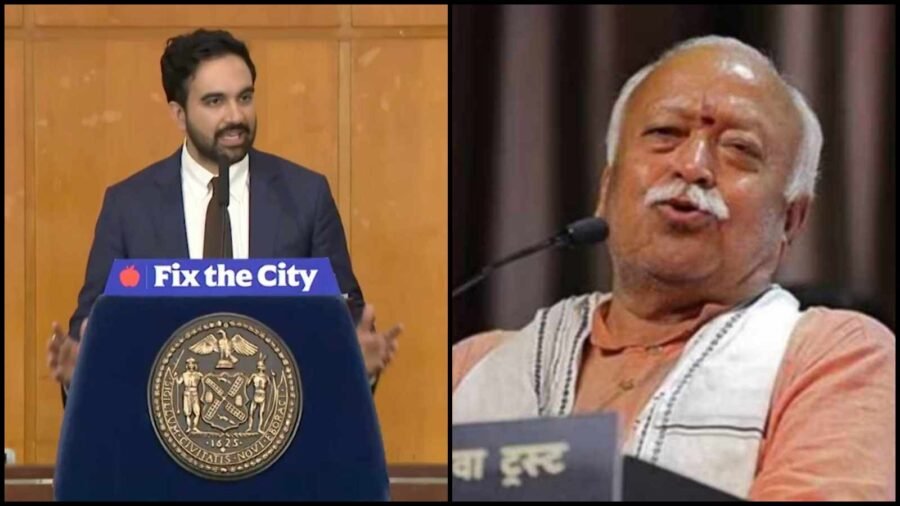
When Mohan Bhagwat, chief of the Rashtriya Swayamsevak Sangh (RSS), arrives in New York this week, he will walk into a diaspora landscape that is no longer politely indifferent. The United States Commission on International Religious Freedom (USCIRF) has already urged Washington to deny Bhagwat diplomatic courtesies and consider sanctions against RSS members for alleged violations of religious freedom in India. India’s government dismissed this as “biased,” but the criticism inside the US has been unusually sharp. New York City Mayor Zohran Mamdani has publicly opposed the Madison Square Garden event, calling the RSS’s ideology “exclusionary” and incompatible with the pluralistic India he grew up believing in. BJP leaders immediately accused him of “divisiveness,” but Mamdani’s stance reflects something deeper: A growing refusal among South Asian Americans to treat Hindutva as harmless cultural pride.
I feel that shift personally. I have signed petitions over this upcoming visit from Hindus for Human Rights, the Indian American Muslim Council, interfaith groups, civil rights organisations as well as my own India Coalition, a small yet nimble forum of like-minded South Asians who want to see the pluralistic India not get eroded. The opposition is not fringe. It is broad, multiracial, and morally clear-eyed.
And then there is the truck.
Advertisement
For days, a mobile billboard has been circling Manhattan with a blunt message in giant red letters: “RSS Killed Gandhi.” The truck is a reminder that the RSS’s ideological project has always been entangled with violence, exclusion, and a particular vision of India that treats minorities as permanent suspects. It is also a reminder that diaspora silence is not neutrality — it is complicity.
The RSS has spent decades cultivating the Indian diaspora, but the US is its most valuable territory. Wealthy, professionally successful, politically connected — Indian Americans are ideal donors and amplifiers for a movement that thrives on the language of civilisational pride. Various smaller outposts have cropped up in the past 10 years, apart from the known ones (like SEVA). The Coalition of Hindus of North America (CoHNA), a grassroots “advocacy” group is one such organisation that hosts events and conducts campaigns to educate and empower Hindus and combat “Hinduphobia”. Its youth wing, CoHNA Youth Action Network (CYAN), quietly and silently takes up the RSS “community” work of outreach into local legislators as well as at the Federal level. School boards, city councils, and state legislatures have already seen coordinated pushes for “Hinduphobia” resolutions. The goal isn’t safety. It’s legitimacy.
Bhagwat’s tour is part of the RSS’s centenary year global outreach, and the US leg is the centerpiece. The Madison Square Garden event is being organised by the American Hindus for Engagement and Dialogue (AHEAD) Forum.
Advertisement
The Manufactured Crisis of ‘Hinduphobia’
One of the clearest signs of Hindutva’s growing influence in the US is the campaign to institutionalise “Hinduphobia” as a recognised category of hate crime. Hindus are already protected under US civil rights law. What this campaign seeks is something different: A way to equate criticism of Hindutva with bigotry, to chill academic freedom, and to sanitise the RSS’s reputation in American institutions. It mirrors the RSS’s domestic strategy in India — reframing political dissent as a civilisational threat.
Organisations like Hindus for Human Rights and the India Coalition have pushed back, arguing that the term is being weaponised to suppress legitimate criticism of majoritarian politics. Their resistance matters, because the stakes are not academic. They are about whether American civic spaces — school boards, city councils, state legislatures — will become unwitting extensions of India’s culture war machinery.
The Diaspora’s Responsibility
The American story of the Indian diaspora is often told as one of upward mobility and professional excellence. But there is a quieter story, one of political export. Many Indian Americans, especially those who embrace the “model minority” narrative, have shown indifference toward the daily humiliations faced by Muslims and Christians in India. Bulldozed homes, arbitrary detentions, lynchings — these realities have been easy to ignore from the safety of American suburbia. But when these horrors come nearer home to bite, the diaspora is surprised and anguished.
It is indeed ironic that the US is no longer immune to the politics of suspicion. In recent years, brown residents have been stopped, questioned, and asked for identification and immigration status — a reminder that the model minority myth offers no protection when the state decides to see you as foreign. A case in point is the infamous “Metro Surge” that happened earlier this year in my city of Minneapolis and its suburbs. My community mobilisation action started during those dark months, helping several Indian students as well as residents who were caught in the quagmire of brute force vs their civil rights.
These moments should have prompted introspection. Instead, many diaspora organisations have doubled down on Hindutva politics, pouring money into groups that promote exclusionary narratives in India while demanding special recognition for “Hinduphobia” in America.
Why Bhagwat’s Visit Matters for America
Bhagwat’s tour is not a cultural celebration. It is a political intervention. It aims to be the equivalent to the formidable American Israel Public Affairs Committee (AIPAC) influence on American policies and legislatures. It signals the RSS’s ambition to normalise its ideology in Western democracies, cultivate diaspora influence, and frame Hindutva as a legitimate civilisational project rather than a majoritarian one. The USCIRF’s recommendations — asset freezes, visa restrictions, denial of diplomatic courtesies — reflect a growing recognition that the RSS’s influence abroad is not benign. Mamdani’s opposition reflects another truth: That American cities, with their pluralistic ethos, cannot afford to host political movements that undermine pluralism elsewhere.
The Choice Before the Diaspora
Bhagwat’s visit is a mirror held up to America’s Indian diaspora. It reflects both the power they wield and the responsibility they have avoided. It reveals how easily patriotism can be weaponised, how nostalgia can be manipulated, and how diaspora influence can be mobilised for political ends far from home.
Democracy erodes quietly, often through gestures that seem harmless. Bhagwat’s visit is one such gesture. It deserves scrutiny, not celebration.
Singh is a writer and community organiser, living in the US for the last 27 years
Light on truth: on the Tamil Nadu G.O. and RTI
By Sohail Khan · 29 Sep
Tackling food loss and waste — India’s opportunity
By Sohail Khan · 28 Sep
Revisiting the farmer question
By Sohail Khan · 28 Sep