Lindsay Clancy case: What is postpartum psychosis — and can it drive a mother to kill her children?

The trial of Massachusetts mother Lindsay Clancy, accused of killing her three young children in January 2023, is approaching its close, with the defence resting its arguments on Friday (August 21).
Over the past month, her defence has claimed that Clancy, 36, was suffering from postpartum psychosis, a rare and severe psychiatric condition that can occur after childbirth. The prosecution, on the other hand, claims that Clancy “knew exactly what she was doing” and made a “calculated” decision to kill her three children.
The high-profile trial has raised questions about what postpartum psychosis is, how it can affect a person’s behaviour, and whether it can affect criminal responsibility for killing one’s children.
Story continues below this ad
What is postpartum psychosis? What can it do to a person’s state of mind?
“A most basic description of psychosis is that someone is out of touch with reality,” Susan Hatters-Friedman, forensic and reproductive psychiatrist at Case Western University, told .
Postpartum psychosis is a state in which mothers who have recently given birth may experience delusions, hallucinations, irritable or depressed mood, insomnia, and confusional states, she added. “Postpartum psychosis tends to come on quickly as opposed to over weeks to months. And postpartum psychosis symptoms wax and wane.”
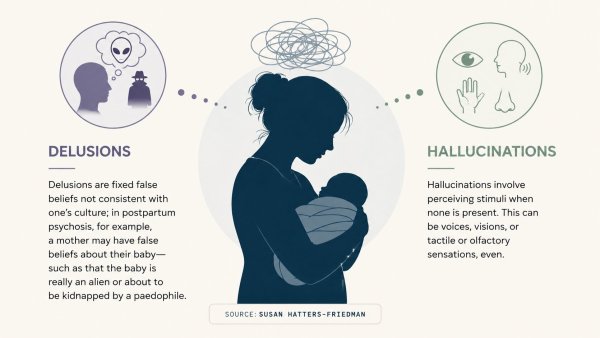
Hatters-Friedman contrasts this with postpartum depression, saying it is “much more common than postpartum psychosis, fortunately.” In postpartum depression, mothers experience symptoms of depression such as depressed mood, loss of enjoyment in activities, difficulty with focus, energy, sleep, and appetite, for example.
Clancy’s symptoms have been described in court as including hallucinations and delusions, which began after the birth of her third child. Her ex-husband, Patrick, testified Clancy had become “very depressed” after giving birth, and her mental health only got “worse and worse”, saying the month before the children’s deaths “was really where her big spiral started”.
Story continues below this ad
But psychosis does not necessarily mean that a person appears disorganised at all times. “A lot of it comes down to how organised the person’s mind is in their state of psychosis — in any psychotic disorder (also such as schizophrenia). For example, someone could still be hearing voices and experiencing delusions, but be able to plan behaviour,” Hatters-Friedman told . With postpartum psychosis, she added, there may be periods of organised thinking alongside periods of less organised thought.
Hatters-Friedman also referred to the five-point framework introduced by Dr Phillip Resnick in the 1960s for mothers killing their children. She said that, in her research and forensic experience, the “altruistic” and “acutely psychotic” motives are the two most commonly found among mothers who are legally insane.
However, a postpartum psychosis diagnosis is not synonymous with violence.
When does postpartum psychosis become legally relevant?
A postpartum diagnosis does not automatically imply that a person is legally insane or not criminally responsible. In Massachusetts, the legal question is whether a defendant is criminally responsible, under what is commonly referred to as the insanity defence. Under state law, “mental disease or defect” is itself a legal term and does not have to correspond to a formal medical diagnosis.
Story continues below this ad
“Particularly relevant in legal insanity evaluations are whether they were experiencing hallucinations or delusions — signs that the person was out of touch with reality at the time of their offending,” Hatters-Friedman told .
The question is what effect the illness had on the person at the time of the offence.
In Massachusetts, the burden of proving criminal responsibility rests with the prosecution, which must prove “beyond a reasonable doubt” that the defendant was criminally responsible at the time of the alleged offence. The defendant has no burden to prove that they lacked criminal responsibility. Under the state’s standard, the prosecution must establish either that the defendant did not have a mental disease or defect at the time of the alleged offence, or that, despite having one, the defendant retained the substantial capacity to appreciate the wrongfulness or criminality of their conduct and to conform their conduct to the requirements of the law.
“So, it is not that we as a society are finding anyone not criminally responsible merely because of having a mental illness — it is about the specific effects of the mental illness,” Hatters-Friedman told .
Story continues below this ad
As Hatters-Friedman noted, a person can be experiencing hallucinations and delusions while still being able to plan apparently purposeful behaviour, including planning or concealment. The fluctuating nature of postpartum psychosis can also mean that organised and less organised thinking occur at different times.
The difficulty is that the court is assessing a person’s state of mind after the fact. Psychiatric experts can offer opinions on whether a defendant was experiencing psychosis and how it may have affected them, but the jury ultimately decides whether the prosecution has proven criminal responsibility.
In Clancy’s case, the jury will therefore have to weigh evidence of her mental illness alongside evidence of her actions and behaviour, and decide whether the prosecution has met the legal standard for criminal responsibility.
What happens if someone is found not criminally responsible?
A finding of lack of criminal responsibility does not imply an ordinary acquittal followed by release. Under Massachusetts law, a person found not guilty by reason of mental illness or mental defect may first be ordered to undergo up to 40 days of observation and examination.
Story continues below this ad
The state may then seek a commitment order, initially for up to six months, with further periods of commitment possible if the statutory requirements are met and subject to legal review.
“The issue is not so much about fitting into legal frameworks—the issue is a lack of knowledge by many people about postpartum psychosis,” Hatters-Friedman said. “If the court, and the jury, understand that postpartum psychosis is a mental illness, then legal insanity criteria may be met just as it may be met with another mental illness.”

Microplastics in bottled water: What 240,000 particles per litre means for your health
By Sohail Khan · 28 Sep
Women’s safety falls through the gap between intention and policy
By Sohail Khan · 28 Sep
Give India’s poor cash. But don’t stop there
By Sohail Khan · 28 Sep