Kharge ‘purification’ row : How the ‘shuddhi’ practice started, evolved
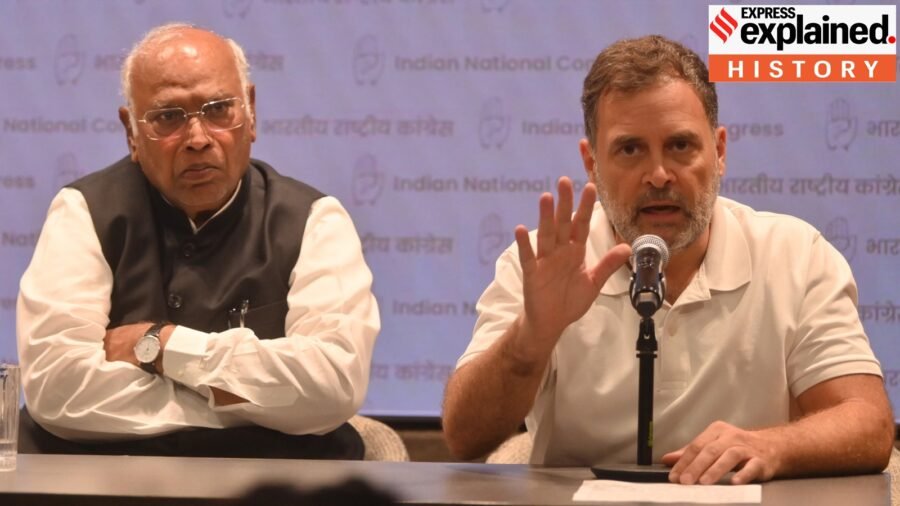
Leader of the Opposition Rahul Gandhi on Saturday attacked the Uttarakhand government and the BJP over the “shuddhikaran” (purification) of the Ramlila Maidan at Haldwani after Congress president Mallikarjun Kharge’s speech, charging that this was an instance of “untouchability”.
This brought into focus the idea of shuddhi (purity) that is more than a century old, and has been influential since the late 19th century. However, its meaning has changed with time, and now the word is sometimes used in a pejorative sense.
The word ‘shuddhi’ was popularised by the Arya Samaj, an influential movement in parts of north India from the late 19th century.
Story continues below this ad
The British began counting caste since 1872 — the first complete census was in 1881 — and gradually numbers became important in the emerging mass politics of the late 19th and 20th centuries. While people assessed the numerical strength of communities through their everyday experiences, the census provided a sense of the demographic weight of castes and communities.
India was periodised by the British as Hindu India (ancient India), Muslim India (medieval India) and British India (modern India). Significantly, modern India was not labelled Christian India, as the British were framed as “secular”, unlike previous rulers of India who were seen as primarily Hindu or Muslim.
The census exercise raised concerns of conversion of Hindus, as loss of numbers were seen as loss of community power. What compounded the problem was that while Islam and Christianity accepted and encouraged conversion, Hinduism had no conversion mechanism.
The Arya Samaj —particularly one Arya leader, Munshiram, a Khatri from Punjab who took Sanyas and became Swami Shraddhanand — devised shuddhi (purification) as a means to convert people from other religions.
Story continues below this ad
In Shraddhanand’s biography, academic JTF Jordens noted that the Swami met Colonel UN Mukherjee in Calcutta in 1912, where Mukherjee told him about his 1909 book Hindus: A Dying Race, in which he argued, using census data, that “within the next 420 years, the Indo-Aryan race would be wiped off the face of the earth unless steps were taken to save it”.
The fact that Christians were numerically growing from their extremely small base sparked such concern in Shraddhanand that he withdrew his daughter from a missionary school — she had told him that the teachers used to propagate Christianity to the students — and started a girls’ school in Jullundhur in 1886, writes JTF Jordens.
While individual shuddhis began to bolster Hindu numbers, these soon turned into mass shuddhis due to the fear that Dalits, facing the stigma of untouchability, would choose other religions instead of Hinduism. The shuddhi ritual required the partaking of Panchgavya — the five products of the cow, meaning milk, curd, ghee, urine, and dung.
The Shuddhi movement led to much unease among Muslims, Christians and even Sikhs. Punjab Congressman Dr Saifuddin Kitchlew set up the Jamiat-i-Tanzim movement in 1923 mainly to counter the Arya Samaj. Tabligh (conversion) movements also came up as a counter to shuddhi. Jamiat-i-Divaat-o-Tabligh was formed in Sialkot to counter the Arya Samaj’s outreach to the leather-working Dalit caste of Sialkot district. Sharpened community competition began through newspapers and journals in Punjab, something that made American historian Gerald Barrier coin the terms Hindu Press and Muslim Press in his book The Punjab Press.
Story continues below this ad
By the early 20th century, the Hindu orthodoxy began to join hands with the Arya Samaj, forgetting doctrinal differences in order to combat conversion. The Aryas also began to regard themselves as Hindus rather than a distinct group.
This convergence was visible in the Shuddhi of the Malkhans of Mathura and Farrukhabad in Uttar Pradesh — they were believed to be Rajputs converted to Islam, but had retained many of their Hindu practices in 1923, when they were “reconverted” to Hinduism.
The Shuddhi movement also became a cause for differences between Hindus and Sikhs in Punjab. The shuddhis of the Rahtias — outcaste Sikhs who were weavers — in 1900 by the Aryas led to unease among Sikhs. The reasons: one, a section of their community was being ‘converted’ and, two, the public ceremony entailed tonsure of the head, which the Sikhs found offensive.
Mass Shuddhis were often attempts to embrace the Depressed Classes in order to retain them as Hindus. Though there were constant orthodox currents seeking to retain caste privileges, a section of the Arya Samaj — called the Mahatma Party with the Jullundur Samaj as its nerve centre under Shraddhanand — sought to perform mass Shuddhis of “untouchables” in order to rid them of untouchability.
Story continues below this ad
The Aryas also opened schools for “low caste” children – and the Aad Dharm movement of Punjab, which broke with the Arya Samaj, was started by Dalits who were products of the Arya Samaj schools.
However, the birth of the Aad Dharm itself showed that there were limits to Shuddhi. Many Dalits educated in Arya Samaj schools broke away, saying they distrusted a group that saw itself as Aryan. The Aad Dharm saw Dalits as the “original” (Adi) inhabitants of India, who were subdued by invading Aryans, and 4,18, 789 of them enumerated themselves as a community different from Hindus in the 1931 census.
Much later, in 1976, Swami Agnivesh, an Arya who gradually got sidelined in the organisation, criticised the Shuddhi movement in his book Arya Samaj – Kya kare, kidhar jaaye written in jail during the Emergency. He questioned Shraddhanad on the idea of purification, wondering whether “purifying” people meant that they were “impure”? He also wondered why idol-worshipping Hindus were not purified, since the Aryas did not believe in idol worship.
From Shuddhi to Ghar Wapasi
As the Arya Samaj gradually lost strength, the RSS took up the work of preventing conversion, particularly in tribal belts of central India. In 1952, the Vanavasi Kalyan Ashram was set up in Jashpur in today’s Chhattisgarh. The organisation’s insiders claim that it was Congress Chief Minister of Central Provinces and Berar Ravi Shankar Shukla who invited the RSS, as he was irked when Christian groups showed him black flags.
Story continues below this ad
The Ashram has been countering the Church through Ghar Wapasi (homecoming) — it got immense help from the late BJP leader and local Raja Dilip Singh Judev, who would wash the feet of Christian tribals and bring them back to the Hindu fold — and welfare activities. Chief Minister of Chattisgarh Vishnu Deo Sai also has a background in the Vanavasi Kalyan Ashram.
Interestingly, the word Vanvasi (forest dweller) was originally preferred to Adivasi (original inhabitant) by the Sangh Parivar to insist that all Hindus are “original inhabitants” of India. The word Adivasi, they felt, is taken from the Aryan invasion or migration theories. However, in recent years, BJP leaders have begun to use the word Adivasi or Janjati, as Vanvasi may have pejorative connotations.
Light on truth: on the Tamil Nadu G.O. and RTI
By Sohail Khan · 29 Sep
Tackling food loss and waste — India’s opportunity
By Sohail Khan · 28 Sep
Revisiting the farmer question
By Sohail Khan · 28 Sep