Kangana Ranaut flaunts her ‘first Meghalaya sari’: ‘Took almost 2.5 months to get woven’
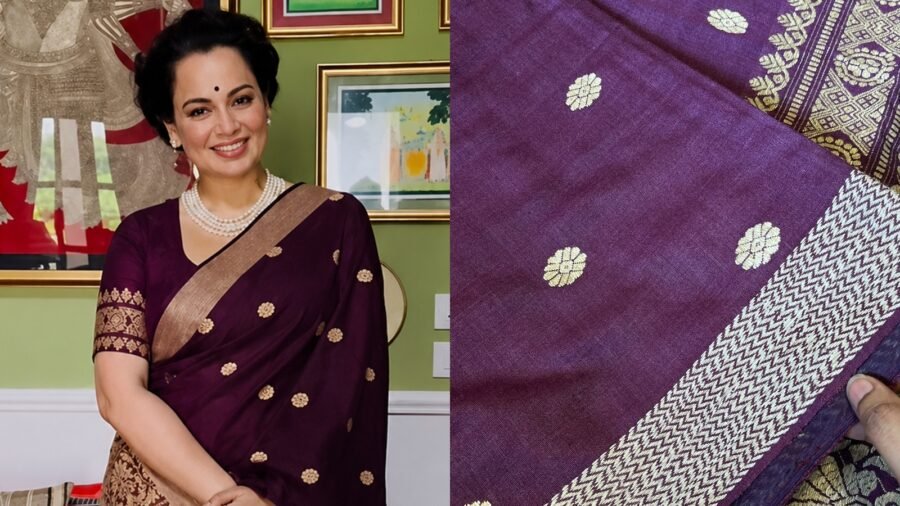
Kangana Ranaut looked resplendent in a vibrant plum Eri silk ensemble for a recent media appearance, and taking to Instagram stories, shared that it was her “first Meghalaya sari”, gifted by the brand Taara Vedaa. According to them, the handcrafted premium fabric is a 100% pure Eri silk saree that has been natural dyed, and the “colour has been derived from Pomegranate and iron dust,” adding that the sari “took almost 2.5 months to get woven”.
What exactly is Ahimsa silk?
According to the label, Eri Silk, or ‘Ahimsa’ (Peace) Silk, is a sustainable, durable textile derived from the Philosamia ricini moth, primarily produced in Northeast India. “Unlike other silks, the moths emerge from cocoons before harvest, making it cruelty free. Known for its matte, cotton like texture, it’s warm in winter, cool in summer, and exceptionally breathable,” they mentioned in the caption of their Instagram post.
In a previous 2023 article published in indianexpress.com, columnist Swasti Pachauri wrote that ‘Eri’, also known as Ahimsa or peace silk, is a salient case for sustainable or eco-handlooms.
Story continues below this ad
“Its name is derived from ‘Errandi’ or ‘Era,’ the local term for the castor plant that serves as the primary food source for the Eri silkworm, scientifically known as ‘Samia ricini.’ The worms also feed on the tapioca plant. Unlike conventional silk production methods, silkworms are not harmed or killed. Once the moths fly out of the cocoon, cocoons are boiled with raw turmeric leaves for 20-30 minutes and left to dry. The cocoon bundle is then mixed with cooked rice starch, and finally, Eri silk is skillfully handspun using the traditional spinning tool, ‘Takhuri’,” she explained in the piece.
View this post on Instagram
A post shared by Taara Vedaa ~ A Sustainable Weave Tale (@taara.vedaa)
What makes this fabric so special?
According to the article, this traditional practice of rearing Eri silkworms, called Ericulture, is deeply ingrained in the northeastern states’ identity, culture, ecology, and economy. “Tribal communities in states like Meghalaya, Nagaland, Arunachal Pradesh, and other northeastern regions actively contribute to producing exquisite Eri silk handlooms,” she wrote.
Pachauri also mentioned that in Assam, it is affectionately referred to as the ‘poor man’s silk’. The Assamese ‘Dokhona,’ ‘Gamosa,’ and the exquisite ‘Mekhela Chador’ are famous examples of Eri handlooms. With its natural sheen, Eri comes in off-white, earthy, and golden-beige shades, while certain silkworm varieties produce a beautiful rust-colored hue.
“Eri is celebrated as a cruelty-free fabric, championing ethicality in fashion and contributing to environmental equity as a critical component of the vegan fashion movement,” she concluded.
Light on truth: on the Tamil Nadu G.O. and RTI
By Sohail Khan · 29 Sep
Tackling food loss and waste — India’s opportunity
By Sohail Khan · 28 Sep
Revisiting the farmer question
By Sohail Khan · 28 Sep