India’s youth is NEET — not in education, employment, or training. That’s the real faultline
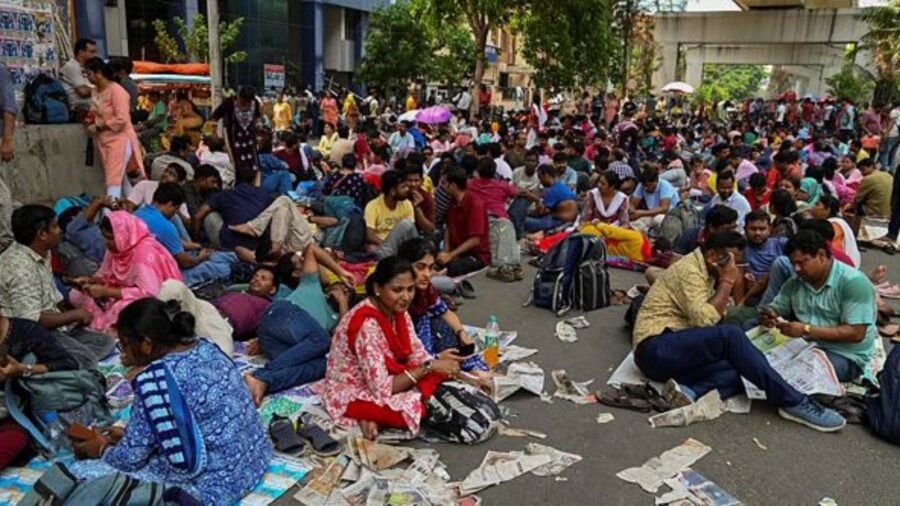
In the aftermath of the CJP protests and Dharmendra Pradhan’s forced resignation, Gen Z is widely recognised as a distinct political constituency. Through this month of August, leaders from both sides — the ruling regime and the Opposition — have engaged in multiple outreach events suggesting a mood shift in Indian politics.
This new state of political play was revealed in Prime Minister Narendra Modi’s address at the convocation ceremony of the IIT-Delhi on August 8. While much of the messaging remained on cue, there was the unmissable evocation of Gen Z lingo with terms such as “first in my bloodline” and the out-of-syllabus quip that “life is not a leaderboard”. Later, in his Independence Day speech, Modi mentioned “youth” more than 40 times along with promises for online coaching and training in AI skills.
Advertisement
Meanwhile, the chief of Rashtriya Swayamsevak Sangh, Mohan Bhagwat, spoke to some 2,000 Gen Z and Gen Alpha attendees at a conference on August 6, held at the capacious Nita Mukesh Ambani Cultural Centre in Mumbai. He presented himself as avuncular, cool, understanding and even used the Gen Z hand gesture “clock it”. Both Modi and Bhagwat appeared to suggest that the earlier “misunderstandings” with Gen Z were headed for a course correction.
On the other hand, Rahul Gandhi, in his well-attended Chhatron Ki Goonj interaction in Prayagraj on August 8, claimed that the Gen Z had been hit by a triple whammy — dard, data, and daulat (pain, data, and wealth). Not only was India’s demographic dividend being roiled by economic policies that favoured only a handful, but the digital economy itself was being gamed to benefit a few platform companies. But many also argue that by reducing the Gen Z disquiet to a demographic concern, Gandhi might be missing the forest for the trees.
More pointedly, the “future of work” for a broad swathe of India’s educated has turned ominous. What is increasingly being passed off as jobs has become punishing, contractual, part-time, and piece work arrangements. This impermanent “gig-based” work is, moreover, occurring within a hostile climate of job redundancies and technology-driven obsolescence. No amount of street smartness, creativity or determination, as these temp-workers are realising, can dodge the suffering from not having guaranteed job security and stable incomes.
Advertisement
Emergence of the ‘precariat’
The activist scholar Guy Standing, in a book titled The Precariat (2011), referred to the latter term as a workforce dominated by flexible labour, zero contracts, casualisation, self-employment and part-timers. Many within the Indian middle class have, in fact, already witnessed their children dropping into the ranks of the precariat. Put differently, a vast number of the educated and professionally trained in India will be economically and socially worse off than their parents. It is this real and constant fear of sliding further in the social order that has turned competitive exams in India into a desperate venture. To this palpable anxiety of India’s middle-class can be added the growing rage of the under-class whose hopes for social mobility through education and secure jobs have all but disappeared.
According to the most recent India Employment Report (2024) by the International Labour Organisation and Institute of Human Development, there were at least 103 million youth in the country, representing 1 in every 3 young Indians in the age group of 15-30 years, who can be classified as NEET — not in education, employment, or training. On the other hand, for most college-going Indians the real wages of their parents have hit a flat-line over the past decade despite the costs of college education more than doubling. The latest Financial Stability Report of the Reserve Bank of India notes how India’s middle class is even being priced out of the housing market, thanks to rising costs of food, transportation, education and healthcare. In effect, the Indian middle class is being squeezed into precarity.
Not an India story alone
The emergence of the precariat and their hopelessness is not exclusively an Indian phenomenon. China too has had to deal with the anger of the precariat, taking the form of a counterculture amongst the young who have resorted to tang ping or “lying flat”. That is, they sullenly chose to only do the bare minimum at work, refused responsibilities such as marriage or owning a house and remained steadfastly averse to pursuing any form of ambition. Tang ping was soon followed by bai lan, or “let-it-rot”, an even more pessimistic turn towards doing nothing while becoming “nothing”.
At the heart of such developments is cynicism, that no meaningful rewards lie in hard work as gains would be appropriated by the top of the feeding chain. In the United States too, a version of tang ping and bai lan played out as the “Great Resignation” immediately after Covid, wherein a large number within the workforce never returned to their jobs as they felt they were being cheated by work that was baked in exploitative practices.
In India, in contrast, the precariat, unlike in China and the US, are not only embracing a counterculture. Rather, what the Jantar Manter agitation and the rise of the Cockroach Janta Party (CJP) suggests that this socioeconomic class is taking to confrontational politics. And if such is the case, the ruling National Democratic Alliance may be caught on the wrong foot.
Addressing precarity, in the main, will require not only a massive expansion in public goods such as investments in health, education and housing but also the recharging of both governance and economic activity through meaningful decentralisation.
Jantar Mantar did not involve only anger and rage. The protests threaded together and created a new political mosaic of otherwise disparate people through the generation of solidarities and enduring friendships across classes, genders and castes. Their electric, ebullient and creative styles of questioning and subversion appeared to have opened fresh democratic possibilities. One cannot deny that this revolt of the precariat had indeed seized control of the conversations on the streets, family dining tables and in many a community gathering. There is certainly a fork on the road on India’s political landscape and much will depend on the path not taken.
Mahapatra is an independent journalist and former editor of Press Trust of India and Rohan D’Souza is a professor at the Graduate School of Asian and African Area Studies, Kyoto University, Japan

‘What’s for lunch when your restaurant is travelling at 28,000 km/h?’
By Sohail Khan · 28 Sep
How South Africa’s new exchangeable pitches could shape the 2027 Cricket World Cup
By Sohail Khan · 28 Sep
The mindset shift Virat Kohli is talking about: ‘Promised myself…to play more freely’
By Sohail Khan · 28 Sep