India to purchase ‘fire-and-forget’ Javelin missile system from US: How it works
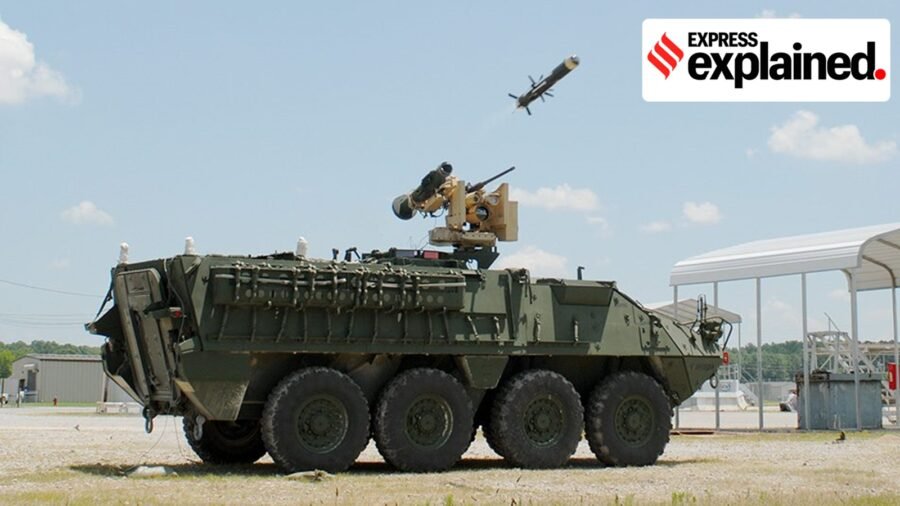
India has signed an agreement with the US to buy its Javelin anti-tank guided missile system, the US Embassy in India said Friday (August 28).
US Ambassador Sergio Gor posted on X that the agreement marks “a great step” forward in the US-India defence relationship and opens the door to co-production possibilities. The cost of procurement and the number of missiles in the deal have not yet been disclosed.
“The United States welcomes the Indian Army’s signing of a Letter of Offer and Acceptance (LOA) for the purchase of the Javelin anti-tank guided missile system through the US Foreign Military Sales process,” an American readout said.
Story continues below this ad
The announcement, which could cap more than a decade of Indian interest in the missile system, comes after India and the US signed a 10-year defence framework agreement in October.
What is the Javelin missile system, how do these missiles work, where have they been used, and why does India want them? We explain.
What is the Javelin missile system?
The Javelin first entered service with the US military in 1996. It is an anti-tank guided munition with a standard effective range of 2.5 km.
A single person can carry this missile system and fire it from their shoulder. Alternatively, it can also be fired from a remote launcher mounted on an unmanned ground vehicle.
Story continues below this ad
According to the Center for Strategic and International Studies (CSIS), the missile was designed to tackle heavily armored vehicles such as main battle tanks and lighter-skinned military vehicles. It is also effective against fortifications, bunkers and helicopters.
Made by the Javelin Joint Venture, a partnership between Raytheon and Lockheed Martin, the Javelin is used by the US Army, US Marine Corps and numerous international customers — most prominently Ukraine.
The Javelin is a “fire-and-forget” missile — its infrared guidance system allows it to travel towards a target on its own. This means that operators can fire and quickly move for cover, relocate to another fighting position, or reload to fire again, says a CSIS article.
How does this work?
A soldier carrying a Javelin missile first needs to locate a target through an infrared sight built into the launcher. Then, they set a square around the target using a cursor.
Story continues below this ad
This target is then sent to a guidance computer that is located on the missile itself. All that’s left to do is press the trigger.
But what about recoil and exhaust? The Javelin system, after all, weighs about 22 kg, with the missile itself making up 8.4 kg of this weight. The Javelin takes care of this problem with a clever innovation called a “soft launch” mechanism.
In lay terms, this means that when an operator presses the trigger, an initial motor within the missile produces just about enough force to launch the missile out of the tube.
According to a thesis by David Qi Zhang of the Rensselaer Polytechnic Institute, “The first motor… produces enough thrust to launch the missile out of the tube and a safe distance away, but is completely burned before the nozzle left the tube, leaving no exhaust to hit the operator.”
Story continues below this ad
Once the missile leaves the launch tube, a second motor kicks in. “The flight motor then ignites to propel the [missile] along its attack path,” writes Zhang.
The benefits of this system are many. “The Javelin’s soft launch mechanism prevents missile exhaust from hitting the operator, enables fires from inside confined spaces and buildings, lowers recoil for shoulder-launched fires, and minimizes launch smoke trails that indicate launch locations and invite counterfire,” says the CSIS article.
But that’s not the only innovation that the Javelin offers. It has two firing modes. In the first, the missile flies straight at a target. This mode is meant for targets such as fortified bunkers and helicopters.
The second mode is the top attack mode. The missile flies upward to an altitude of 150 m before diving towards its target at a steep angle. This is particularly useful against tanks, which have vulnerable roofs.
Battle-tested
Story continues below this ad
US and allied forces used the Javelin extensively during the wars in Iraq and Afghanistan. But perhaps its most effective use was seen in 2022, when Russia invaded Ukraine.
The numerically inferior Ukrainian military used the missile to devastating effect against Russian main battle tanks and other armored vehicles. Indeed, some observers have credited the Javelin system with helping Ukraine repel the full-scale invasion.
NATO Secretary Jens Stoltenberg has stated that the Ukrainians “were able to push back the Russian invaders, not least because they had the Javelins and they played a critical role in those opening weeks of the war.”
The US has been delivering significant numbers of Javelins to Ukraine since 2018 itself, well before the 2022 Russian invasion. As of September 2024, the US had provided Ukraine with more than 10,000 Javelin missiles.
Story continues below this ad
Such was the weapon’s popularity that an image of Mary Magdalene holding an FGM-148 missile, dubbed “St. Javelin,” became a symbol of Ukrainian resistance.
 A re-imagining of the Javelin in Ukraine.
The weapon has also been sold to 18 partner nations, including Ukraine, France, Qatar, Turkey and the United Arab Emirates.

Light on truth: on the Tamil Nadu G.O. and RTI
By Sohail Khan · 29 Sep
Tackling food loss and waste — India’s opportunity
By Sohail Khan · 28 Sep
Revisiting the farmer question
By Sohail Khan · 28 Sep