How Gorkha state demand evolved from a 1907 petition to the Centre’s new panel
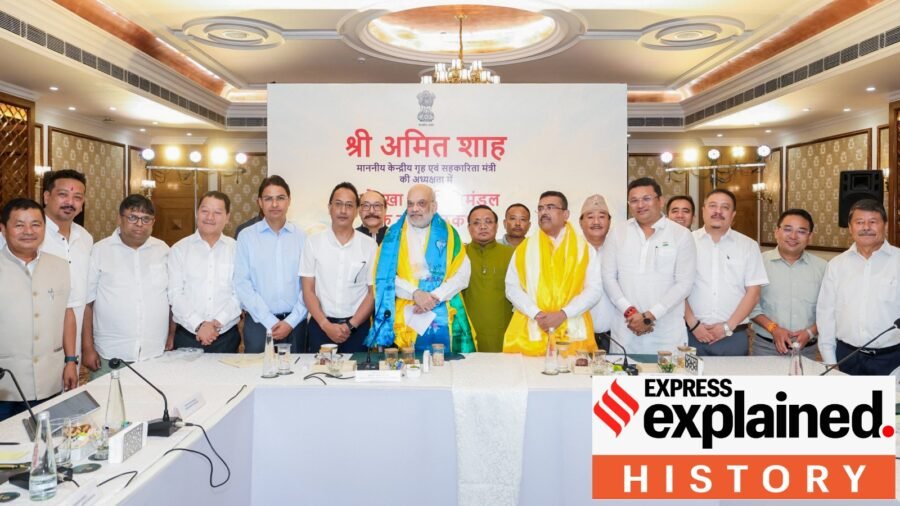
The Union Ministry of Home Affairs on Saturday (August 22) constituted a high-level committee following a key meeting of Gorkha leaders with Union Home Minister Amit Shah and West Bengal government representatives in Siliguri.
Tasked with preparing a framework for a “permanent political solution” to the Gorkha issue, the committee will address a contentious demand whose origins can be traced back over 100 years.
What are the roots of the Gorkhas’ demand?
The Gorkhas’ movement for a separate administrative identity is among the oldest of its kind in India.
Story continues below this ad
Darjeeling and its adjacent areas — including Kalimpong, Kurseong, the Terai, and the Dooars — are culturally, ethnically, and linguistically distinct from the rest of West Bengal. Because the region’s population primarily speaks Nepali and possesses distinct physical features, residents frequently face racial profiling and are wrongly labelled as citizens of Nepal or China.
This persistent alienation has fueled a deep-seated identity crisis, driving the demand for a separate state to affirm their identity as Indian citizens.
But its origins go further back. The movement began in 1907, when the Darjeeling Hillmen’s Association, led by Sonam Wangel Laden La, submitted a formal petition to the Minto-Morley Reforms Committee seeking to separate Darjeeling and Jalpaiguri from Bengal.
Over the following decades, the association was joined by groups like the Gorkha Officers’ Association and the Kurseong Gorkha Library. They presented their case to the Simon Commission (1929) and British officials Sir Samuel Hoare and Lord Pethick-Lawrence for another governance system, like a Chief Commissioner’s Province for direct rule.
Story continues below this ad
By 1947, the undivided Communist Party of India (CPI) formally submitted a memorandum for “Gorkhasthan” to interim leaders Jawaharlal Nehru and Liaquat Ali Khan.
And what is the history of the Gorkhaland movement?
In the 1980s, the demand for a separate state took on a violent, high-profile dimension under Subhas Ghising, founder of the Gorkha National Liberation Front (GNLF), who coined the term “Gorkhaland”.
The resulting unrest led to the creation of the Darjeeling Gorkha Hill Council (DGHC) in 1988, a semi-autonomous body that governed the hills for 23 years.
In 2007, politician Bimal Gurung formed the Gorkha Janmukti Morcha (GJM), reigniting the statehood demand and leading to the establishment of the Gorkha Territorial Administration (GTA) in 2011 to replace the DGHC. Agitations flared up again in 2013 after the Centre recommended carving out Telangana from Andhra Pradesh, prompting widespread strikes and central security deployment.
Story continues below this ad
The hills experienced their longest and most intense period of unrest in 2017, after the West Bengal government announced Bengali as a mandatory language in state-run schools across the region.
On June 8 that year, as the state cabinet held a historic meeting in Darjeeling, GJM supporters clashed with security forces, burning outposts and prompting military intervention. The violent agitation lasted 104 days, resulting in 11 protestor deaths, bomb blasts in Darjeeling and Kalimpong that claimed the life of a civic volunteer, and a complete shutdown of the region’s tourist economy.
What is the political landscape in the Darjeeling Hills today?
The fallout from the 2017 protests permanently altered hill politics.
State action forced Bimal Gurung underground, creating a rift that led his party’s leaders Anit Thapa and Binay Tamang to form a breakaway faction aligned with the ruling Trinamool Congress (TMC).
Story continues below this ad
This development permanently split the Gorkha vote bank between TMC-backed local administration and BJP-aligned national candidates. In the June 2022 GTA elections, held after a gap of 10 years, Thapa’s newly formed Bharatiya Gorkha Prajatantrik Morcha (BGPM) won 27 of 45 seats to take control of local governance, while the BJP and Gurung’s GJM boycotted the process.
However, the BJP has maintained a strong electoral grip in parliamentary and state contests, winning the Darjeeling Lok Sabha seat in 2019 and 2024, as well as securing victory across all three assembly seats Darjeeling, Kalimpong, and Kurseong in the May 2026 West Bengal Assembly elections.
What will the newly formed committee panel do?
The committee is tasked with examining all dimensions of the Gorkha issue within the framework of the Indian Constitution.
During the meeting, Shah reiterated the Centre’s commitment to delivering a “just, dignified, and lasting political resolution that respects the aspirations of the Gorkha community.”
Story continues below this ad
Alongside evaluating structural governance, the panel will examine financial assistance for the region and review a roadmap to grant Scheduled Tribe (ST) status to 11 key Gorkha communities.

Turmeric, honey, and yoghurt: Decoding Ananya Panday’s glow secret
By Sohail Khan · 28 Sep
SpaceX puts Starship megarocket in orbit for first time
By Sohail Khan · 28 Sep
‘What’s for lunch when your restaurant is travelling at 28,000 km/h?’
By Sohail Khan · 28 Sep