How a 24-hour delay explains the India-China dynamic
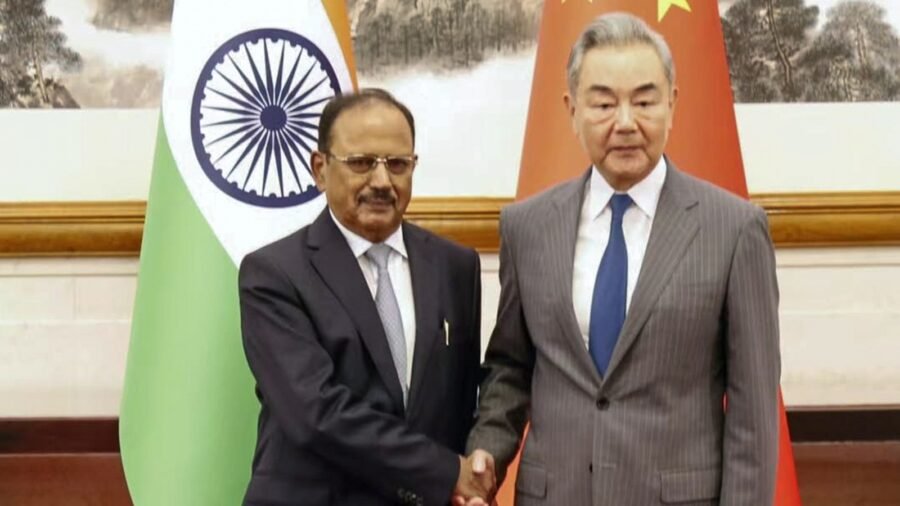
For 24 hours, India and China did what they do best — spoke separately.
On the evening of August 25, after NSA Ajit Doval met Foreign Minister Wang Yi in Beijing for the 25th Round of Special Representatives (SR) talks, the Indian Embassy posted on X that both sides had “reviewed bilateral ties and discussed ways to further expand cooperation and maintain stability.” Beijing’s version was warmer: Wang Yi and Doval had “comprehensive, in-depth, friendly and candid” discussions and China-India ties now had “global and strategic significance.”
Advertisement
But the absence of a joint statement led to speculation that semantic consensus on how to frame contentious issues remained elusive. However, on August 26, an identical eight-point joint consensus was released, first by New Delhi and later by Beijing. The latest statement included a push for an ‘Early and Substantial Harvest’ on boundary delimitation, two new military meeting points, two new border hotlines in the Eastern and Middle sectors, an Expert-Level Mechanism on trans-border rivers in September, facilitation of Kailash-Mansarovar Yatra, resumption of border trade and the next SR round in India in 2027.
This delay is perhaps the clearest expression of what defines the India-China relationship today: Deeply embedded wariness.
A joint statement after SR talks is rare. This time, an eight-point text was actually agreed within 18 hours, which signals political intent at the highest level to lock in stability ahead of a packed fortnight: The SCO summit in Bishkek and the BRICS summit in New Delhi on September 12.
Advertisement
But the language adopted shows how complex this task is when dealing with a tangled bilateral relationship where contested territoriality and deeply embedded suspicion are at the core.
‘Early and Substantial Harvest’ is not a casual phrase. It was coined during talks in 2024 and 2025 to denote progress on delimitation, mapping where the border is, without prejudice to final settlement under the 2005 Agreement on Political Parameters.
Agreeing to two additional hotlines and meeting points in the Eastern and Middle sectors (Eastern refers to Arunachal Pradesh, Middle means Himachal and Uttarakhand) is operationally significant. Until now, the only functional hotline was in the Western sector, Ladakh.
For Beijing to accept new military CBMs in the Eastern sector, which it claims as South Tibet, would have required internal clearance, that the new mechanism does not amount to recognition of the LAC. That is why the joint text carefully says “improving understanding of LAC in appropriate areas” and “promptly address situations through existing diplomatic and military channels to avoid misunderstanding and miscalculation” — classic wariness vocabulary.
The wariness extends to nomenclature. In the joint statement, both sides avoided the word Tibet/Xizang altogether, referring only to “Kailash-Mansarovar Yatra” and “border trade through three passes.”
When they must sign jointly, they simply omit the contentious noun and keep the dual mountain-lake names — Kailash and Gang Rinpoche, Manasarovar and Mapam Yun Tso — as a linguistic buffer.
India as chair needs a successful BRICS summit. China has publicly said it “supports India in hosting a successful BRICS summit” but as of late August, remains evasive regarding the participation of President Xi Jinping. The official response from Beijing is “no information to share” on whether Xi will attend. It is calibrated tactical ambiguity, to keep Delhi anxious and not to commit early.
India has to accept this kind of ambiguity given its current vulnerability on the trade-economic front and the prevailing Trump-triggered geopolitical turbulence. The Doval visit has led to a deft outcome, wherein Delhi can highlight difficult bilateral issues even while nurturing BRICS as a multipolar platform.
The 24-hour gap between separate and joint statements is that deftness in miniature: Separate texts to protect domestic optics, agree together after overnight vetting by the top leadership and choose words so carefully that even a mountain has two names.
Wariness is not the failure of diplomacy. In India-China ties, it is the method.
The writer is director, Society for Policy Studies, New Delhi
Light on truth: on the Tamil Nadu G.O. and RTI
By Sohail Khan · 29 Sep
Tackling food loss and waste — India’s opportunity
By Sohail Khan · 28 Sep
Revisiting the farmer question
By Sohail Khan · 28 Sep