Gnani unveils sovereign AI stack ‘Artha’ powered by open-weight model, enterprise agents

Bengaluru-based voice AI startup Gnani has launched an open-weight, foundational large language model (LLM) trained from scratch, alongside a new agentic AI platform built on top of the model.
Both Evon v3.3 and Plexus are part of Gnani’s end-to-end sovereign AI stack, Artha, designed for Indian enterprises and public institutions. It was unveiled in the presence of Vice-President C P Radhakrishnan at his official residence in New Delhi on Friday, August 28.
Stating that sovereign LLMs are the greatest advantage India has, Radhakrishnan emphasised that India’s approach should focus on making AI open, affordable, and accessible in order to ensure that innovation uplifts society as a whole. “Both these platforms reflect the growing strength of India’s technology ecosystem. This initiative shows that our engineers have the capability not only to use frontier technologies, but also to build them,” the vice-president said.
Story continues below this ad
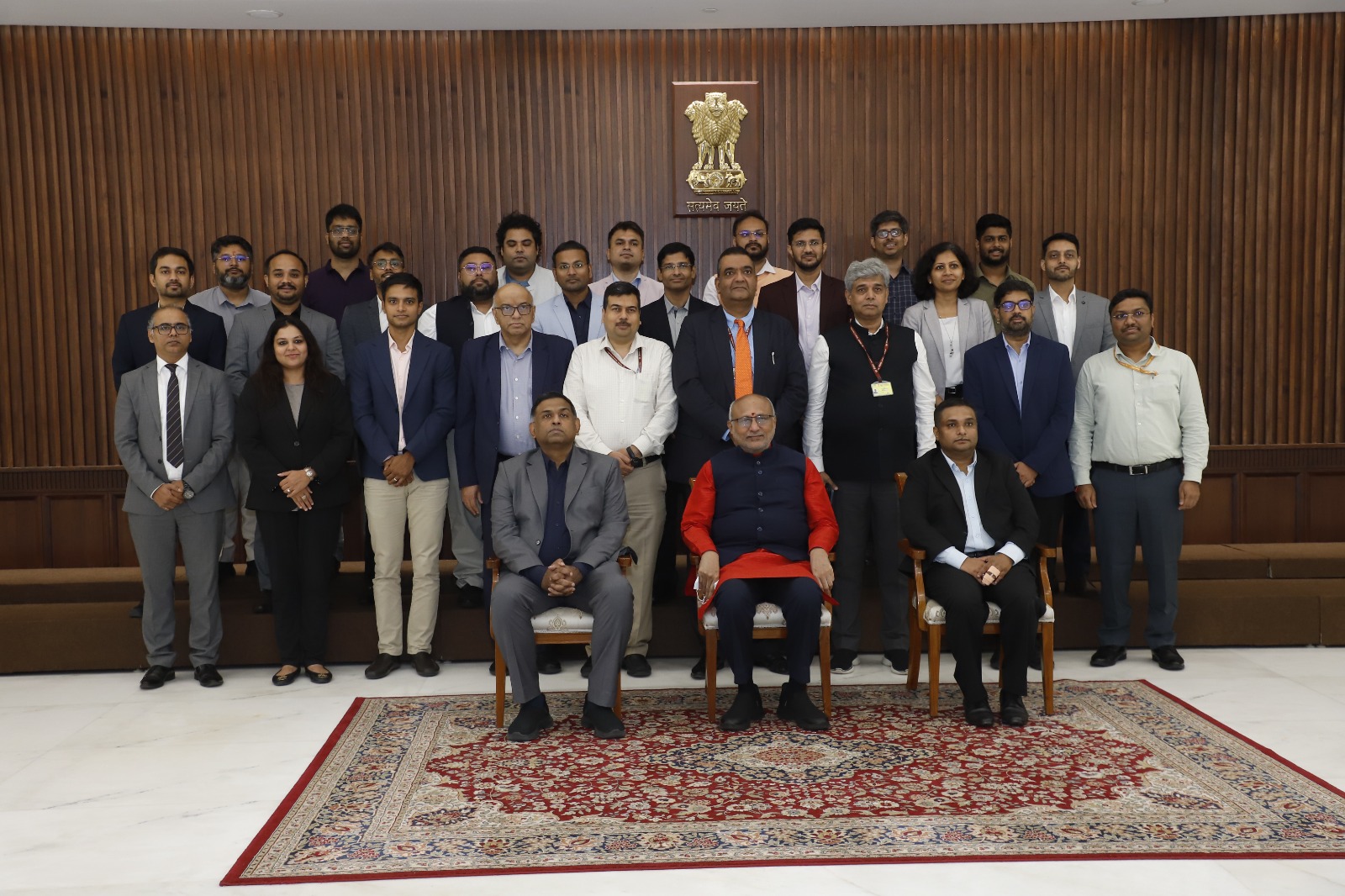 Vice-President of India, C P Radhakrishnan, with the Gnani AI team and other dignitaries at the launch of Artha in New Delhi.
Evon v3.3 is a 30-billion-parameter model with roughly 3.5 billion parameters active on any given token, suggesting that it is based on a mixture-of-experts (MoE) architecture designed to improve efficiency while maintaining performance across reasoning and other tasks.
It supports over 11 Indian languages and the model weights have been released under the Apache 2.0 open-source licence, meaning that developers can download the weights for free upon request at Hugging Face. But what makes the LLM stand out is its token consumption.
Notably, Evon v3.3 needs roughly 20 per cent fewer tokens per Indian-language word than the model tokeniser used by the GPT-5 family, and less than half of what byte-level tokenisers such as DeepSeek, Llama and Qwen require, as per Gnani AI.
The company said it achieved this by rebuilding the model’s tokeniser — used to break down plaintext into tokens — to better support Indian scripts. Token consumption has come under growing scrutiny as enterprises grapple with rising AI costs. This has fueled the popularity of Chinese open-weight AI models such as Moonshot AI’s Kimi K3, which is said to achieve performance on par with leading US models like Anthropic’s Claude Fable 5 while coming out to be cheaper to use.
Story continues below this ad
Ganesh Gopalan, the CEO and co-founder of Gnani, said that Evon v3.3 outperformed a similarly sized, unnamed model and an unnamed 105-billion-parameter Indic model on a widely used Indian-language benchmark, MILU, spanning eleven languages and dozens of academic and professional subjects. Defining sovereign AI as having control of one’s own data and AI models, Gopalan further said, “Sovereign AI is not about keeping the world out. It is about India having the capability to build for itself – and then for every country that shares its problems.”
With Gnani Artha, the company is targeting banks, insurers, and government bodies that need to meet data residency requirements under various regulations. Evon v3.3 is designed for self-hosting on a single node, allowing organisations to keep sensitive customer data within their own infrastructure, it said.
Gnani Plexus for enterprises
Plexus is Gnani’s agentic AI platform for enterprise customers. It can be used to build and deploy AI agents through natural language prompts. The agents support tool calling and can work autonomously across documents, systems, and conversations alike. Customers can also choose from a set of underlying models on Plexus, including Evon v3.3.
In a pre-recorded demo on Friday, Gnani showcased how Plexus could be used to design an AI agent that fetches a customer’s PAN card details with a single prompt. In another demo, the company demonstrated the platform’s multi-step feature by building and deploying a swarm of agents for welfare beneficiary programmes and grievance resolution by government agencies.
Story continues below this ad
“Each agent is a discrete, identity-bearing unit – closer to an employee than a script – combined with other agents into workflows built around a defined outcome. These workflows run under an orchestration layer that can be human-in-the-loop or AI-led, with guardrails, observability, and audit logging built in rather than added afterwards,” Gnani said.
Gnani AI is one of the 12 local entities selected under the India AI Mission to build sovereign LLMs. The India AI Mission was approved by the Union Cabinet in 2024 to build sovereign AI capabilities, including foundational LLMs, large-scale compute infrastructure, and AI applications for public use, with an initial outlay of Rs 10,372 crore.
In early 2025, the government operationalised GPU subsidies and invited startups to apply for compute support.
At the India AI Impact Summit held in February this year, Gnani launched Vachana TTS, a text-to-speech model capable of cloning human voices across 12 Indian languages using under 10 seconds of reference audio. It was one of three sovereign AI models that made its debut on the global stage.

Can AI make dysfunctional governments more effective?
By Sohail Khan · 28 Aug
How I turned the Samsung Galaxy Z Flip 8 into a ‘Zen Phone’
By Sohail Khan · 28 Aug
Meet Microduck, Hugging Face’s new open-source AI robot that can learn new tricks
By Sohail Khan · 28 Aug
Leave a Reply