Floating solar: Can it be India’s next renewable energy success story?
India’s installed solar capacity has grown rapidly, from 3 gigawatts (GW) in 2016 to over 160 GW in 2026, mainly through large-scale projects. But finding land for new projects is becoming harder as solar competes with urbanisation and agriculture, while the need for ecological conservation remains a priority. Policymakers, therefore, need to explore ways to expand solar capacity without requiring more land.
The recent approval of the Pradhan Mantri Surya Sarovar Yojana (PM-SSY) clearly signals the Indian government’s intent to promote land-neutral solar applications. The scheme aims to develop 5,000 megawatts (MW) of floating solar projects, with a total outlay of Rs 5,070 crore, making it the first dedicated national initiative to scale up floating solar adoption.
Story continues below this ad
It also covers co-located energy storage systems with a minimum storage capacity of 2 hours, that is, 10,000 MWh (or megawatt-hour; 1 MWh equals 1 MW of power used or produced continuously for one hour) of cumulative storage capacity, to support grid stability. Although India has already made some strides in large floating solar plants, the scheme could provide the much-needed policy push to accelerate pan-India deployment.
We explain.
What is floating solar?
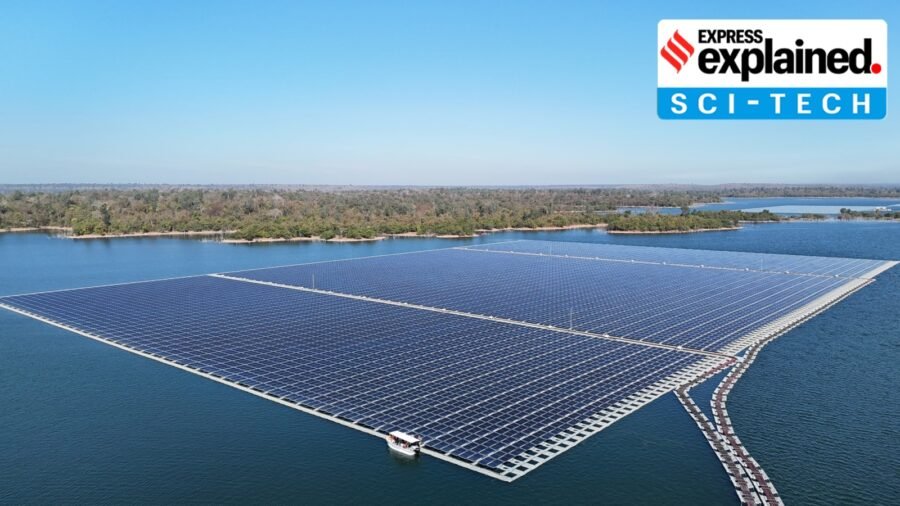
Floating solar systems comprise solar modules that are mounted on floating platforms over water bodies such as reservoirs and lakes. To maintain their position, the platforms are anchored to the reservoir bed or banks. Inverters and other electrical equipment may be installed on floating platforms or onshore, depending on the system design.
The clean energy generated by floating solar systems is transmitted to shore via electrical cables. As these systems do not need land for installation, industrial ponds, reservoirs, and inland water bodies are well-suited for floating solar deployment.
Relevance for India
The biggest advantage floating solar offers in India is land conservation, enabling more efficient land use and delivering economic benefits.
Story continues below this ad
Other benefits include reduced water evaporation and improved solar module efficiency. Portions of water bodies covered by floating solar systems have lower evaporation rates than uncovered portions. Water savings from reduced evaporation, however, will also depend on the area covered, local climatic conditions, and reservoir characteristics. Further, water under the solar modules keeps them cooler, thereby enhancing their performance and efficiency, especially during hot summer conditions.
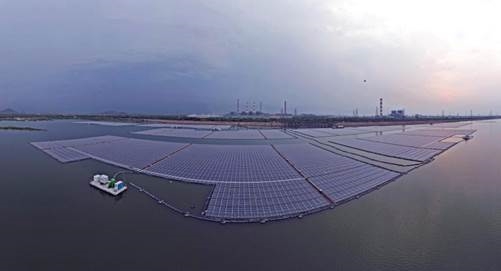 The 100 MW Floating Solar Power Project was fully operationalised at NTPC-Ramagundam, Telangana, in 2022. Photo: PIB
India has already made significant progress in deploying floating solar. NTPC Limited commissioned two of India’s largest floating solar projects in 2022: the 100 MW Ramagundam project in Telangana and the 92 MW Kayamkulam project in Kerala. The planned 600 MW Omkareshwar Floating Solar Park in Madhya Pradesh is another milestone project, of which 278 MW capacity is currently operational. The park, when fully commissioned, is expected to generate a staggering 460 crore units of clean energy over its 25-year lifetime.
The current installed capacity of floating solar in India, however, stands at only 700 MW. A recent assessment by the National Institute of Solar Energy indicates the country’s floating solar potential at 102 GW (considering only 20% usage of reservoir areas), suggesting a significant expansion opportunity.
Role of PM-SSY
India’s existing floating solar installations comprise a few large projects developed by state agencies and public sector undertakings. Beyond these projects, this solar segment has yet to gain traction in the country. PM-SSY aims to change this and mainstream floating solar in India’s renewable energy landscape.
Story continues below this ad
The scheme will provide central financial assistance (CFA) of Rs 1 crore per MW for each eligible project upon commissioning. For successful floating solar projects, feasibility studies and preparatory activities, including hydrographic assessments (to understand the physical characteristics of a water body, such as its depth and bottom contours) and environmental assessments (to assess potential impacts on aquatic life and water quality), are critical. Although these activities can be time- and resource-intensive, they are essential to de-risk project development. The scheme recognises this and provides additional CFA of up to Rs 0.5 crore per project for these activities.
It will also boost domestic manufacturing and generate employment opportunities across the floating solar value chain, with a 5-year implementation period and financial support available until 2032-33.
Factors necessary for success
The scheme’s success will depend not only on financial support but also on effective implementation, the bankability of eligible projects, and institutional coordination. Implementation will require clear identification of suitable water bodies and comprehensive feasibility studies for each site.
Floating solar systems are exposed to extreme winds, waves, and rapidly changing water levels, making climate-resilient system design crucial. It is also important to avoid any adverse effects on ecology and aquatic life. Ecologically sensitive water bodies, as well as areas important for biodiversity, bird habitats, and fisheries, should therefore be treated with caution and approved for floating solar development only after thorough assessments.
Story continues below this ad
Floating solar is generally more expensive than traditional ground-mounted solar because of the cost of floating platforms, anchoring systems, specialised electrical equipment, and installation. The inclusion of energy storage systems will further increase overall capital costs. While the CFA provided under the scheme will improve project economics, developers will still require access to affordable financing and clear revenue streams through long-term power purchase agreements.
For a floating solar system to be sanctioned, coordination among multiple institutions (including state agencies, municipal authorities, electricity utilities, water resources and irrigation departments, environmental authorities, and industries) is essential. Developing clear frameworks for identifying and allocating suitable water bodies, defining institutional responsibilities, and streamlining approvals will therefore be vital for successful implementation.
What lies ahead
Floating solar can complement ground-mounted and rooftop solar by providing an additional pathway for expanding India’s renewable capacity without placing further pressure on scarce land resources. PM-SSY provides an opportunity to move floating solar from a handful of large-scale installations towards systematic and widespread deployment. But converting financial assistance into actual projects will require careful site selection, environmentally responsible and climate-resilient designs, and effective institutional coordination.
India has already demonstrated the technical feasibility of floating solar at the MW scale. PM-SSY now provides an opportunity to build on this experience and make it a significant part of India’s renewable portfolio, while making better use of water resources and easing pressure on land.
Story continues below this ad
The author is the sector coordinator for renewables and energy conservation at the Center for Study of Science, Technology and Policy (CSTEP), a research-based think-tank.

Microplastics in bottled water: What 240,000 particles per litre means for your health
By Sohail Khan · 28 Sep
Women’s safety falls through the gap between intention and policy
By Sohail Khan · 28 Sep
Give India’s poor cash. But don’t stop there
By Sohail Khan · 28 Sep