Expert Explains | How India and China’s differing approaches to talks may hinder boundary resolution
By Maj. Gen. G G Dwivedi (retd)
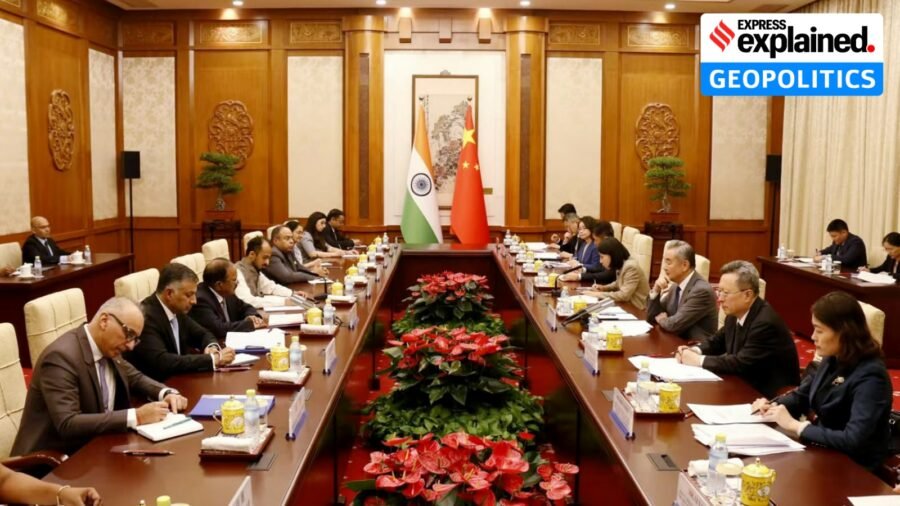
National Security Adviser (NSA) Ajit Doval and Chinese Foreign Minister Wang Yi met in Beijing on Tuesday (August 25) for the 25th round of the India-China Special Representatives (SR) talks.
Their discussions, besides the boundary dispute, covered bilateral, regional and international issues.
Story continues below this ad
The SR dialogue is an important part of the process to rebuild the bilateral ties between the two neighbours and move beyond the bitterness of 2020 military confrontation, despite deep strategic differences.
The Special Representatives mechanism was instituted in 2023 after the “Joint Working Group” format to resolve the boundary dispute failed to make much progress. It is meant to establish a political framework to resolve the boundary problem. Although the issue remains unsettled till date, the SR dialogue has still evolved as an important channel for crisis management.
Post-Galwan to Kazan: Cautious thaw
India and China’s bilateral ties plunged to the lowest point in decades during the 2020 conflict in eastern Ladakh’s Galwan, triggered by the People’s Liberation Army’s attempt to to arbitrarily change the status quo at the Line of Actual Control (LAC).
The Chinese aggression took India’s politico-military leadership by surprise, as it was assumed that the “strategic guidance mechanism” evolved as a sequel to the meetings between Prime Minister Narendra Modi and President Xi Jinping at Wuhan in April 2018 and Mamallapuram in October 2019 was working effectively.
Story continues below this ad
It took multiple meetings at political, diplomatic and military commanders’ levels for the opposing forces to disengage, resulting in the creation of buffer zones and introduction of new patrolling modalities.
The Depsang sector, however, remained a sticking point. A breakthrough came about after the Modi-Xi meeting at Russia’s Kazan city on the sidelines of the BRICS Summit in October 2024, which opened the door for a cautious thaw.
The process of consolidation started with the 24th SRs meeting in Delhi in August 2025. It produced a 10-point consensus, including implementation of the ‘2005 Political Parameters and Guiding Principles’, strengthening of border management, creation of an ‘Expert Group’ under the Working Mechanism for Consultation and Coordination to explore ‘early harvest’ boundary delimitation in appropriate sectors, constitution of a separate working group for effective border management, continuation of the military-diplomatic mechanism, cross-border river cooperation and reopening of traditional border trade points. Certain tangible outcomes included the resumption of direct flights, easing of visa norms and restarting the Kailash Mansrovar yatra.
What happened at the latest SR meeting?
During the 25th SR round, both sides reviewed the bilateral ties positively, noting that these align with the strategic vision established by PM Modi and President Xi during the previous summits (Kazan- October 2024 and Tianjin-August 2025).
Story continues below this ad
They reaffirmed the commitment to maintain an open dialogue to secure a “fair, reasonable and mutually acceptable settlement” for the 3,500 kms of un-demarcated Himalayan border. The ongoing focus on preventing miscalculations along the LAC and gradual resumption of institutional exchanges and cooperation following military disengagement also received due attention. India officially agreed to host the 26th SR meeting in Delhi in 2027.
The Indian Ministry of External Affairs’ formulation remained centred on the boundary process and importance of peace and tranquillity for stable bilateral ties. China’s readout was significantly broader and political, given Wang Yi’s strong emphasis on keeping the boundary issue in its “proper place” within the wider relationship and preventing it from becoming an impediment to wider cooperation.
Ahead of the formal session, Doval called on the Chinese Vice President Han Zheng to address the strategic approach towards maintaining peace and tranquillity at the border.
The strategic importance of the dialogue
The 25th SR meeting can best be seen as consolidation and not a breakthrough. India-China bilateral ties have moved from the post-2020 crisis management towards a structured border stabilisation mechanism and gradual political normalisation. Notably, neither readout announced any fresh measure or change on disengagement, patrolling protocols or the buffer zones.
Story continues below this ad
There is an obvious difference in the approach being adopted by the two sides.
India frames the issue sequentially — that is, durable peace and tranquillity along the LAC being a foundational prelude for a stable overall relationship.
China, on the other hand, believes in a holistic approach — appropriately managing the boundary issue while the broader bilateral relationship continues to develop.
This semantic difference is strategically important and remains a major hurdle in resolving the boundary dispute.
Story continues below this ad
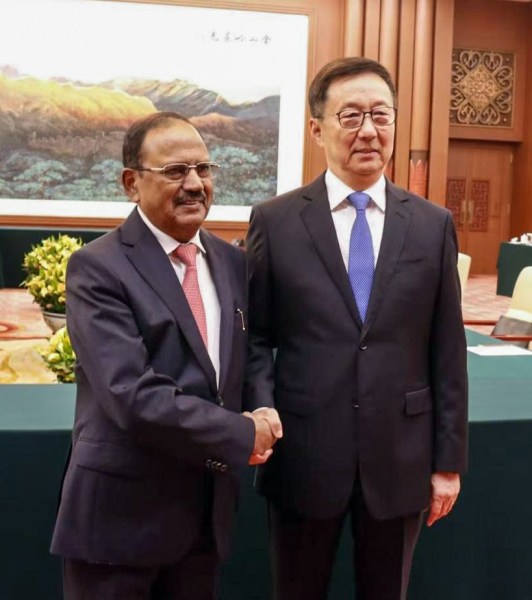 NSA Ajit Doval calls on Vice President of the People’s Republic of China, Han Zheng, prior to the 25th Round of the SR Talks, in Beijing on Tuesday. ANI
The Chinese approach is seemingly working out well. Despite the boundary issue, the bilateral trade is at an all-time high, breaching the $151-billion mark, with China enjoying a $112-billion trade surplus. The PLA continues to build military infrastructure along the LAC, especially opposite Arunachal Pradesh. There is no sign that China is likely to de-escalate the current deployment along the LAC, as it looks to maintain pressure on India as leverage.
Both nations, however, have compulsions to normalise the relations. India needs a stable northern frontier to pursue its economic agenda amid a turbulent global environment. China is grappling with slowing growth and faces strategic competition from the US.
So, both have overlapping stakes, though divergent national interests. There is also an inherent rivalry between the two, given China’s relationship with Pakistan, the Tibet issue, Beijing’s expanding footprint in the Indian Ocean and India’s strategic partnership with US, Japan and Australia as a member of the Quad.
Over the past over half a decade, India-China relations have witnessed three distinct phases — confrontation, disengagement and cautious reconciliation.
Story continues below this ad
The 25th SRs meeting signals that the two countries have moved from crisis management to the process of reconciliation — an uneasy détente to obviate another Galwan-type clash.
Given the current Chinese assertiveness, however, its expansionist designs and the glaring trust deficit between Delhi and Beijing, the resolution of the boundary dispute is unlikely, even in the future.
(The writer is a war veteran, former assistant chief, and served as defence attache in China, North Korea and Mongolia. He is currently Professor of Professor Strategic-IR, Management Studies at Lal Bahadur Shastri Institute of Management)
Light on truth: on the Tamil Nadu G.O. and RTI
By Sohail Khan · 29 Sep
Tackling food loss and waste — India’s opportunity
By Sohail Khan · 28 Sep
Revisiting the farmer question
By Sohail Khan · 28 Sep