Cars in India will soon ‘talk’ to each other. Will it reduce road deaths?
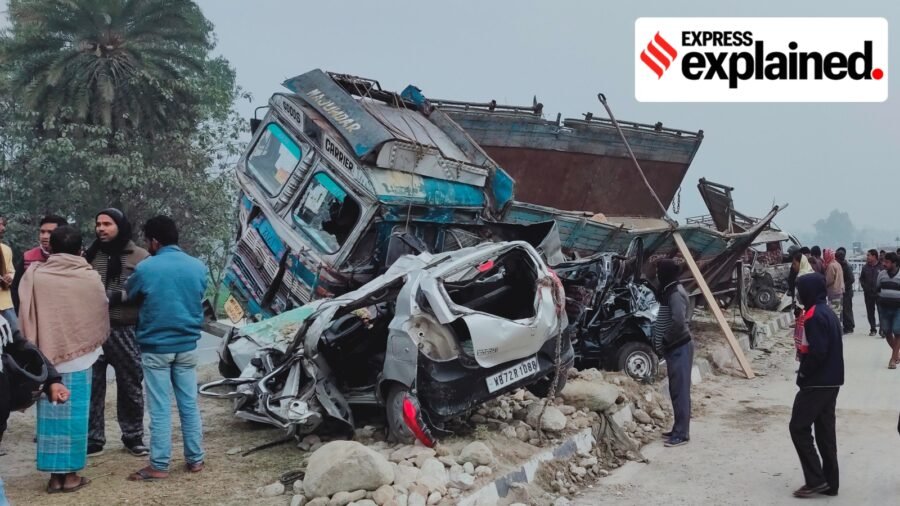
In 2025, crashes on roads claimed 1.83 lakh lives in India — around 6,000 more than the previous year — raising alarm across different segments of the government. Now, the Union Ministry of Road Transport and Highways (MoRTH) will soon mandate its new road-safety intervention, the Vehicle-to-Vehicle (V2V) communication system, through which cars will essentially talk with each other wirelessly to warn drivers about upcoming accident risks on the road.
The Ministry had published the draft Central Motor Vehicles (Amendment) Rules, 2026, on July 22 seeking objections and suggestions from the public on the V2V system within 30 days; now, they will be taken into consideration.
We explain what the new Rules propose, how the V2V system will work, and how it’s different from other safety devices.
Story continues below this ad
What do the proposed rules say?
The proposed changes to the Rules mark a significant transition in India’s vehicle manufacturing and road infrastructure by moving ahead of onboard safety mechanisms like advanced driver assistance systems (ADAS) and interconnecting two vehicles.
The draft Rules propose mandating the minimum technical and safety features for V2V-fitted vehicles before they are rolled out on roads, while also setting a deadline for manufacturers to install the V2V system.
According to the MoRTH notification, the vehicles of categories L (two- and three-wheelers), M (cars, buses), and N (goods vehicles) manufactured on or after October 1, 2027, will be required to comply with AIS-230 standards, if they are fitted with V2V system. It also says that vehicles of categories L, M and N, manufactured on or after October 1, 2028, will be required to be fitted with V2V communication systems, meeting specifications as per AIS-230.
AIS-230, or Automotive Industry Standard-230, is a technical backbone for the V2V system, which specifies a list of requirements like radio performance, frequency stability, receiver sensitivity, cybersecurity and communication-security provisions, electromagnetic interference and compatibility requirements, Global Navigation Satellite System road safety applications, etc.
Story continues below this ad
The standard also provides for phased introduction of other safety features in V2V such as emergency brake alert, forward collision warning, wrong-way driving, and emergency vehicle alert.
How will it work?
For the V2V system, an On Board Unit (OBU) will be installed in vehicles so that it can exchange information with other vehicles wirelessly. It will use cellular Vehicle-to-Everything (C-V2X) technology in the 5.875 GHz to 5.925 GHz frequency band. On June 10, 2026, the Department of Telecommunications exempted the use of this frequency band from licensing requirements. Now, the original equipment manufacturers (OEMs) can use this spectrum to get V2V installed in new vehicles.
The V2V-fitted vehicles will alert the driver about sudden braking, black spots, unsafe lane changes, obstacles like parked vehicles on roadsides, fog or any potential collision risk. For instance, if a car applies brakes suddenly, the nearby vehicles will get an alert to slow down before seeing it. Usually, V2V systems have a range of 300 metres and can detect vehicles in this range.
Officials said that OBUs will cost Rs 5,000 to Rs 7,000. This will be first installed in new vehicles.
How is it different from other safety devices?
Story continues below this ad
The traditional safety features in vehicles — such as the camera-based ADAS — depend on the line of sight of a driver, that is, how far one can see the road. The V2V system, however, works beyond the line of sight such as blind corners or behind large trucks, and it alerts the driver by establishing contact with other vehicles. So, it is expected to complement ADAS and predict forward collision risk. The vehicles will continuously exchange real-time data including speed, position, direction, and acceleration.
The system is somewhat similar to the aviation sector technology where the aircraft broadcast their position, speed, and altitude — and the nearby aircraft and ground station receive it. While this system is now common in the aviation sector globally, the road sector is still evolving and V2V is working in a few countries like the US and mostly developed nations.
Why is there a privacy concern?
While the V2V system offers an advanced solution for reducing road accidents, there are some privacy concerns. Since the system will store a large amount of data about the vehicles, its location, etc, it puts the whole intelligent transport infrastructure at the potential risk of being susceptible to cyber attacks. This will certainly require government regulations to prevent this.
There is the question of whether the frequency band allocated for the system will support all vehicles. Also, miscommunication might lead to road crashes.

On women, Manusmriti has a context. Don’t go by colonial interpretation
By Sohail Khan · 31 Aug

‘Sever Displeasure’ censure in Poonch case shows Indian Army holds its own to account
By Sohail Khan · 31 Aug
Leave a Reply