On women, Manusmriti has a context. Don’t go by colonial interpretation
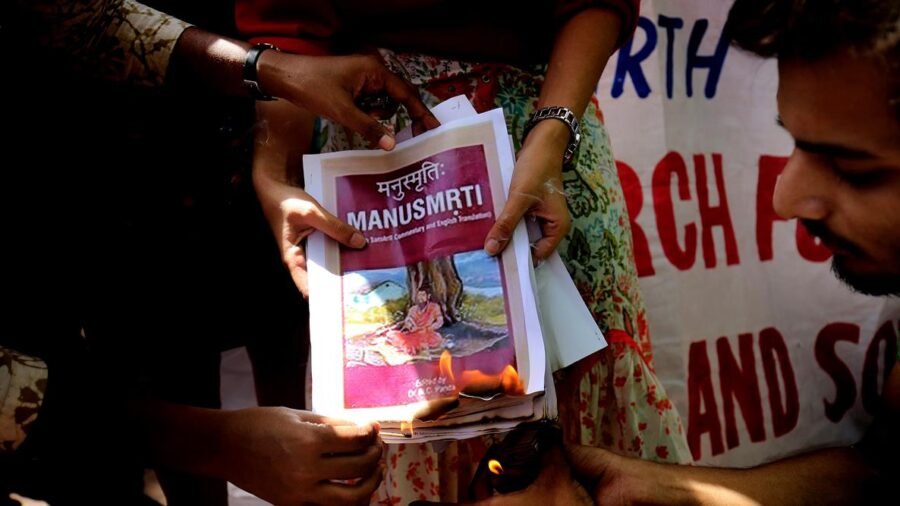
A prominent politician speaking recently to students in Pune has reportedly referenced an oft-cited verse from a great religio-legal treatise of ancient India: Manusmriti, or Manava Dharmashastra. Does this verse really say something derogatory about women? For over half a century I have, as a law professor, been discussing with my students — and writing in my books — on the reality of this alleged “verdict” of the so-called “classical Hindu law” on the social status of women.
Manusmriti and similar other treatises came into existence in an era when Christianity and Islam were not born, and the word “Hindu” was unknown. Branding the general law of ancient India as “Hindu law” was the handiwork of British rulers. I often wonder: If Roman law cannot be called a Christian law, how can the ancient Indian law be described as Hindu law? The fact is that it was the traditional law of ancient India, which is the inherited cultural legacy of all Indians of the present generation.
Advertisement
Manusmriti speaks of dharma (divine code of conduct for human life) and adds that man is to be guided by four different sources — the shruti (divine revelation in divine language heard by sages of antiquity), smriti (the same transmitted by them from memory in human language), sadachara (practices of divinely inspired seers), and atmanastushti (what modern jurisprudence calls “good conscience”). The four holy Vedas are shruti, and Manusmriti was the first in the galaxy of a large number of smritis.
Coming to Manusmriti’s verse on women under reference, how many of us can understand, or even accurately read, its original wording? It is a shame that whatever we, Indians of the present age, know about our ancient law is through English translations by foreign writers centuries ago. Our knowledge of Manusmriti rests on William Jones’ translation of 1794. Let us check the original words of the verse: Pita rakshati kaumare bharta rakshati yauvane/Rakshanti sthavire putra na stri swatantrayamarhati.
This verse uses derivatives of the word “raksha” thrice – who in India does not know what raksha means? According to all dictionaries, it simply means protection and safety. So by Manusmriti’s command, a woman’s father, husband, and son are charged with the sacred obligation of ensuring her “protection” and “safety” at different stages of her life. Was this a verdict on women’s inferior status, as the foreign translators of our sacred texts have claimed? They chose to mechanically translate the Sanskrit expression swatantrayamarhati as “undeserving” or “unfit” for independence. Sanskrit is an extremely rich language in which every word can have a wide range of meanings, and I would translate the said expression as “never left unprotected”.
Advertisement
Whatever Manusmriti or any other dharmashastra says, or is supposed to be saying, must have been in accordance with the contemporary stage of human civilisation. Their learned authors could not have meant that what was being said had to be literally followed in all ages to come. Ancient texts of any society are to be interpreted and understood in every age according to the social trends of the time. Under all the modern laws of our times, daughters have to be provided maintenance by their fathers or guardians, the wives by their husbands, and the mothers by their children or grandchildren. And, in law, maintenance means all the necessities of life, including adequate measures of protection and safety. This is all that Manusmriti had also said — of course in the jargon of its time. It is absolutely wrong to treat this as a verdict of lifelong subjugation of women to the menfolk in the family.
The religio-legal heritage of a nation is a specialised discipline, a proper understanding of which requires exceptional skill and expertise. It would be unfair for a layperson to cite a disjointed text in its literal sense, and describe it as “archaic” or “anachronistic”.
The writer is professor of Law and former member, Law Commission of India

Stocks down again — but what are the outliers in India’s share market slide?
By Sohail Khan · 29 Sep
Cash transfers alone cannot tackle the problem of educated unemployment
By Sohail Khan · 29 Sep
Rabbit vs hare: Why one runs and the other hides
By Sohail Khan · 29 Sep