Carney’s counterattack: Canada’s America problem could be India’s opening
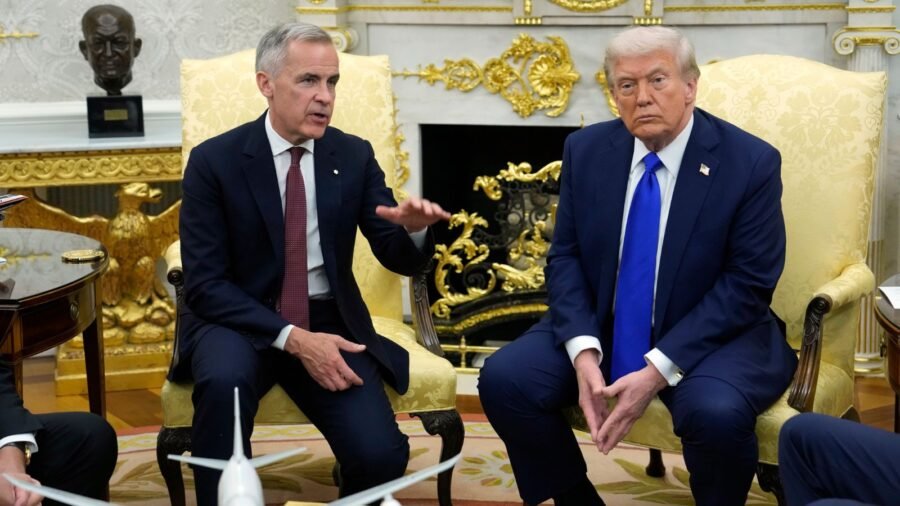
In Davos earlier this year, Canadian Prime Minister Mark Carney delivered the address that defined the summit, arguing that the rules-based order had given way, that large powers were converting economic integration into leverage, and that middle powers would have to coordinate if they wanted to protect their interests. He did not name the United States, but the reference was understood, and within a day Donald Trump retorted that Canada owed its existence to American generosity.
New Delhi also listened attentively, because India had spent the previous year living through the same situation: An interim trade deal with Washington that staged rather than settled tariffs, a reciprocal rate that later gave way to a forced-labour surcharge, and energy supply exposed to a single maritime chokepoint. The middle-power predicament Carney described was not unique to Canada, and the two countries have since behaved accordingly. Seven months after Davos, at one minute past midnight on August 22, 50 per cent American tariffs on roughly $28 billion of Canadian goods took effect, Canada’s negotiators were recalled, and matching counter-tariffs were set for September 8.
Advertisement
This is how uncertainty works as a tariff in itself. In July, Trump announced that a new round of duties would follow unless Canada dropped what the US saw as unfair practices, chiefly provincial bans on American alcohol, duties on some US-made cars, and quotas on American dairy. The threatened list went well beyond those irritants, covering goods that had been duty-free under the CUSMA (Canada-United States-Mexico Agreement), from wine, dairy, and lumber to clothing, furniture, and hockey sticks. Less than two hours before the first deadline, Trump paused the tariffs for three days and posted that a deal was done. Three more days of negotiation followed, and then a collapse that Ottawa blamed on late changes to Washington’s terms.
I have been in Ottawa through this period, and the mood is more layered than the headlines suggest. On one side is an economic nationalism that has proved durable. The Bank of Canada’s own research finds that the “Buy Canadian” shift is visible in grocery and travel data, and eight in 10 Canadians still believe the boycott strengthens Ottawa’s negotiating position. Liquor shelves are where this is most visible, and the agricultural arithmetic behind them is underappreciated: American beer, wine and spirits are ultimately corn, barley and grapes, and Canada was, in 2024, the largest market for US wine exports.
On the other side is a more sceptical reading, heard from officials and commentators alike, that this is less a trade policy than a personality seeking a reaction. The annexation talk, the AI-generated images of Canada under an American flag, and Trump’s Las Vegas rally remarks calling Canada’s leadership nasty suggest a test of which provocation generates the most attention, with midterm elections in November and American aluminium prices up 58 per cent as a result of existing tariffs. On this view, Canada functions as a convenient foil rather than a genuine adversary, and the sensible response is not to compete for the attention being offered.
Advertisement
The two readings are not incompatible. A leader can be both theatrical and consequential, and goods crossing the Ambassador Bridge are taxed either way.
The costs are already visible. Exports to the United States fell by a tenth over the past year while exports elsewhere grew, steel shipments south have roughly halved, and Ontario and Quebec, where the tariffed industries are concentrated, are expected to post the weakest growth of any province this year. Agriculture has its own strain: Canola and pea exporters were already dealing with Chinese tariffs and India’s duties on yellow peas and lentils before dairy and wine joined the American list.
This is where India offers a useful reference point, because diversification is now the working vocabulary in both capitals, and New Delhi has pursued it longer and from a position of greater choice. New Delhi’s answer to its own tariff exposure has been a rapid sequence of agreements, with the EU deal concluded in January foremost among them. Ottawa has set itself the goal of doubling non-US exports by 2035, reached a trade arrangement with China in January, and sent its prime minister to the Middle East and Asia to find buyers.
Indeed, the Indo-Pacific is the natural destination, and India is the natural anchor. After three years in which the relationship effectively stalled over the Nijjar affair, Carney and Modi rebuilt it in stages, at Kananaskis, in Johannesburg, and then in New Delhi in March, where the two sides signed the terms of reference for a Comprehensive Economic Partnership Agreement to be concluded by year-end and announced a strategic energy partnership covering LNG, LPG, uranium and hydrogen. Three negotiating rounds have since been completed; the target is two-way trade of $50 billion by 2030, from a goods base of roughly $8.5 billion.
Canada supplies what India needs in quantity, from uranium and potash to LNG and pension capital, while India offers Canada a large, fast-growing market that lies beyond the reach of American tariffs. Frictions remain, including pulse tariffs, a drop in Canadian education exports, and an earlier CEPA attempt that stalled in 2017. But the incentive on both sides is now stronger than it was then.
Carney’s Davos observation was that a country not at the table tends to end up on the menu. The table in Washington has been cleared for now; the one in New Delhi is still being set, and both governments have good reason to stay seated.
The writer is with the Observer Research Foundation (ORF)

‘What’s for lunch when your restaurant is travelling at 28,000 km/h?’
By Sohail Khan · 28 Sep
How South Africa’s new exchangeable pitches could shape the 2027 Cricket World Cup
By Sohail Khan · 28 Sep
The mindset shift Virat Kohli is talking about: ‘Promised myself…to play more freely’
By Sohail Khan · 28 Sep