Airport security alert: This tiny item in your pocket can cause ‘additional’ check
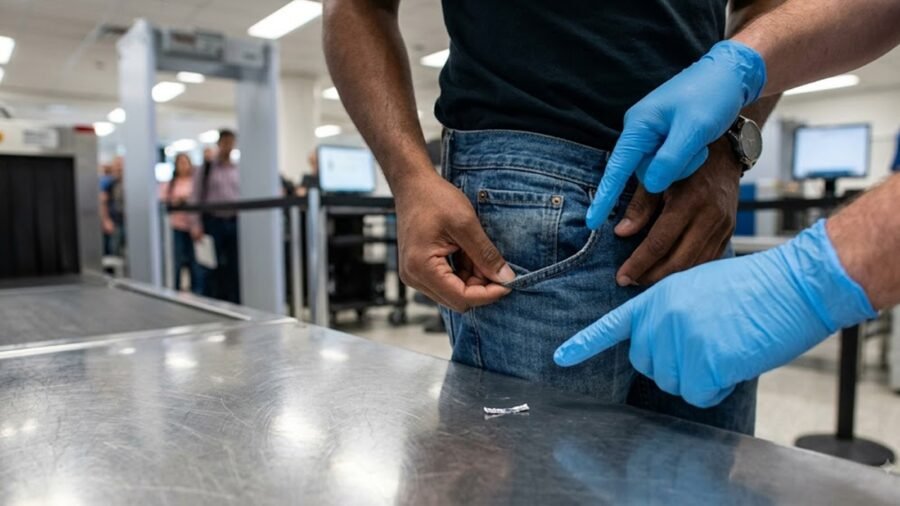
Food wrapped in silver or aluminium foil is generally allowed through airport security X-ray screening, but did you know a tiny piece of foil or wrapper in your pockets can trigger a metal detector, prompting a manual bag check or pat-down and drawing additional scrutiny? This is what happened with Khichdi director, filmmaker, and actor JD Majethia at two airports in India. “Security Alert. A MUST WATCH for air travellers,” he captioned an Instagram post where he shared how a tiny piece of discarded medicine strip was found in one of his pant pockets, which triggered an additional security check at Hyderabad airport.
“It was deep inside the pocket. The security beeped at the boarding airport too, but they couldn’t figure it out and eventually let me go. The same incident happened again, and finally, when I emptied the entire pocket, this tiny piece was found,” Majethia described in Hindi on his Instagram, urging passengers to save time and check their pockets thoroughly.
“This was such a small thing, but it was five minutes on both sides. It also slowed down the queue behind me. So, please thoroughly check your pockets,” he urged.
Aviation expert and analyst Dhairyashil Vandekar told indianexpress.com that this can happen during passenger security screening, when screening equipment responds to metallic material. “Some medicine strips use aluminium foil and although the amount of metallic material is small, metal detection equipment such as a Hand Held Metal Detector (HHMD) may respond to it depending on the type and sensitivity of the equipment, the amount of material present and its location,” said Vandekar.
An alarm simply indicates that the screening equipment has detected a characteristic requiring further assessment; it does not, by itself, indicate that the object is dangerous or prohibited, clarified Vandekar. “Security personnel may therefore conduct an additional check to identify the source of the alert. This is a normal part of the security screening process.”
 Here’s what you should consider
Passengers should also understand that screening equipment detects physical characteristics, such as the presence of metallic material; an alarm does not identify the object as a medicine wrapper. “Consequently, an ordinary aluminium foil medicine strip can result in a secondary check. Such additional screening is a routine security measure intended to establish the reason for the alert,” noted Vandekar.
Story continues below this ad
To minimise the possibility of an avoidable alert, passengers can place medicine strips along with other metallic personal items in the screening tray and empty their pockets before passenger screening. “If an HHMD is used, passengers should follow the instructions of the security personnel conducting the screening,” said Vandekar.
View this post on Instagram
A post shared by Jd Majethia (@jd_majethia)
As an aviation professional and from an aviation security perspective, Vandekar emphasised that a more important issue is consistency in responding to screening alerts. “Based on the passenger’s account, if a similar alert had occurred during an earlier screening and was attributable to the same item, the source of that alert would ordinarily be expected to be assessed in accordance with applicable screening procedures. The subsequent verification described by the passenger at Hyderabad illustrates the general principle that a screening alert should be appropriately assessed and resolved before the screening process is concluded, irrespective of the airport. This highlights the importance of consistent application of security procedures and standards across the aviation system,” said Vandekar.
‘Airport’ has been trending on Google for the last 24 hours.

COP31 hosts Australia and Türkiye face the fossil-fuel question
By Sohail Khan · 28 Sep
Rishi Sunak, Ro Khanna, Dinesh D’Souza: united by colour; divided among white nationalists
By Sohail Khan · 28 Sep