From Nepal to India, how AI is improving disaster management
Growing utility and use
Story continues below.
Subscribe to see fewer ads.
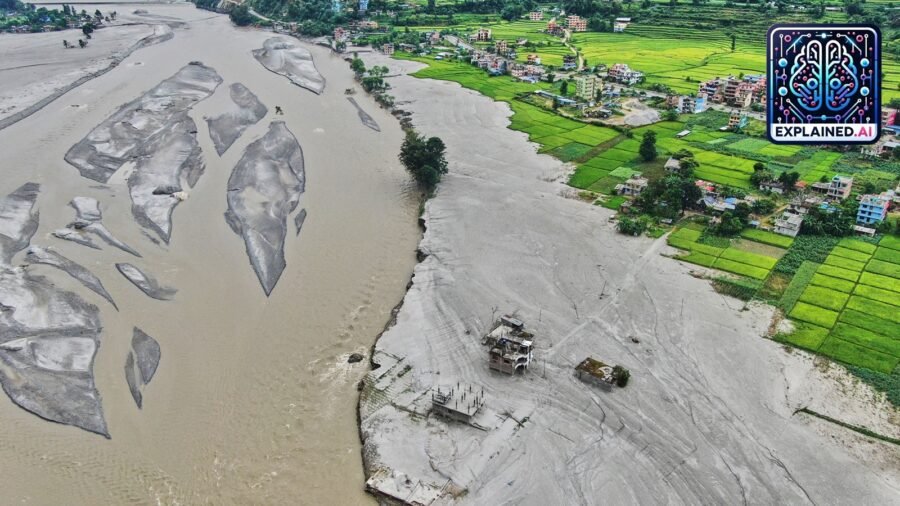
Disaster preparedness and management are no longer confined to designated authorities. Companies like Google, national and local telecom providers, satellite companies, and others have now become an integral part of disaster management. Smartphones, and increasingly, drones, act as force multipliers, producing large amounts of data.
“The big advantage of the AI tools is their ability to process large volumes of data in a meaningful way, using natural language, speech and video, on an almost real-time basis. In disaster management situations, time is the most vital thing. That is the main reason why we are seeing increasing reliance on AI tools in disaster management. It’s a great use case scenario,” said Subimal Ghosh, head of the Centre for Climate Studies at IIT Bombay, who has been using AI to provide local forecasts of heavy rainfall events in Mumbai.
Numerous AI-enabled tools have been developed and deployed of late. Examples include GraphCast, DisasterAWARE, Google’s Flood Hub, and SKAI, which provide services such as early warning, hazard mapping, and satellite imagery. AI is now being integrated across stages of disaster management — from preparedness and early warning to response and rescue, and finally, recovery and rehabilitation.
Early warning
One of the most effective uses of AI has been in generating timely forecasts and early warnings. In general, weather forecasting is an inexact science. Forecasters routinely run hundreds of physics equations to arrive at local, regional and national weather forecasts. The more local or time-constrained a forecast, the greater the uncertainty.
Story continues below this ad
AI produces weather forecasts differently: AI models trained on vast amounts of past weather data ‘learn’ how the atmosphere behaves and churn out a forecast at a much faster rate.
“It is very difficult to get hyperlocal forecasts by just working on physics equations. It requires a huge amount of computing resources, and usually takes a lot of time. But once an AI model has been trained effectively, very hyperlocal forecasts also become possible in almost real-time. We have shown this, and it is working fantastically for extreme rainfall and flooding events in Mumbai,” Ghosh said.
For instance, Google’s Flood Hub, a research initiative, takes data from leading weather agencies worldwide and uses a prediction model. This was first used during floods in India in 2018 to forecast flooding events, including localised urban floods. It can generate advisories up to seven days earlier and even predicted recent floods in Thailand, Japan and parts of India.
But the forecast has to be combined with hazard maps that show risks of a particular type of event to make a risk assessment. This is where AI shines. It can process multiple datasets from different agencies, combine text, complex graphs and imagery to provide an overall threat assessment, based on which an early warning can be issued.
Response, relief and rescue
Story continues below this ad
This stage has been traditionally dependent on human intervention and access to physical resources, like helicopters and boats. But increasingly, AI is making its presence felt. Because everyone can broadcast visuals thanks to phones and the internet, a glut of information and misinformation is now common to most disasters.
The ability of AI tools to understand and process natural language, and make sense of unstructured data — even in local languages — is what makes efforts like those from Niraj Bhushal successful. Putting together disparate information from hundreds of different sources and extracting meaningful information is something that AI can do far more efficiently.
Post-event
Specialised tools can help locate habitats left disconnected after a disaster, assess the condition of roads, and identify locations for landing helicopters. Tools can also help local governments prioritise the distribution of food, medical aid and relief to different groups of people.
While using AI technologies can vastly improve disaster management efforts, their success remains dependent on the expertise and dedication of scientists, humanitarian workers, and other humans. As a recent report by the UN Office on Disaster Risk Reduction put it, effective disaster management still relies on strong institutions, governance frameworks, and human expertise.
Story continues below this ad
“AI introduces new capabilities… but also new responsibilities. Its value will ultimately be measured not by technological sophistication but by lives saved, and resilience strengthened,” the report said.
“The measure of success will not be model sophistication, but whether the integration of AI enables more timely, equitable, and trusted protection for those most vulnerable to disaster,” it added.

40 years ago September 28, 1986: Relief for Haryana farmers
By Sohail Khan · 28 Sep
Between Trump’s US and Xi’s China, the trap India must avoid
By Sohail Khan · 28 Sep
Farmers need a share of the solar boom
By Sohail Khan · 28 Sep
Leave a Reply