A river as a legal person
Way back in 1972, Christopher Stone, in his celebrated article “Should trees gave standing? – Toward legal rights for natural objects”, opined that whenever a new entity is provided rights, it is met with either ridicule or fear.
Ever since the Supreme Court [SLP (C) No.16879 of 2017, on 07/07/2017] stayed the judgment of the Uttarakhand High Court in Mohammed Salim v. State of Uttarakhand [WP (PIL) No.126 of 2014], which had granted “legal personality” to the Ganga and the Yamuna, things have looked bleak, to say the least, from a rights-of-nature (RoN) perspective. The poignant part was that the RoN movement was gaining a much-needed foothold worldwide, and India was lagging behind. For a country that has a rich history that fostered environment protection, followed intricately through customs and traditions, and where people grew up hearing stories and anecdotes of the symbiotic relationship between humans and nature, this was ironical.
Though Indian courts have been delivering judgments on a regular basis which act as a silver lining, the RoN movement, strictly speaking, failed to get a stronghold in India. The Supreme Court’s decision in the People’s Charioteer Organization case in 2023 — the last in line of a number of cases discussing “legal personality” — put to an end the tiny ray of hope that earth jurisprudence aficionados had. “Legal personhood status” cannot be extended to non-humans was what the judges declared. Stone’s statement was validated, yet again. One cannot but help reminiscence that this was the same Supreme Court which had in T.N. Godavarman Thirumulpad v. Union of India & Ors [(2012) 3 SCC 277], observed that “Environmental justice could be achieved only if we drift away from the principle of anthropocentric to eco-centric”.
At the Faneuil Hall, Boston, on April 18, 1859, Carl Schurz’s said: “Ideals are like stars; you will not succeed in touching them with your hands. But like the seafaring man on the desert of waters, you choose them as your guides, and following them you will reach your destiny.” These words act as a beacon light and many a time, courts in India have tried to, and have achieved as well, extraordinary success.
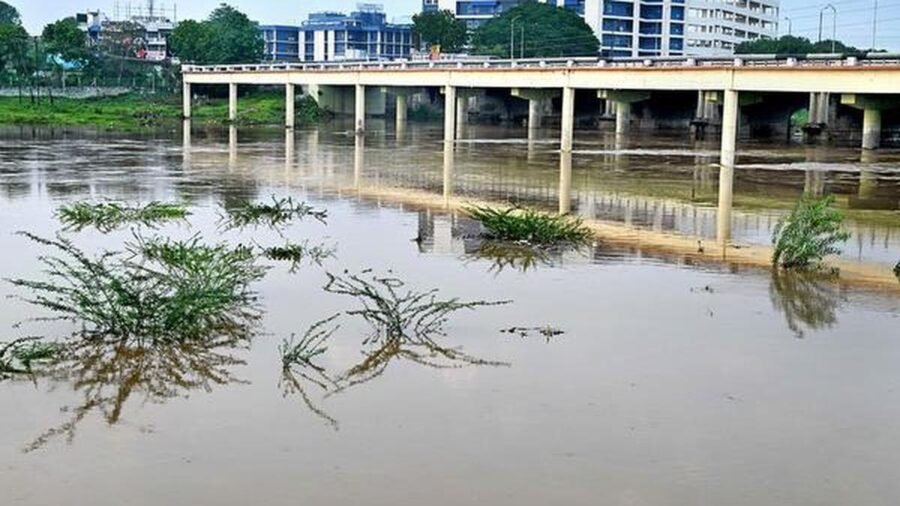
The judgment delivered on July 23, 2026, by the Madurai Bench of the Madras High Court has trodden a path less taken —and by circumventing the Supreme Court’s position, subtly, yet effectively, has once again given a glimmer of hope for earth jurists. In the Tamirabharani case, while hearing a writ petition challenging the eviction of an individual, the court had a chance to dwell into the pitiable situation that the river found itself in — as a result of the obsequies performed regularly. Statistics on record before the court stated around 90 tonnes of clothes, two tonnes of ash and around three tonnes of other waste materials were collected from the river within a span of three weeks. Observing that this was in direct violation of Section 24 of the Water (Prevention and Control of Pollution) Act, 1974, the court made startling observations about the extent of pollution. The court had to ensure a balanced stand between Article 25 — the Fundamental Right to practise and propagate religion, and the right to live in a healthy environment as interpreted as part of Article 21.
Circumventing an order
Having had to circumvent the decision of the Supreme Court whereby non-human entities can’t be afforded legal status, the judges made use of the legal conceptualisation of the term “deity”. Categorising the Tamirabharani as a deity, the court held that it was capable of being treated as a “legal person”. While this move allowed the court to recognise the “intrinsic value” of the river, it is pertinent to note that the judges were particular about their stand that this conferment of “legal personality” is solely to ensure that the river is not polluted. The court also laid down stringent measures that need be in place to ensure that there was no pollution.
However, the court erred in pointing out that the immersion of ashes need be treated differently — clearly putting across the point that religion and religious practices are so intertwined with human life. It allowed the immersion of ashes, though under specific conditions: that it be immersed only in unfired earthen pots which dissolve immediately. Statistics earlier mentioned clearly laid down that a little over two tonnes of ash was collected during the cleaning drive. Cremated human remains, or cremains, pose an environmental threat in varying degrees. Studies have shown that in lotic systems (rivers and streams), it causes moderate to high ecological risk levels. While in high-volume flowing rivers, it might not be a concern, in designated areas of mass cremation, continuous immersion of ashes overrides the river’s self- purification capacity.
Sea burials
Marine systems seem to be the best bet, for obvious reasons, and certain jurisdictions, for example, the United States, do allow “sea burials”, or “scattering of cremains“, provided it is at least three nautical miles from land, as laid down in the Marine Protection, Research and Sanctuaries Act, 1972. It specifically allows only human remains and categorically excludes non-human remains including of pets and materials which do not decompose easily such as plastic or metal flowers and wreaths.
While Section 502(6) of the U.S. Clean Water Act defines a pollutant to specifically include biological materials, Indian pollution control laws tackle it differently. The Water (Prevention and Control of Pollution) Act, 1974, does not define it, whereas air pollutant is defined in Section 2(a) of the Air (Prevention and Control of Pollution) Act, 1981. The Water Act, however, while defining pollution under Section 2(e), mentions that it includes among other things, alteration of the biological properties of water — which is very much the case in lotic systems where mass cremation/rites take place — and to treat the immersion of ashes differently, as the court did in the current scenario, placing reliance on rituals as an integral part of Article 25 which guarantees a Fundamental Right to practise religion, is in effect counterproductive.
By not falling back on one of the reasonable restrictions — health — on this right as enumerated in Article 25(1), the court has erred. The term health should not have been construed restrictively, but as including both human as well as environmental health, and should have been read not only in the context of Article 21, the irrefutable right to life and personal liberty, providing an avenue to restrict the application of Article 25 itself but also as a means for imbibing an eco-centric approach.
Above all, the court could have fallen back on Indian customs and traditions which treat nature as a mother, and impose a positive duty on humans not to pollute Mother Earth, even if it is in pursuance of one’s religious beliefs.
Manjeri Subin Sunder Raj is the only Indian member of the Expert Group on Harmony with Nature, United Nations. He teaches law at CHRIST University, Bengaluru.

Kochi Is changing the way it dates, talks about sex and relationships
By Sohail Khan · 26 Sep
Post-World War II norms cannot fix today’s problems
By Sohail Khan · 26 Sep
A bronze medal, quiet gains in table tennis
By Sohail Khan · 26 Sep