The Mighty American Consumer Is Crashing Through Inflation and Driving Growth

Spending is rising because prices are climbing and Americans are buying more stuff.
Updated on: Oct 5, 2026, 08:30:24 IST
Prefer HTon Google
Share via
Copy link
CHICAGO—Happy hour at Chicago’s Bar Roma was buzzing this past week as locals poured in for $10 cocktails and $11 bruschetta. Kathleen Harper and her husband would normally share a few appetizers, but tonight they were splurging on the $50 tasting menu.
“After a long day—I work from home—I like to just get out of the house,” said Harper, who sells fraud-protection services. “Business has been good,” she added, “because fraud, unfortunately, is up.” She worries about the overall health of the economy and rising prices for gas and groceries, but feels secure enough to enjoy a good happy-hour deal.
Decisions like that across the economy show America’s appetite for consumption is expanding. Americans are spending more on food, travel, couches, Halloween decor and most anything else they want or need—pushing through inflation and their own gloomy feelings about the economy.
The dollar amount spent by U.S. households rose by 6.1% in the 12 months through August, up from annual growth of 4.3% at the end of last year, the Commerce Department reported. Economic growth for the second quarter of 2026, the most recent data available, was revised upward this past week, fueled by consumer spending and business investment.
“For all the talk about AI data centers, the main engine of growth for GDP in the United States has been broad-based consumer spending growth, which I think is tied to a broad-based, stable labor market,” Austan Goolsbee, head of the Chicago Fed, told journalists after an economic forum this past week.
Hiring slowed last month, though the unemployment rate remains low.
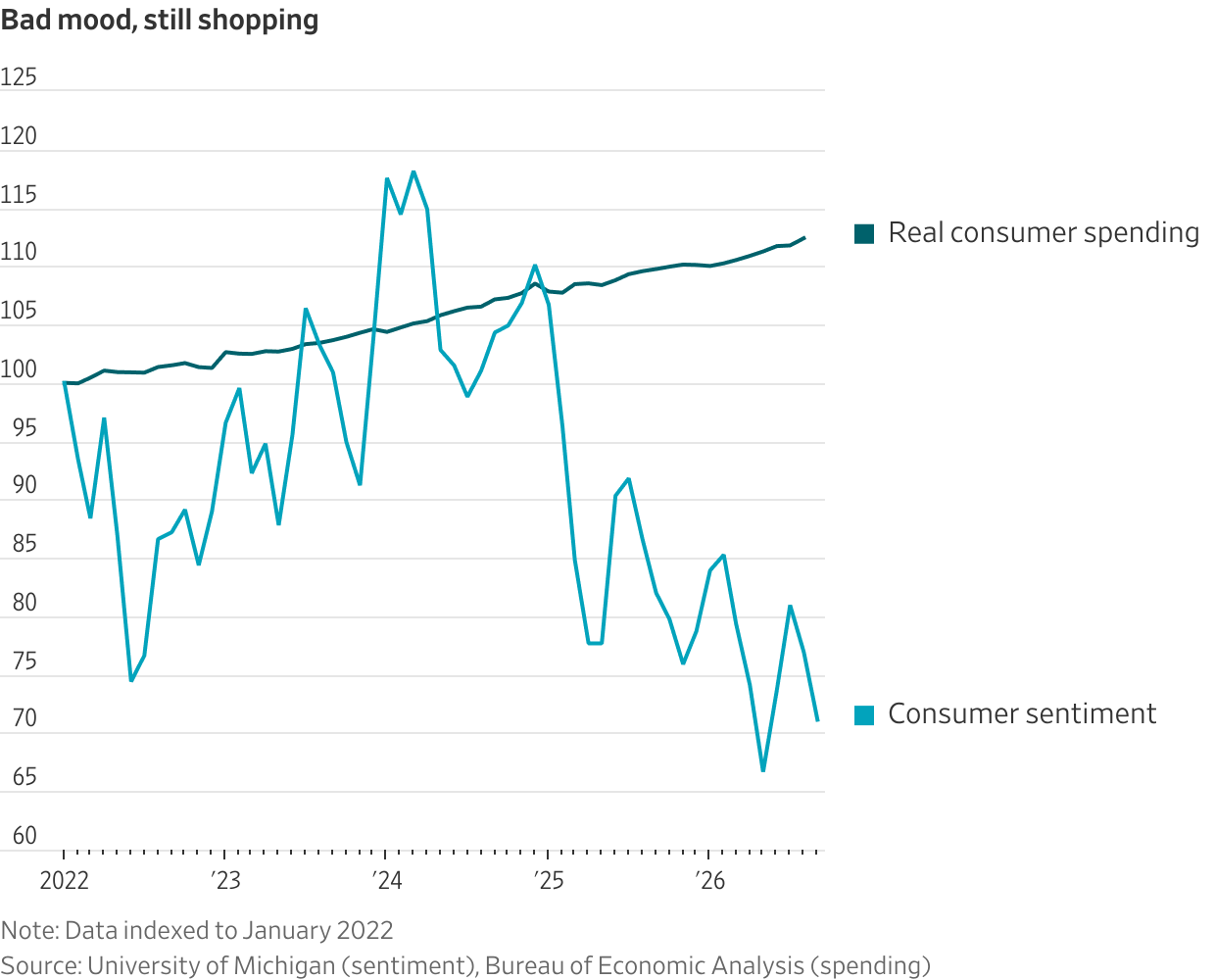
Spending is rising because prices are climbing and Americans are buying more stuff. Just over half the spending increase in the year through August owes to the persistent inflation that has frustrated many shoppers: Consumer prices were up by about 3.4% over that period. But inflation-adjusted spending climbed by 2.6%, too, extending a streak of steady growth over the past five years.
Supporting all that consumption is an economy that might frustrate Americans but is nonetheless keeping spending habits afloat. The job market has cooled from the postpandemic surge, but remains sturdy, with unemployment hovering at historically low rates.
Meanwhile, many older Americans who own homes and stocks have benefited from soaring prices for both. A larger net worth might not mean a higher monthly income, but it has made many people comfortable spending a bit more than they would otherwise.
Upbeat spending is particularly remarkable because it seems to contradict downbeat consumer sentiment. Long-running gauges of consumers’ moods are running near historic lows, weighed down by high gasoline prices, subdued hiring and contentious politics. Lousy consumer moods once correlated with lower consumer spending, but since the pandemic, sentiment has increasingly decoupled from spending and other economic indicators, economists say.
The University of Michigan’s monthly sentiment index is just a hair above a record-low level it touched earlier this year. A similar survey, by research group The Conference Board, turned in its lowest reading in 12 years last month.
“The macro numbers look good…spending looks good. And no one is happy,” said Brian Fabes, senior fellow at the research group NORC at the University of Chicago.
Fabes attributed much of the spending to high earners, while Americans in the middle search for value and those at the bottom scrape to get by. For the poor, “spending isn’t actually a choice,” Fabes said. “You can’t not buy food. You can’t not buy housing.”
Down the street from Bar Roma at a high-end furniture store, retired lawyer Alice Withaar, 65 years old, was looking for a sofa, a coffee table and two side chairs. “I’ve lived with my old stuff for a long time and it’s time for a refresh,” she said.
Rising prices bother her. At lunch with a friend, they grumbled about everything being “twice as expensive,” Withaar said. But her old sofa is threadbare, and she no longer has to worry about pets ruining her furniture, so she is ready for an upgrade. “I don’t mean I have unlimited money,” she added. But she is able to spend “whatever it’s worth to me.”
A survey by the New York Fed suggests spending growth has been fairly even across income groups. People who earned less than $50,000 said that their spending rose by 4.7% in the year through August, while those who made more than $100,000 said their spending grew by 4.4%.
Charlie Zhang, 30, a charity fundraiser who was canvassing for donations near Bar Roma, said he was trying to bounce back after getting into credit-card debt and declaring bankruptcy. He earns $24 an hour, giving him just enough to split his $2,800 rent with a roommate and to cover his Taco Bell habit and an occasional Uber.
Zhang has been trying to save by cooking more at home, or at least picking up his fast food rather than paying for delivery. “When I’m home and I’m exhausted, I’m like, ‘I can’t spend $30 for, like, a burrito right now. I got to just go walk over there.’” When he thinks about the future he feels “pretty down,” he said.

Wealthier Americans have a rosier outlook. Since May 2025, consumer sentiment has risen for people who own the most stocks, while it has fallen for those who don’t own any, according to Joanne Hsu, director of the Michigan survey. During that stretch, the broad S&P 500 stock index has handed investors a roughly 32% return.
Because spending is growing faster than disposable income, it might stall as people face the limits of what they have in savings or want to borrow, said Gregory Daco, chief economist at EY-Parthenon. Americans’ saving rate has been trending down and is now at the historically low level of 4.1% of after-tax income, versus almost double that before the pandemic. Meanwhile, Americans are taking on record levels of debt to fund their lives.
“People are using their savings, they’re using credit, they’re using wealth, and they’re trying to find different ways to finance their outlays,” Daco said. “But these alternative resources are finite.”
Liz Senator, 28, a civil engineer from Atlanta, sees plenty of negative news and social-media posts about the economy, and some of her friends have struggled with long stretches of unemployment. But for her, costs have felt more manageable now that she is married and splitting more living expenses with her husband, a cybersecurity researcher. Over nearly four years of full-time work since getting a master’s degree, her salary has gradually climbed by about $20,000, giving her a slightly more comfortable budget each year.
Senator still tries to be frugal when eating out with friends, especially as she and her husband save up to buy a house. Still, when her husband’s cousin was getting married in Hawaii this summer, the couple didn’t hesitate to RSVP despite high airfares, and they didn’t feel like they needed to cut back elsewhere to afford the trip. The looming need to replace her aging Honda also isn’t a major anxiety.
“When I first started working, I felt like what I was making was just enough to get by,” Senator said. “Now, it feels like there’s a lot of breathing room.”
By and large, consumer businesses are seeing solid demand for their goods and services.
In the latest quarter, which ran through June, ticket sales at StubHub were up 34% from a year earlier, lifted by the crush of fans shopping for World Cup seats. Other companies selling restaurant meals, furniture and vacations have posted more modest numbers, but say that customers, for the most part, aren’t afraid to treat themselves.
When money feels tight, many people often cut back on extras such as casual meals out or streaming subscriptions, said Mark Mathews, chief economist at the National Retail Foundation. But recently, spending behavior doesn’t reflect the gloom that many people say they feel. Back-to-school spending this year rose at a double-digit year-over-year pace.
“Consumers are spending their financial condition, not their psyche,” Mathews said.
In projections based on its credit-card data, Mastercard expects U.S. holiday shopping to rise 5.5% this year, which would be the fastest growth rate since 2022. Rising prices would likely account for about half that increase, the card issuer said, with the rest coming from a higher volume of purchases.
Write to Jeanne Whalen at Jeanne.Whalen@wsj.com and Matt Grossman at matt.grossman@wsj.com
See Less




Leave a Reply