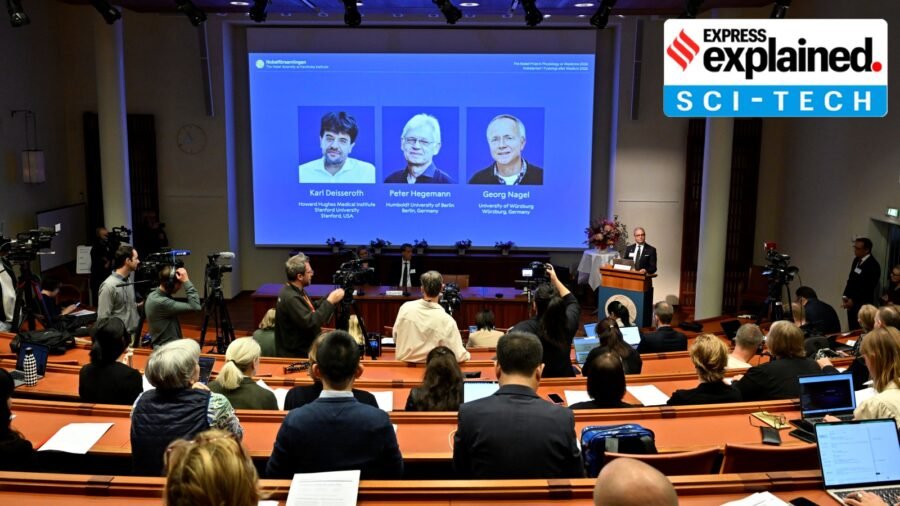
Nobel Medicine Prize 2026: How three scientists discovered a way to control brain cells with light
Story continues below.
Subscribe to see fewer ads.
In simple terms, they found a way to control cells with light. Imagine that the brain is a vast electrical network containing billions of tiny cells called neurons. These neurons communicate by sending electrical signals, allowing us to move, see, remember, feel pain and experience emotions.
Karl Deisseroth, Peter Hegemann and Georg Nagel helped scientists develop a remarkable way of controlling these electrical signals: using light. Their research led to the discovery and development of light-sensitive proteins, called opsins, that can be placed in specific cells. When light is shone on those cells, the proteins act like tiny switches, turning the cells’ activity on or off. This technology is known as optogenetics — essentially, using light to control genetically modified cells.
What is optogenetics?
It is basically a field of research that uses light to manipulate the activity of neurons or other types of cells and study the resulting effects. This is done by expressing the light-sensitive protein in the targeted cells. Within the brain, it has contributed towards identifying neural circuits responsible for sense of pain, social behaviours, thirst, food consumption, reward and attention or the understanding of how memories are created.
How did the discipline evolve?
Interestingly, the field rests on a theory proposed by Francis Crick, the molecular biologist who was behind the discovery of and was awarded the Nobel prize for the double helix structure of DNA.
Story continues below this ad
He envisioned activating individual nerve cells in a brain to investigate the mechanisms that underlie human consciousness.
With nerve signals being extremely rapid, he realised it would only be possible if scientists were somehow able to manipulate the nerve cells with light. He himself admitted that the idea sounded far-fetched.
But it was made possible by the work of Peter Hegemann and Georg Nagel on the alga Chlamydomonas. These are famous for their ability to quickly swim towards a light. Hegemann found that it reacted extremely quickly, within half a millisecond after the light reached a tiny orange dot called eyespot that the alga used to detect light. To compare, it takes 10 milliseconds for the human eye to react to light. Hegemann wondered how could the response to light be more than twenty times faster in Chlamydomonas?
He hypothesised that a single protein complex both captured light and acted on it in the alga as opposed to the multi-step process in the human eye. Yet, finding this protein was a challenge because when the proteins in the algal eyespot were removed from their natural setting, they became unstable and easily damaged. This is when he discovered that Japanese researchers had mapped the DNA of Chlamydomonas, among which were the codes for two genes that had similarities to light-capturing proteins.
Story continues below this ad
Enter Nagel. He used egg cells of frogs to express the two proteins and confirm that Hegemann’s hypothesis was actually correct. The alga detected and reacted to light using the protein channelrhodopsin-2 (ChR-2). They then introduced the cells in different types of cells and found that they all became light sensitive.
Karl Deisseroth found that ChR-2 could control the activity of specific nerve cells in the manner proposed by Francis Crick. He used it to control rat nerve cells in a petri dish and later in the rats. With Deisseroth’s lab at the forefront, researchers soon found more proteins that can turn nerve cells on and off, and which are activated by different wavelengths of light.
How does it help to study the brain?
“Imagine the brain to be a building with lots and lots of rooms — now there was no way for us to know what happens if the light is switched on in just one room. Optogenetics has given us an extremely powerful way to switch on and off the neurons and see what happens. It has allowed us to manipulate nerve cells and study its effects with unprecedented level of precision. It has completely changed the scale at which discoveries are happening in neurosciences,” said Vidita Vaidya, senior professor at the Tata Institute of Fundamental Research.
While optogenetics is still largely used in the laboratories to see which set of neurons regulate what type of behaviour in animals — it helps us look into the black box, she says — it is still ways away from therapies to help those with spinal cord paralysis.
Story continues below this ad
Dr Sanjeev Kumar Mahto, professor at IIT BHU, said it has allowed scientists to see the functions of the brain and enhance the understanding of what causes certain conditions.
Deisseroth’s research group introduced the gene for ChR-2 in 2006 and successfully used a light to activate neurons to control movements of the mouse whiskers.The same year he used the technique to wake sleeping mice by manipulating a recently discovered type of nerve cell that was suspected to control wakefulness. His team also studied the brains of mice as they experienced fear, and noted which nerve cells appeared to form the memory. When they later reactivated these nerve cells, the mice showed signs of fear, despite not being in danger at the time.
What kind of therapies are being developed based on this field?
There are ongoing clinical trials on restoring vision in people who have become blind due to retinitis pigmentosa, a disease that destroys the eye’s rods and cones. Using special glasses emitting light, the person was able to discern and grasp objects on a table. There are also hopes that optogenetics could improve cochlea implants. Currently, these implants stimulate the auditory nerve using electricity.

How skipping breakfast for a month affects men and women differently
By Sohail Khan · 5 Oct

Legislative privileges vs free speech: The question before Supreme Court
By Sohail Khan · 5 Oct
Leave a Reply