How was Gandhi’s portrait chosen to appear on rupee notes?
Story continues below.
Subscribe to see fewer ads.
The origins of Gandhi’s image on Indian currency
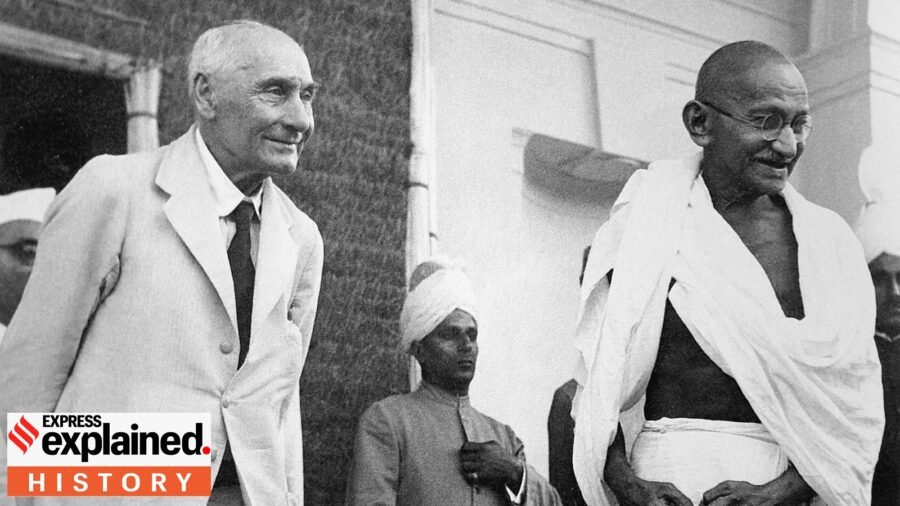
The portrait of Gandhi visible on banknotes isn’t a caricature. It’s cut-out of a photograph taken in Delhi in 1946, where he is standing with British politician Lord Frederick William Pethick-Lawrence. The photograph was selected as it had the most suitable expression of Gandhi smiling — the portrait is a mirror image of the cut-out.
The identities of the photographer of the particular photo and the person who shortlisted it remain unknown.
What was on the banknotes before Gandhi?
For a few months after the declaration of independent India on August 15, 1947, the RBI continued to issue notes from the colonial period featuring King George VI.
The government of India brought out its new design of the 1-rupee note in 1949 — in the watermark window, King George was replaced with a symbol of the Lion Capital of Ashoka Pillar at Sarnath.
Story continues below this ad
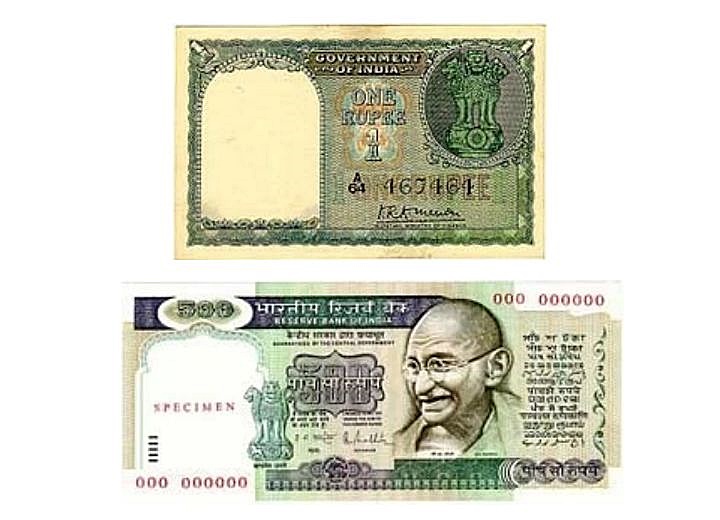 The one-rupee note (top) and the later Rs 500 note that featured Gandhi. (RBI)
Sharing deliberations from the period, the RBI museum website notes, “Symbols for independent India had to be chosen. At the outset, it was felt that the King’s portrait be replaced by a portrait of Mahatma Gandhi. Designs were prepared to that effect. In the final analysis, the consensus moved to the choice of the Lion Capital at Sarnath in lieu of the Gandhi Portrait. The new design of notes were largely along earlier lines.”
Consequently, in 1950, the first Republic of India banknotes were issued in denominations of Rs 2, 5, 10 and 100. All of them bore the Lion Capital watermark.
Over the years, legal tenders of higher denominations were introduced, and the motifs on the back of the notes transitioned to represent new India — from fauna motifs such as tiger and sambar deer in the early years, to motifs depicting agricultural endeavours in the 1970s, such as farming and plucking of tea leaves.
The 1980s saw emphasis on symbols of scientific and technological advancements and Indian art forms — the Aryabhatta satellite featured on the Rs 2 note, farm mechanisation on Rs 5 and the Konark Wheel on Rs 20, among others.
Story continues below this ad
When did Gandhi first appear on rupee notes?
The RBI’s Department of Currency Management is responsible for designing the rupee notes. It has to receive approval for the designs from the central bank and the Union government. According to Section 25 of the RBI Act, 1934, the design, form and material of banknotes shall be such as may be approved by the central government after consideration of the recommendations made by the central board.
Gandhi first featured on Indian currency in 1969, when a special series was issued to commemorate his 100th birth anniversary. Bearing the signature of then RBI governor LK Jha, it depicted Gandhi with the Sevagram Ashram in the backdrop.
Then, in October 1987, a series of Rs 500 currency notes, featuring Gandhi, was launched. The RBI website says, “Management of Currency had to cope with the rising demands of a growing economy, together with a fall in purchasing power. The Rupee 500 note was introduced in October 1987 with the portrait of Mahatma Gandhi. The water mark continued to be the Lion Capital, Ashoka Pillar.”
When did Gandhi’s portrait become a permanent feature on banknotes?
By the 1990s, the RBI felt that the traditional security features on currency notes were inadequate considering the advancements in reprographic techniques like digital printing, scanning, photography and xerography. It was reportedly believed that inanimate objects would be relatively easier to forge compared to a human face.
Story continues below this ad
Gandhi was chosen because of his national appeal, and in 1996, a new ‘Mahatma Gandhi Series’ was launched by the RBI to replace the former Ashoka Pillar bank notes. Several security features were also introduced, including a windowed security thread, latent image and intaglio features for the visually impaired.
In 2016, the ‘Mahatma Gandhi New Series’ of banknotes were announced by the RBI. The portrait of Gandhi continues, while the Swachh Bharat Abhiyan logo has been added on the back of the notes, apart from additional security features.
The demand to include others on banknotes
Recent years have seen several suggestions on others who could feature on currency notes, apart from Gandhi. In October 2022, then Delhi Chief Minister Arvind Kejriwal made an appeal to the Prime Minister and the Union government to put photos of Lord Ganesha and goddess Lakshmi on currency notes.
In 2014, there were suggestions to include Noble Laureate Rabindranath Tagore and former President APJ Abdul Kalam. Addressing the Lok Sabha, then Finance Minister Arun Jaitley stated that the RBI had rejected suggestions of replacing Gandhi’s portrait with any other leader on the bank notes.
Story continues below this ad
He said, “The Committee (constituted by RBI) decided that no other personality could better represent the ethos of India than Mahatma Gandhi.”
In the same year, then RBI governor Raghuram Rajan also stated that India did have many great personalities but Gandhi towered above all others, and many others could also be controversial.
This is an edited version of an earlier explainer.

From giraffes to pandas: The millennia-long history of animal diplomacy
By Sohail Khan · 2 Oct
Riding Elon Musk’s Falcon 9 to space, how a Made-in-Gujarat satellite will help India
By Sohail Khan · 2 Oct
‘She was constantly burping’: Cardiologist recalls unusual heart attack case
By Sohail Khan · 2 Oct
Leave a Reply