From fractured to formidable: How Marijne helped resurrect Indian women’s hockey
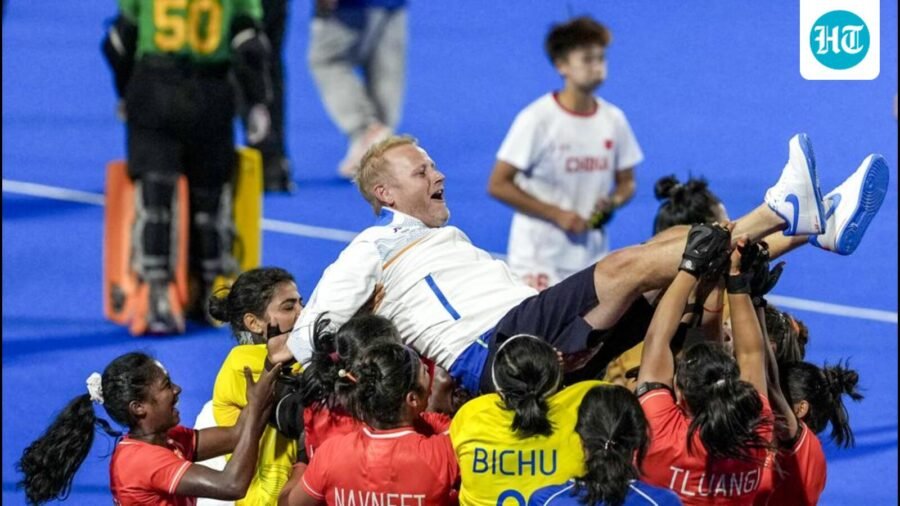
India's women’s hockey team, revived by coach Sjoerd Marijne, transformed from despair to champions, clinching gold at the Asian Games and qualifying for the 2028 Olympics.
Updated on: Oct 3, 2026, 13:57:45 IST
Prefer HTon Google
Share via
Copy link
New Delhi: Not long ago, the Indian women’s hockey team was a fractured unit, drowning in the echoes of missed opportunities.
Relegated from the FIH Pro League, starved of top-flight international fixtures, and reeling from the heartbreak of failing to qualify for the 2024 Paris Olympics, the squad was bogged down by internal rifts. The turbulence and mounting failures claimed the tenures of two successive coaches, Janneke Schopman and Harendra Singh.
The Tokyo Olympics high — an unprecedented fourth-place finish under Sjoerd Marijne in 2021 — felt like a distant memory. The team desperately needed a catalyst, and at the start of this year, they found one in the return of a familiar face.
Stepping back into the fold, Marijne engineered a metamorphosis that has dramatically rewritten the narrative of Indian women’s hockey. Within months, a divided dressing room was transformed into an unbreakable sisterhood.
The turnaround wasn’t born of complex tactical overhauls, but of a fundamental cultural reset. To mend the divided squad, Marijne cleared everything back to a single, uncompromising philosophy: the team comes first.
“It’s not one thing, it’s a combination,” the Dutchman had told this paper ahead of the Asian Games. “The most important thing is creating a culture where players can be themselves, where the discipline is really high. I have high expectations, but also a lot of space for fun and enjoyment.”
He dictated a clear message to his players: “Focusing on team goals will help you achieve personal goals. But focusing on individual goals, you’ll never achieve team goals. We created unity. We created the belief that they can do more than they think.”
Former India captain Pritam Rani Siwach pinpointed exactly how Marijne healed the divide. “What Marijne does is he lets the girls be free and play freely. He does not scare them that if they don’t play well, they will be dropped,” Siwach told on Saturday.
“Secondly, he makes the players mix with each other. He doesn’t allow the segregation of junior and senior players in the team. He never lets that happen. He doesn’t allow any mischievousness in the team and makes everyone play together with unity,” said the Dronacharya awardee, five of whose wards — Neha Goyal, Jyoti, Shilpi Dabas, Sakshi Rana and Ishika — are in the team.
This unified front translated directly into on-field milestones, sparking a relentless winning momentum. Marijne’s first major test came quickly, and he delivered by guiding the team to victory at the World Cup Qualifiers in Hyderabad in March. Riding that wave, India then clinched the Nations Cup in June, a crucial triumph that promoted them back into the elite FIH Pro League.
The true litmus test, however, was the World Cup in the Netherlands and Belgium. Operating with a squad featuring 11 debutants, Marijne deployed a decentralised leadership model. Seniors like Savita Punia, Navneet Kaur and Neha set the standard, allowing younger players to thrive without fear. The result was a brilliant fifth-place finish, India’s best showing since the inaugural edition in 1974.
Navigating elite opposition, India suffered just one defeat in the tournament — a hard-fought 0-2 loss to world No.1 Netherlands. They showcased extraordinary grit, holding Paris Olympics silver medallists China, a formidable England squad, and two-time world champions Australia to grinding draws. Apart from a 6-1 hammering of South Africa, the highlights of the campaign was a resounding 3-1 victory over two-time world champions Germany.
This resilience was underpinned by elite physical conditioning, spearheaded by Wayne Lombard — also brought in by Marijne — and a solid support staff that includes analytical coach Matias Vila, scientific advisors Rodet and Ciara Yila apart from multiple physios and video analysts.
Using advanced data analytics and GPS trackers, Lombard ensured the players had the stamina to transition seamlessly between a rock-solid defence and rapid counter-attacks.
Former India chief coach Neil Hawgood, under whom the team qualified for their first Olympics in 2016 after a 36-year gap, summarised Marijne’s tactical approach perfectly. “Sjoerd gives them structure and discipline and the freedom to play within those boundaries,” Hawgood told from Perth.
Yet, the crowning glory of Marijne’s return was still to come at the Asian Games. Entering the tournament with their belief fully restored, India remained unbeaten. In a fairytale climax, they stunned the defending champions and Paris Olympics silver medallists China, ending an agonising 44-year drought to claim the Asian Games gold. That historic victory brought with it the ultimate prize — a direct qualification ticket to the 2028 Los Angeles Olympics.
From a team that had seemingly lost its way to continental champions bound for Los Angeles, the Indian women’s hockey team has risen from the ashes.
The foundation is now undeniably solid. With their Pro League status restored and the Olympic ticket secured, Marijne has afforded his squad the greatest luxury in international sports: time, two years to be precise.
As Siwach aptly concluded, with their ticket punched for LA, “They have a lot of time to prepare the girls and the team to do well at the Olympics.”
See Less

Aman Sehrawat wins men’s freestyle 57kg gold at Asian Games 2026
By Sohail Khan · 3 Oct
India beat Pakistan to win Asian Games T20 gold in high-scoring final
By Sohail Khan · 3 Oct
Leave a Reply