Congress’s Karnataka strategy: In power, but still in street protest mode
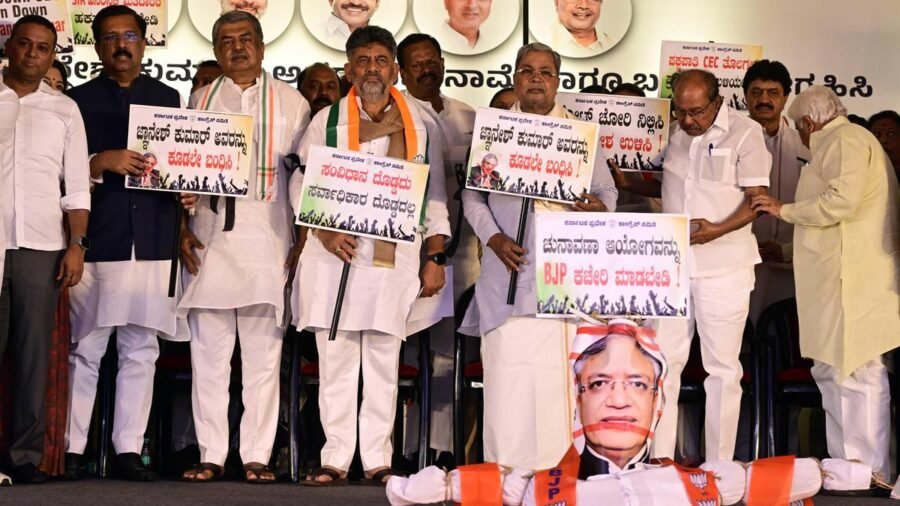
Since returning to power in Karnataka in May 2023, the Congress has increasingly taken to the streets, staging protests on a range of issues, many directed against the Centre or its agencies. The strategy appears aimed at keeping its political base mobilised while projecting itself as a party willing to challenge what it describes as injustice to the State.
Protests, however, are not new to the Congress in power. The party has taken to streets over developments perceived to be against Karnataka’s interests, particularly the Cauvery river water dispute and language and border issues. During the tenures of S. Bangarappa in 1991 and S.M. Krishna (1999-2004), the Congress organised protests and padayatras against what it termed injustice to Karnataka in the sharing of Cauvery river water.
Shifted orientation
What has changed today is the range of issues and the frequency of such agitations. With the Left parties losing much of their electoral influence over the past decade, the Congress has increasingly occupied the space of political mobilisation on economic and social issues while taking on the BJP-led NDA government and central agencies. Under Rahul Gandhi’s leadership, the party appears to have adopted a more pronounced left-of-center position on several issues.
Since 2023, the then Chief Minister Siddaramaiah, Chief Minister D.K. Shivakumar and their Cabinet colleagues have led several protests, making street mobilisation an instrument of the State government’s politics. The issues have ranged from the alleged discriminatory allocation of central funds to the Special Intensive Revision (SIR) of electoral rolls.
Barely a month after assuming office (June 2023), the Congress government protested against the Centre’s decision not to supply rice for the Anna Bhagya scheme, which promised 10 kg of rice to every member of eligible families.
On February 7, 2024, the government launched the ‘Chalo Delhi’ campaign to highlight what it described as an inequitable allocation of central grants and the Centre’s “stepmotherly” treatment of Karnataka. Mr. Siddaramaiah led a protest in Delhi along with his Cabinet colleagues.
In August 2024, Congress ministers protested against Governor Thaawarchand Gehlot’s decision to sanction prosecution of Mr. Siddaramaiah over alleged irregularities in the allotment of 14 sites to his wife, Parvathi, by the Mysuru Urban Development Authority. Later, sites surrendered.
Congress leaders D.K. Shivakumar, H.K. Patil, G. Parameshwara, and others take out a Raj Bhavan Chalo protest rally from Vidhana Soudha, against Governor Thaawarchand Gehlot, for permitting prosecution of then CM Siddaramaiah in the MUDA site allotment scam, in Bengaluru on August 31, 2024.
MURALI KUMAR K
National agenda too
The party’s protests have also increasingly reflected its national political agenda. On August 8, 2025, Rahul Gandhi led a rally at Freedom Park in Bengaluru, alleging vote theft in the 2024 Lok Sabha election and accusing the Election Commission of India (ECI) of colluding with the BJP to “steal seats and elections." He also demanded an investigation into alleged electoral irregularities in the Mahadevapura Assembly constituency.
In January 2026, Congress leaders protested against Mr. Gehlot for refusing to deliver the State government’s prepared address at the joint legislature session.
In the legislature
The Legislature has provided another platform for agitation. During the 2026 monsoon session, Congress ministers and legislators demonstrated in front of the Mahatma Gandhi statue on the Secretariat premises, accusing the BJP and JD(S) of disrupting proceedings by demanding Minister B. Nagendra’s resignation. Mr. Nagendra subsequently quit the Cabinet.
The party has also used protests to highlight wider national concerns. On September 17, 2026, KPCC president B.K. Hariprasad and Youth Congress members observed Prime Minister Narendra Modi’s birthday as “Unemployment Day.”
More recently, the Congress intensified its agitation against the ECI and Chief Election Commissioner Gyanesh Kumar over alleged irregularities in the SIR, demanding his resignation, believed to be following the instructions from the top brass.
The growing reliance on protests suggests that the Congress sees street mobilisation as more than an instrument of opposition politics. For a party in power, such agitations are believed to help articulate the State’s demands before the Centre, reinforce its national political positions, and keep its organisation active between elections.

Prices rising fastest for those who can least afford it: Raichur MP
By Sohail Khan · 2 Oct
Sachin Yadav assumes charge as KFON MD
By Sohail Khan · 2 Oct
Leave a Reply