Childhood: sold, silenced, stolen
(Names of all the minors in the story have been changed to protect their identity)
Most nights, Kirti, in her teens, is jolted awake by nightmares of a marriage ceremony she never chose: the raucous twang of a banjo band rattling out popular Hindi-film songs, garlands swaying chaotically, and a stranger, nearly twice her age, waiting at the other end of the mandap, where Kirti is dressed like the bride.
Kirti’s nightmare is triggered by the harsh generational reality of childmarriage, which continues to be practised by families across Maharashtra’s drought-prone Marathwada region.
Here, child marriage is not simply a consequence of tradition. Families say fears over girls’ safety, so-called family honour, migration, and economic insecurity leave them with few choices. Activists point to predators, weak institutional protection and a growing marriage market that exploits vulnerable families.
The result is a cycle in which married minor girls often face violence or abandonment and return to the same homes where the next generation of girls is growing up.
Despite laws and government campaigns aimed at ending child marriage, breaking the cycle remains a long and lonely battle for the girls who choose education and independence.
Kirti lives in Kathoda, 27 kilometres from the region’s historical Beed district, with her maternal grandparents Suman and Achyut Ovhal.
Suman says her own mother was married at 13 and hated it. “But then there was no other option, and I was married at the same age. Mulgishyanizali ki gharatthevta yet nahi [Once a daughter attains puberty, she cannot be kept in the house],” says Suman. After she was married, she adds, her foremost responsibility was to deliver children, preferably sons. She birthed four daughters and then a son.
A majority of children born to underage mothers are not delivered in medical institutions, even though there are some government hospitals in the region. In fact, the Aadhaar cards of many women here mention only their ‘tentative’ ages.
Both Suman and Achyut work as daily-wage labourers, even though they own a 1.5-acre patch of dry land.
They migrate to western Maharashtra and other States like Karnataka and Telangana to work as sugarcane cutters during the six-month crushing season — October-November onwards.
Marathwada records high numbers of farmer suicides. In 2025, the region’s eight districts recorded 1,129 farmer suicides between January 1 and December 31, with Beed being among the worst hit, as per government data.
In the remaining six months Suman and Achyut work in their fields and take up odd jobs in their village. With an unsteady income and an uncertain future, Suman got all her daughters married before they turned 16. They have all returned to her with their children following marital disputes. Suman and her husband have been convincing their sons-in-laws to reconcile with their respective spouses.
Trapped into tradition
Kirti’s mother, Chaya, has been living with her parents for a few months. Every few months, her husband leaves her and she returns to her maternal home. Suman refuses to say why he leaves or why the couple fights. She is worried he will not come back if he comes to know about the matter being discussed publicly.
Kirti has witnessed her mother suffer through domestic violence and it colours her views on marriage. She is reticent and refuses to speak to strangers.
At the mention of school, her eyes twinkle, yet she doesn’t speak much. Circumstances have forced her to mature beyond her years and any talk of marriage brings her to tears.
Chaya blames her mother for “destroying” her life by not allowing her to finish school. Yet, even as Chaya complains, she remains unsure whether she can avoid repeating her mother’s mistake and enable Kirti to study as she wishes. Chaya, who is a mother to three girls, including Kirti, works as a daily-wager and sometimes joins her husband as a sugarcane-cutter.
Suman does see child marriage as a social evil, but also explains how society is unsafe for girls. “There are predators all around. As daily-wage workers we cannot take our daughters when we migrate for months as they are unsafe in a new place; we cannot leave them home, because they are unsafe alone,” she says.
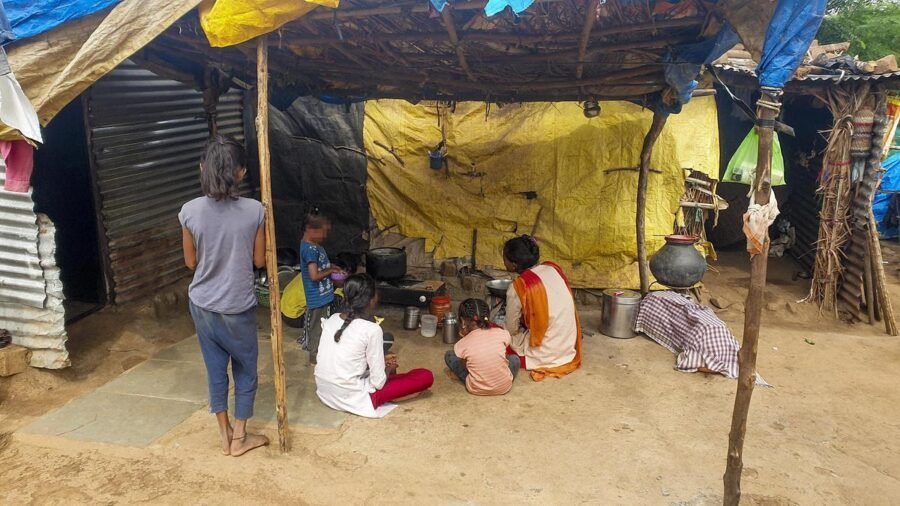
A family in Beed district weighs the future of its daughters amid poverty and seasonal migration.
Radheshyam Jadhav
For Achyut, the family’s respect in society rests upon a singular, unyielding pillar —ijjat (honour) that is inextricably bound to a girl’s character. The girl’s character is measured solely by the preservation of her virginity. He believes that if a girl elopes, is molested, abducted, or raped, it is an insult to the family.
The best solution, in his view, is to marry the girl off as soon as possible so that the responsibility shifts to her husband.
Under the Prohibition of Child Marriage Act, 2006, marriages involving females under 18 or males under 21 are classified as child marriages and are associated with cycles of poverty, inequality, and health risks, particularly in rural and tribal regions. Under the Bharatiya Nyaya Sanhita, 2023, sexual acts with a wife under 18 constitute rape.
The Supreme Court has said that a husband committing penetrative assault on a child bride can face punishment for aggravated penetrative sexual assault under the POCSO Act, 2012. The Bal Vivah Mukt Bharat campaign by the Government of India aims to reduce the prevalence of child marriage by 10% by 2026 and make India child-marriage-free by 2030. Maharashtra has the highest number of child marriage prevention officers at 21,196, as per government data.
But Achyut has a different take on the issue. “Everyone condemns child marriage and talks about ending this custom, but what about the predators who force parents into marrying off their daughters early?” he asks.
Prey for predators
Tatwashil Kamble, a child rights activist based in Beed, highlights that addressing these issues exposes a deeper systemic crisis involving political influence in molestation, rape and abduction.
He points out that predators backed by political influence frequently target vulnerable minors and pressure them to flee, leaving poor parents largely powerless to speak out due to severe intimidation. In Aher Dhanora village, some four kilometres away from Beed, a local youth lured a 15-year-old girl away from home and raped her. He continued to sexually assault her in the following days. When she resisted, he blackmailed her, threatening to tell the village that she was no longer a virgin.
When her parents came to know about this, they planned to marry her off. The local youth returned and demanded they pay him.
In Kaij, about 50 kilometres from Beed, another family mustered the courage to seek justice for their 13-year-old daughter who was allegedly molested by a local goon. Yet, her parents were subjected to severe systemic apathy — the father and the girl were forced to wait 27 hours in Kaij police station and government health centre simply to file a report and obtain medical documentation, say activists. They add that although cases of exploitation involving politically connected men, their associates, and local goons are widely discussed across Beed, fear prevents many families from speaking out.
Kamble notes that social media has fuelled the trend of minor girls eloping from their homes. “One-on-one communication has become easy because of WhatsApp and other platforms,” he says, adding that movies romanticising running away from home influence girls, even though the films are about adult women.
According to police records, in 2025, approximately 266 minor girls went missing from Beed, out of which 214 were rescued. The police say many of these girls had fallen in love with local youth online.
“Parents like me who want to educate their daughters are unable to because of concerns over social security,” says Asha Ugade, a sugarcane cutter from Kasari village, which is some six kilometres from Kaij. Married with her four sisters when she was in her early teens, Asha says her parents could not afford her education.
“My parents were landless labourers, so were my in-laws,” she reflects. Having no memory of her wedding, she recalls working as a labourer in sugarcane fields with her husband. “I started cutting sugarcane the year I was married,” she says. Asha has two sons and a daughter. Her daughter was eager to continue studies, but Asha and her husband married her off to a fabrication worker in Pune while she was still in Class 11.
“It is easy for you people to say that we must educate our girls, but you do not know what we have to face as parents of young girls — our biggest fear is their safety,” says Asha, who migrated for sugarcane cutting with her husband and could neither take their daughter along nor leave her back at home.
Asha claims her son-in-law is just a couple of years older than her daughter.

“There are predators all around… As daily-wagers, we cannot take our daughters when we migrate for months, as they are unsafe in a new place; we cannot leave them home, because they are unsafe alone”Suman OvhalResident
Brides for sale
“A majority of families marry their daughters for security reasons, but many parents exploit their own daughters,” says Ashok Tangade, chairperson of the Beed District Child Welfare Committee (CWC). In Shirur, 41 kilometres from Beed, a police case has been registered against the father and stepmother of a 15-year-old for forcefully marrying her off. The girl’s mother and maternal uncle claim monetary transactions took place before the marriage.
Not all girls have a safe route home. A few years ago, 14-year-old Sheetal from Pimpla village in Beed wanted to stay home, go to school, and play with her friends. Married off by her parents to a local farmer, Dadasaheb Toge, she repeatedly returned to her parental home. When she resisted going back, her father, Prakash Bhange, strangled and smothered her to death in a sugarcane field, according to the police. Her father told authorities, “She wouldn’t listen.”
“Girls are being treated as a commodity in the marriage market,” observes Tangade. He adds, “You will find agents who identify poor parents with minor daughters. These agents bring marriage proposals and the grooms are ready to pay the agent and the girls’ parents,” says Tangade. He adds that some parents are even auctioning their girls. Caste takes a backseat in child marriages due to the shortage of brides caused by rampant female foeticide in the region.
The National Family Health Survey (NFHS-5) puts Beed among the districts in Maharashtra with most cases of child marriages: 43.7% of women aged 20-24 were married before 18. Parbhani, a district in Marathwada, recorded the highest rate at 48%. Activists note that these numbers represent just the tip of the iceberg in Beed. While authorities have intervened to stop about 800 child marriages in recent years, filing formal cases remains difficult.
Maharashtra Women and Child Development Minister Aditi Tatkare said in the State Assembly in June this year that while child marriage rates have declined over the last five years in the State, the goal is to bring them below 10% within the next five years. “In Maharashtra, we don’t just act against the families involved, we register cases against everyone who enabled a child marriage: the priest, the band, the tent vendor, and the neighbours who attended. When an entire community is held accountable, an entire community becomes a safeguard,” she said.
Noting that child marriages frequently occur in districts with heavy seasonal migration, she announced plans to establish childcare centres during migration periods to provide parents with safe spaces for their children. She emphasised, “Child marriage is not a tradition. It is a failure of systems, of awareness, and of protection.”
Long, lonely battle
Political leaders in Beed and the Marathwada regions have popularised mass marriages, particularly during droughts or natural calamities. These ceremonies, say activists, provide an avenue for distressed masses to marry their minor daughters off.
Yogita, one of Suman’s four daughters, is worried about both her niece Kirti and her own daughter. She wants to ensure that all the girls in the family finish school, but is concerned about the money. She wants independence, but is financially insecure. A daily wager, she is currently unable to find work. “I have contacted social activists in Beed to help me complete my Class X examination. I am trying to get admission in school and appear for the exam,” she says. Not everyone in the family is happy with her decision, especially her parents. They feel that she and their other daughters must go back to their homes and fulfil their responsibilities as wives and mothers.
Yogita resists. She has experienced how minor girls face mental and physical violence with nobody to complain to. In her village alone, there are young girls who have been beaten with hammers and iron rods by their husbands until they lost consciousness. “The only way to break this vicious cycle is to educate girls and make them stand on their own feet. This is not going to be easy, as girls will have to navigate their own way and fight their own battles,” she says.
What Yogita is thinking, 15-year-old Rupali from Georai in Beed district has done. She was married forcibly to a 22-year-old man in Pune. After allegedly being tortured by her drunk husband and in-laws in the first week of her marriage, she approached a local NGO and was subsequently shifted to a hostel in Beed.
In February this year, she appeared for her Class 10 exam. She wants to study further and is now living with her parents. A local activist, requesting anonymity, said that government agencies, NGOs, and activists can only help her or any other girl to a certain extent. “There are hundreds of child marriages here and it is not possible to keep track of each one,” he says.
For Rupali, the battle remains immensely difficult, devoid of support from parents and family members who remain deeply resentful that she chose to leave her husband. She does not have any children. Now, she fights for self-respect and a future that is different from the other women in her family.
radheshyamj@gmail.com

Vigilance recovers bribe money flushed down toilet, arrests official in Keralam
By Sohail Khan · 3 Oct
Irrigation Minister asks officials to pursue clearances, speed-up Gouravelli project
By Sohail Khan · 3 Oct
Nine A.P. students begin 10-month metallurgy training in Russia
By Sohail Khan · 3 Oct
Leave a Reply