Can a police confession justify NSA detention? What Supreme Court said in Sambhal case
Background of the case
Story continues below.
Subscribe to see fewer ads.
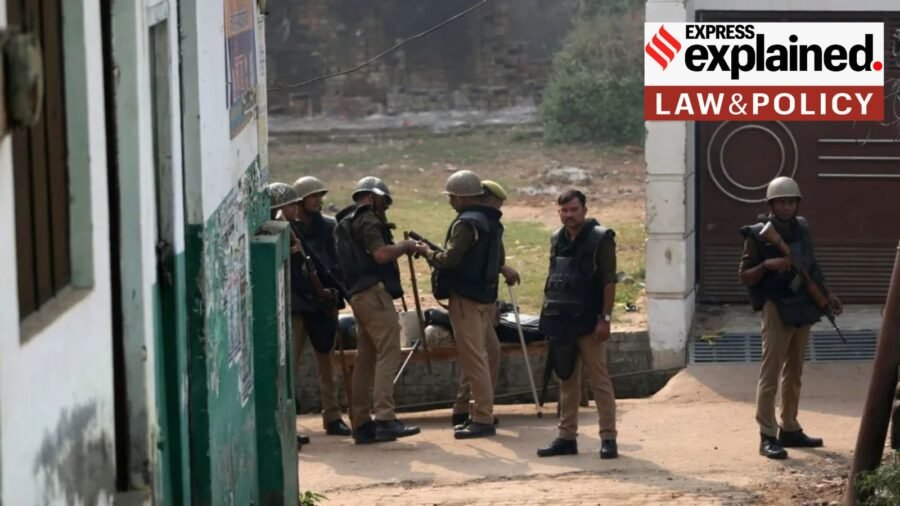
Violence broke out in Sambhal in November 2024 during a court-ordered survey of the Shahi Jama Masjid, in which four people died. Afroz, whom police described as the “principal architect” of the violence, was not named in the first FIR but was arrested 54 days later.
The police claimed that while in custody, Afroz made a confessional statement that led to the recovery of a .32 bore pistol. Afroz argued that the statement had been extracted “through torture and threats to his life.” In September 2025, the HC granted him bail in one of the criminal cases.
The Sambhal District Magistrate, over a month after his bail, invoked Section 3(2) of the National Security Act, 1980, which permits detention without trial if the state is satisfied that such a detention would prevent “him from acting in any manner prejudicial to the security of the State or from acting in any manner prejudicial to the maintenance of Public order or from acting in any manner prejudicial to the maintenance of supplies and services essential to the community.”
That detention order was confirmed by the UP government in November 2025 and upheld by the Allahabad HC in June 2026. By then, Afroz had secured bail in all six criminal cases against him — on allegations relating to murder, rioting, attacks on police personnel, arms offences and damage to public property — yet he remained in prison under the NSA. He eventually moved the Supreme Court, arguing that relevant material had not been supplied to him and that the alleged confession had been obtained through torture.
Story continues below this ad
Can a police confession sustain preventive detention?
The key question before the apex court was whether Afroz’s confession could be used to justify his detention under the NSA.
Section 23 of the Bharatiya Sakshya Adhiniyam (BSA), 2023 bars a confession made to a police officer from being proved against an accused. A confession made while a person is in police custody is also inadmissible unless made in the immediate presence of a magistrate. However, the portion of information that distinctly leads to the discovery of a fact may be proved.
The bench observed that “a confession made before a police officer is presumed to be tainted and vulnerable to the influences of coercion, threat, inducement or promise.”
The bench observed that the State had neither denied Afroz’s allegations that the confession was extracted through torture nor addressed it in written submissions. Under such circumstances, the court said that “by no stretch of imagination, can the confessional statement of the appellant be seen as voluntary in nature.”
Story continues below this ad
The court held that if a police confession is generally inadmissible to prove guilt in a criminal trial, it cannot by itself justify preventive detention. It said, “a confessional statement made before a police officer cannot, by itself, and in the absence of any independent material lending support thereto, constitute a basis for forming the subjective satisfaction necessary to sustain an order of preventive detention.”
Article 22(5) of the Constitution guarantees a detenu the right to be informed of the grounds of detention and to make an effective representation against them. The Supreme Court said that these safeguards can only be exercised when the grounds relied upon are relevant and clear.
Applying that principle, the court said that a detention order cannot rest on an irrelevant ground. Since a police confession is inadmissible to prove guilt and could not be treated as voluntary, the bench held that relying on it undermined the constitutional protection available to the detenu. “The inclusion of an irrelevant ground, no less than the inclusion of a vague or obscure ground, strikes at the heart of the protection guaranteed by Article 22(5).”
Why did the court reject the other grounds?
Having found the confession insufficient, the court examined whether the remaining material could independently sustain the detention order.
Story continues below this ad
The detaining authority had relied on CCTV footage and video recordings to identify Afroz as the “principal architect” of the violence. That footage, however, was not among the 22 documents supplied to him and was never produced before either the High Court or the Supreme Court. The bench said that any “reliance upon material which has neither been supplied nor disclosed cannot be sustained.”
Noting the 54-day gap between the violence and Afroz’s arrest, the bench said that “it defies reason” why Afroz was not arrested earlier, if the footage had clearly identified him. “This was a question which we posed, but no satisfactory answer was forthcoming,” it said.
The detention order had also referred to alleged communication between Afroz and a person who described him as “boss”, which the authorities said pointed to a criminal conspiracy behind the 2024 violence. However, the order itself recorded that the phone’s data had been erased. The SC noted that the detaining authority had neither relied on the phone nor the messages. This, the bench said, raised “serious doubts regarding the very existence of the material sought to be relied upon.”
The authorities also relied on a chargesheet to substantiate Afroz’s involvement in the violence. The SC rejected that argument, holding that a chargesheet reflects the investigating agency’s opinion and is not proof of guilt. At best, it said, it represents a “suspicion”.
Story continues below this ad
The detention order also relied on police inputs suggesting that Afroz would incite fresh violence if released on bail. The court held that such detention appeared to be “an attempt to frustrate the judicial order granting bail and to keep the detenu in custody by another route.” In those circumstances, the bench said the detention was “not preventive but punitive.”
On bail and preventive detention
The bench said that where a person is already in custody or has obtained bail, a preventive detention order must be examined with greater care. Such laws, it said, cannot be used simply to keep someone behind bars after a court has granted them bail.
The bench also said that the existence of multiple criminal cases against a person is not by itself enough to justify preventive detention. There must be reliable material to show the need to invoke such an extraordinary power.
In Afroz’s case, the court found that the distinction between preventive and punitive detention had “become blurred” as the detention order was based on the same incident and largely the same material that formed the basis of criminal cases against him.
Story continues below this ad
The court said that “the reliance placed upon the very same occurrence and substantially the same material for sustaining both the criminal and preventive detention proceedings lends considerable force to the contention that the detention order has assumed a character more punitive than preventive.”
Preventive detention, the bench observed, authorises the State to curtail liberty “not for what has been done, but for what is apprehended may be done in future”. Because of the serious impact such orders have on personal liberty, the court said they must be used only in the “rarest of rare cases” where circumstances justify them.

Jyotika praises her mother-in-law, says ‘only a queen can raise a prince’
By Sohail Khan · 1 Oct
How is HbA1c calculated? Expert explains what your blood sugar test really means
By Sohail Khan · 1 Oct
At Nagoya, promises kept, a winning arc
By Sohail Khan · 1 Oct
Leave a Reply