‘You saw my raudra roop in Bigg Boss’: Priya Malik on her transition from a vocal contestant to a poised poet
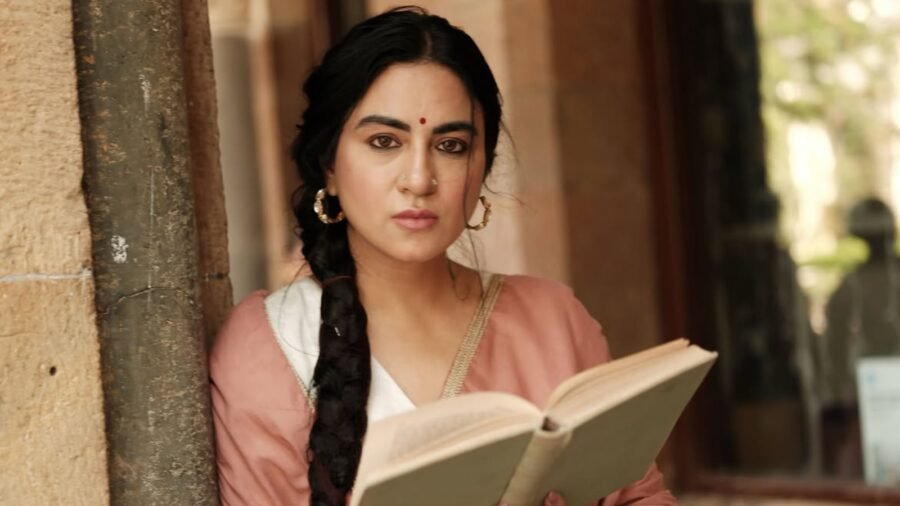
“Mai 2019 mei 1999 dhund rahi hun,” recited spoken word poet Priya Malik, drawing a rhythmic snap of fingers from the audience during the final stretch of her show Ishq Hai, her ongoing 21-city tour. The gesture means that “we like your work,” she tells indianexpress.com in an exclusive interview.
“In fact, it’s very similar to echoes of ‘Irshad Irshad’ that qualify a Mushaiyra (Urdu poetic gathering),” Priya explains, emphasising how the world of spoken word poetry also operates along the same lines.
On September 5, at Delhi’s Lok Kala Manch, people witnessed Priya 2.0, possibly the version she had been working on all these years. Compelling enough to make one admire her graceful transition from a reality TV contestant to a poised spoken word poet.
Story continues below.
Subscribe to see fewer ads.
In her words, “You noticed that raudra roop-wali Priya, the fierce Priya in Bigg Boss,” who was trying to disguise the turmoil in her personal life. “When you go through a bitter or dark phase, you start projecting that outwardly—whether it means dressing a certain way, having coloured hair, tattoos, or lots of piercings. I had to externalise my grief somehow.”
But what took you so long to continue your passion for poetry? “My inability to love myself,” she answers.
 Priya Malik inside the Bigg Boss house
Tryst with love
Malik, who hails from Dehradun, was only 12 years old when she first fell in love. “That was the first time I started writing my own poems.” Her first love story began in the school corridors. “I was in standard 7, and he was a year older. It was the kind of love that you find in books: expressive and raw,” she recalls.
But was it strong enough to last?
“I kept falling in love with different people until class 10,” she quips, suggesting that love is evolutionary. As we grow older and become more mature, its meaning begins to shift. “And when you are young, you must experience love in all its forms,” she emphasises.
Story continues below this ad
As a little girl, Malik was searching for love. But adulting taught her to love herself first: “My good, my bad, my ugly,” she reiterates. And this kind of love isn’t about grand romantic gestures. For her, the realisation happened much later.
She was settled in Australia after her first marriage, building her life from scratch. But deep down, she missed home every single day. Her relationship with her then-husband had hit rock bottom, and she would often feel guilty about “not having it all figured out at 30.
“I was in an unhappy marriage and was really depressed. I wanted to come back to India,” she says.
The desire to go back home became the premise of her viral poem ‘2019 mei 1999’, an evocative take on nostalgia. “iPhone X ke zamaane mein, Nokia 3810 dhoondh rahi hoon/ Soya milk coffee ke zamaane mein, ek adrak waali chai dhoondh rahi hoon… High-speed broadband ke zamaane mein, dial-up connection dhoondh rahi hoon… Main 2019 mein 1999 dhoondh rahi hoon.” ( “In the age of the iPhone X, I’m looking for a Nokia 3810/In the age of soy milk coffee, I’m looking for a cup of ginger tea… In the age of high-speed broadband, I’m looking for a dial-up connection…In 2019, I’m looking for 1999.”)
Story continues below this ad
As an international student in Australia, Malik was gradually making her mark as a poet. “My first spoken-word poem was an angry breakup poem because I was going through so much in my life.”
She performed it at the Australian Poetry Slam and won. And yet, despite professional laurels, she felt a void, a sense of incompletion. “I missed home, my parents and their adrak wali chai (ginger tea).” At times, she wondered why she felt so.
The missing dots in her personal life brought her back to India, to her hometown, Dehradun, where she wrote her first poem as a teenager.
“When I came to India, poetry wasn’t a career. It was just something I was doing on the side. In fact, nobody was doing it as a career. I started doing it out of sheer love for poetry,” Malik says.
Story continues below this ad
She first appeared as a reality show contestant on Big Brother Australia in 2014, followed by her stint as a wild card entry on Bigg Boss India in 2015. Besides recognition and fame, these shows helped her bag several acting projects, including the movie Sheer Qorma, where she featured alongside Swara Bhaskar, Divya Dutta and Shabana Azmi.
 Priya Malik at the Delhi show
‘My home in 2019’
The reality shows earned Malik both fame and work. By 2019, she was living in a studio apartment and working on multiple projects. And yet, she felt incomplete. “Once again, I was searching for the missing link. Ab main 2019 mein 1999 dhund rahi thi (Now I was looking for 1999 in 2019)”
Despite a successful career, Malik was not content with the path her life was taking. “That kind of fame is very short-lived,” she asserts. Then came Karan Bakshi, her now-husband, whose arrival changed how she looked at life. His serendipitous presence made her fall in love with poetry all over again.
The two lived in the same building in Mumbai. “Karan lived on the floor above mine,” she shares. They started as strangers, then neighbours, and gradually her ‘upar wala padosi’ became an inseparable part of her life.
Story continues below this ad
When Bakshi came, it was nothing like love at first sight. Her interactions with him were anything but warm. “They were cordial in a way that neighbours should be. I didn’t approve of him after our first meeting.”
But one day, she fell sick, and the first person she reached out to for help was this ‘upar wala padosi’ (upstairs neighbour)
“He looked after me the entire night while I was shivering with fever. For the first time in many years, a man felt like home, and I kind of time travelled to 1999,” she says.
“Love has this beautiful, transformative way of softening the edges that you have hardened around yourself. I felt like I was a coconut—a hard shell, but inside there was this vulnerable, confused girl who didn’t know what to do. Then, by loving myself, I was able to allow someone else to love me completely,” she reminisces.
Story continues below this ad
How love shaped her
Meeting Bakshi changed Malik’s perspective on life. She was once again feeling like the carefree girl of 1999. “There is so much beauty in being able to transition through different life roles while having your core remain the same. So, after all the reality TV shows and everything else, I eventually found myself.”
She spent the first 30 years of her life trying to answer two questions: What do I want to do in life? Who do I want to be? Reality TV made her famous, but her true calling was always poetry. Bakshi’s presence taught her self-worth, and she finally chose poetry as a full-time profession.
 How love shaped Priya Malik
Priya 2.0
After Ishq Hai, Malik wants to just soak in the love and admiration she has earned from her fans.
But why does she want to bring the curtains down to such a hit show? She explains, “It’s like every good sentence needs a full stop at the end; otherwise, the sentence is not complete. I think I’m just trying to give it a beautiful ending. And as poet Sahir Ludhianvi said, “Kisi khoobsurat cheez ko agar anjaam dena mumkin na ho, toh usse khoobsurat mod dena achha.” So I think this is that moment for me.”
Story continues below this ad
But it’s not the end of her journey as a poet. There is a new show in the pipeline as well. At the same time, she doesn’t deny a resurgence of Ishq Hai in a couple of years, “never say never,” she continues.
Her book is also coming out in the next couple of months. “So you will not just find me on stage, but on a page as well,” she reveals.
On Gen Z
Malik’s work travels across age groups. “It’s not like, ‘Oh, Gen Z is trending, so let me write something for them. I know people do that, but I absolutely don’t. I need to write about things that I genuinely and passionately feel about,” she shares.
For her, it’s all about staying true to her craft. “You can’t be writing to cater to virality,” she reiterates, saying it makes her immensely happy to see people from an 18-year-old to an 80-year-old follow her work. And she credits poetry for making it possible.
Story continues below this ad
“Poetry is a beautiful medium to break down all types of walls and make people feel at ease,” Malik asserts. Perhaps that’s why her work stands out in an age of ‘blink-and-miss’ Instagram reels.
No wonder Gen Z is drawn to her work, as was evident at Lok Kala Manch, where they lip-synced to every line, clapped at every pause, and shed a tear or two when their hearts were full.
“I think Gen Z really knows what it wants, and it’s not afraid to ask for it. When I see them come to a show and spend two hours listening to poetry, I feel that is such a big achievement. In a world where attention spans are now less than 30 seconds, to have them sit through a show, feel all the feels and engage with it—I think it is just so beautiful to behold.”
When asked how she justifies love in the time of situationships, she paused for a little while before continuing, “I have nothing against people exploring different kinds of relationships. I think we did too. Millennials have done it. Your 20s are for you to explore things. But if you’re looking for a connection, a lifelong relationship, then you also need to separate the prince from the frogs.”
“But don’t get married before 30,” she advises. “I personally feel nobody should get married before 30. That’s something I really subscribe to,” she reiterates, suggesting why organic connections are always a better choice over rushed decisions.

Baft-e-Hawa: Janhvi Kapoor turns heads in a 460-count Bengal muslin sari in Paris
By Sohail Khan · 6 Oct
Higher yields in US test India’s macro resilience
By Sohail Khan · 6 Oct
Christa Pike case exposes the myth of ‘humane’ execution
By Sohail Khan · 6 Oct