Women should take back the night
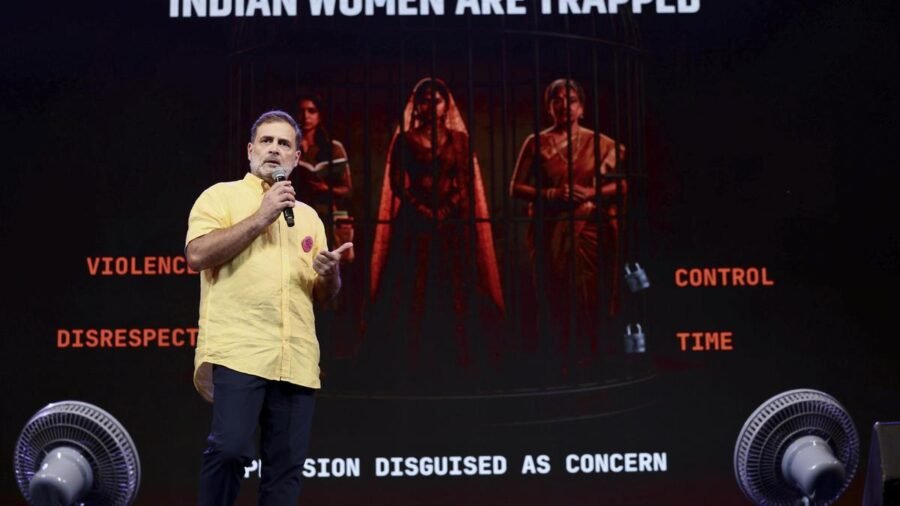
The Leader of the Opposition, Rahul Gandhi, recently caught patriarchy by the horns at Pune’s ‘Chhatron Ki Goonj’ women-only conclave.
He confronted the vulnerability of women in public spaces by explicitly framing women’s autonomy as ownership not only of their bodies but of their lives. Instead of considering women merely as a constituency to be protected, Rahul Gandhi questioned the very “cage” in which women are confined on the pretext of safety. This intervention echoes a seminal argument on women’s mobility by Rebecca Solnit in her book Wanderlust: A History of Walking, where she explores how the freedom to walk alone at night and to discover the world on one’s own terms has historically been a male prerogative — a right denied to women.
Feminist theorist Catharine MacKinnon argued that male dominance exercises its force as consent and its control as the definition of legitimacy. Patriarchal control operates through practices presented as protection and cultural legitimacy. When Indian women contest these restrictions, cultural narratives and religious scriptures are weaponised to preserve the status quo. This systemic oppression is then presented as “Indian culture.”
However, in Culture and Society, Raymond Williams reminds us that culture is never a singular, homogenised, fixed, or unalterable monolith. Rather, it is a dynamic reaction to the changing “conditions of our common life.” Williams argues that while the idea of culture describes our common inquiry, “our conclusions are as diverse as our starting points.” The understanding of culture as an unalterable value system fails to see Indian culture as a composite entity shaped by caste, class, religion, region, and ways of life. For example, the practice of ‘Sati Pratha’, once construed as central to Indian culture, is today deemed one of the most savage and inhuman rituals.
Challenging status quo
Rahul Gandhi challenged the interpretation of Indian culture as an unchanging entity by publicly condemning the Manusmriti’s dictates on women. He struck at the literal text of ancient paternalism: “Pita rakshati kaumaare, bharta rakshati yauvane, rakshanti sthavire putra; na stri swaatantryamarhati” (a woman is protected by her father in childhood, by her husband in youth, and by her son in old age; a woman does not deserve independence). In doing so, he also drew a sharp ideological battle line against the foundational philosophy of Hindutva. It is worth remembering that M.S. Golwalkar revered Manu as the “first and greatest lawgiver of the world” and advocated for the Manusmriti to serve as the constitution of independent India.
The argument that reducing a woman’s identity to just three boxes — daughter, wife, or mother — denies her the right to belong to herself seamlessly connected the everyday anxieties of young Indian women to this deep, historical architecture of male custody. No longer is the question simply whether women are safe; it is whether women are free. The call to “break the cage” was therefore not the usual, toothless metaphor for empowerment. It was a direct assault on the idea of male guardianship.
Historically, the night has belonged to men. Girls, from a very tender age, are made to fear the night; of venturing out alone in darkness. Consequently, a woman’s mental energy is consumed by the constant, exhausting labour of safeguarding her body. Simple mobility becomes a calculated risk, forcing women to monitor their posture, clothing, timing, and surroundings just to exist safely in public spaces.
While a structural shift is underway in urban India, it is driven by economic necessity rather than societal liberation. The growth of a 24/7 service economy — spanning IT, aviation, healthcare, and journalism — has propelled Indian women into night shifts. Yet infrastructure remains stubbornly hostile. Dark stretches, unlit transit hubs, a lack of clean public restrooms, and perilous last-mile connectivity ensure that night travel remains hazardous. Economic utility, therefore, must not be confused with emancipation. True spatial reclamation requires moving from forced utility to unconditional freedom, where a woman can occupy the night without fear.
In the 1970s, European and American women took to the streets at night under the banner ‘Take Back the Night.’ For Indian women to fully reclaim the night, the practices that negatively impact women’s enjoyment of basic human rights must be done away with. Women must break the cage, take back the night, and wander.
Ragini Nayak is a national spokesperson for the INC and former president, DUSU

Jyotika praises her mother-in-law, says ‘only a queen can raise a prince’
By Sohail Khan · 1 Oct
Can a police confession justify NSA detention? What Supreme Court said in Sambhal case
By Sohail Khan · 1 Oct
How is HbA1c calculated? Expert explains what your blood sugar test really means
By Sohail Khan · 1 Oct