Why the Xi-Modi meeting did not deliver an economic reset
By Antara Ghosal Singh
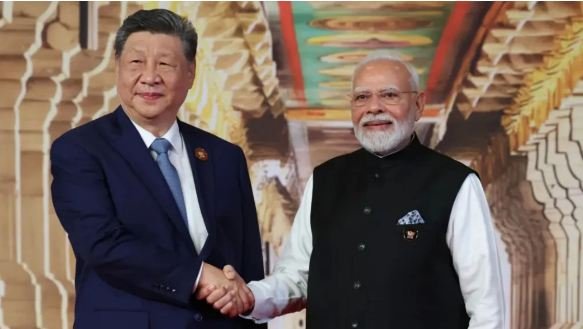
Chinese President Xi Jinping’s visit to India, his first in nearly seven years, on the occasion of the 18th BRICS Summit was, by most measures, a diplomatic success. It understandably sparked cautious optimism on both sides that China and India might finally open a new chapter in bilateral ties. But as the dust settles on this historic summit, it is becoming increasingly clear that the meeting underdelivered on one crucial front: The much-anticipated economic reset between Asia’s two largest economies.
Advertisement
Hopes of reviving the Strategic Economic Dialogue, attracting big-ticket Chinese investment, and collaborating on exports to third countries remain largely unfulfilled. The most substantive outcome in this space was a modest meeting between Commerce and Industry Minister Piyush Goyal and his Chinese counterpart, Wang Wentao, who pledged to hold further talks in the future.
It is rather intriguing that just a week earlier, both sides had managed to reach an eight-point consensus on the border issue, supposedly the key sticking point in China-India relations. Yet on the economic front, the two countries continue to struggle to move the needle. Why is it so? A closer look at internal debates and discussions within China offers important clues as to where the problem may lie.
China tightens the noose around Indian manufacturing
China’s state-regulated internet space has lately been abuzz with reports of how China, without imposing direct tariffs or cutting off supplies, is bringing Indian industry to its knees simply by choking off the most critical technical links. Chinese public opinion has hailed this as a major policy success, noting that some of India’s largest private enterprises, including Reliance, JSW, and the Tata Group, have faced production difficulties due to new Chinese restrictions on technology transfer, which have forced them to seek alternative sources or delay production plans, particularly in the new-energy sector.
Advertisement
China’s Ministry of Commerce and other departments have recently added several technologies to the export control list, including lithium battery cathode material preparation technologies, lithium batteries with energy density above 300Wh/kg, high-pressure lithium iron phosphate cathode materials, artificial graphite and related equipment technologies, while also tightening the licensing process. Starting June 30, 2026, China’s General Administration of Customs imposed stricter restrictions on the export of “industrial mother machines,” such as lathes, milling machines, grinders, and other mid-range CNC machine tools, equipment that Beijing believes is helping India expand its manufacturing base and gradually close the gap with China, forming a medium- to long-term competitive threat.
In addition, new regulations on outbound investment and technology transfer — the State Council’s “Regulations on Outbound Investment” (Order No. 784) — officially took effect on July 1, 2026. These regulations explicitly state that technologies prohibited from export cannot be circumvented through means such as dispatching technical personnel, providing cross-border technical guidance, or running overseas training programmes. They also established an overseas investment security review system that monitors the entire process, from a Chinese company’s market entry to its exit abroad. Notably, some Chinese analyses have linked these provisions to the unfavourable 2025 exit of the Chinese company Baoding Tianwei Baobian Electric from the Indian market.
China has also tightened the issuance of business visas to Indian executives, limiting their ability to travel to China to connect with suppliers, inspect equipment, or resolve technical issues.
Taken together, China’s message to India’s electronics manufacturing and automotive OEM sectors, the core of the global “China+1” strategy, is unambiguous: India may buy equipment, build factories, and hire workers, but the process parameters, production know-how, and technical expertise that determine product performance, yield, stability, and scalability will not be readily shared. China will ensure that Indian companies cannot replicate the production capabilities of their Chinese counterparts.
China is alarmed by India’s push for a complete manufacturing supply chain
Indian Prime Minister Narendra Modi’s 2026 Independence Day address, in which he reiterated his commitment to building India into a “developed country” by 2047 and establishing “a complete and controllable local manufacturing supply chain”, drew considerable attention within Chinese policy circles. Beijing is concerned that Indian leadership may be moving beyond rhetoric and charting a concrete roadmap for industrialisation, built around seven pillar industries with manufacturing at the top of the agenda.
The speech triggered intense debate within China over whether India can genuinely make the leap from “assembling more products” to “mastering the complete value chain” within the next few years. Can structural barriers like land, infrastructure, workforce skills, and fragmented state policies be adequately resolved in such a short span? Will India’s strategy of incentivising foreign companies to build factories translate into genuine localisation of technology, supply chains, and profits?
These debates were further fuelled by a NITI Aayog report, “Key Industries for Making India a Global Manufacturing Hub (Volume 1),” released just days before PM Modi’s Independence Day speech. The report identified 12 priority sectors out of 62 manufacturing categories, with its first volume focusing on four high-potential areas: Chemicals, textiles, telecom and network equipment, and solar photovoltaic manufacturing. Chinese observers were quick to note that all four sectors India is targeting for global leadership are, in fact, China’s own stronghold.
The External Affairs Minister’s recent remarks at a public event, where he spoke of India’s long-term ambition to become a more self-reliant, industrialised economy capable of competing confidently with China and other major powers, added further fuel to the fire. Chinese social media erupted with accusations that “India is seeking to leverage Chinese capital and technology to outcompete China” and that “there has already been an official consensus between China and India that both sides are partners, not competitors — but India is now backtracking.”
The weight China has placed on this issue is telling. Whether at the Special Representatives’ meeting or the recent Modi-Xi summit, senior Chinese officials have consistently reiterated one message: China and India need to be “partners, not competitors”.
In sum, the agenda of a China-India economic reset now appears hostage to China’s own “India dilemma”: The more Beijing tightens its grip on Indian manufacturing, aiming to confine India to a mid-to-downstream role in its supply chain and signal to the world that “the next China is still China,” the more India strives to establish itself as a “trusted” hub of the global supply chain, betting heavily on domestic capacity across sectors ranging from polysilicon to tunnel-boring machines, with occasional breakthroughs such as in the case of ultra-high-voltage transformers.
Ultimately, China-India economic ties appear locked in a closed loop. India remains wary of its deep dependence on China and is keen to de-risk; China, in turn, is anxious about India emerging as a new global manufacturing hub that could threaten its centrality in global supply chains. As China leverages India’s dependence to prevent it from decoupling, India grows only more resolute in building a complete, independent industrial system. And the more India pursues diversified supply-chain partnerships with the US, Europe, Japan, and Middle Eastern countries, the more China worries about a de-sinicised global supply chain becoming a reality. Unless the leadership of both nations are able to break this vicious cycle, economic competition risks emerging as the single biggest obstacle to China-India reconciliation going forward.
Antara Ghosal Singh is a Fellow at the Strategic Studies Programme at Observer Research Foundation, New Delhi

Expert Explains | Why China’s answer to frontier AI risk looks different from America’s
By Sohail Khan · 22 Sep
‘What is a normal blood pressure for someone over 70?’
By Sohail Khan · 22 Sep
Leave a Reply