Why is the CISF leaving Visakhapatnam Steel Plant? | Explained
Ever since the Cabinet Committee on Economic Affairs (CCEA) approved the 100% strategic sale of Rashtriya Ispat Nigam Limited (RINL)—the corporate entity of the Visakhapatnam Steel Plant (VSP)—on January 27, 2021, the story of the plant has gone from bad to worse.
The Union government cited chronic financial losses, mounting debt and a lack of captive iron ore mines—which rendered the public sector unit (PSU) unsustainable—as the primary reasons for the decision. To stall the privatisation move, plant workers and trade unions mobilised a strong protest under the banner of the Visakha Ukku Parirakshana Porata Committee (VUPPC), successfully halting the sale so far.
However, operational realities remain grim. The plant has seen mass downsizing of both permanent and contract staff since 2021. Its financial position also presents a grim picture, with escalating debt and recurring production and financial losses, despite a revival package of roughly ₹11,440 crore from the Union government.
Safety concerns have been growing, as the plant has been hit by a string of workplace accidents —including major incidents resulting in fatalities— which staff and trade unions attribute to compromised maintenance caused by severe cash flow constraints.
CISF exit adds fuel to the fire
Amid these challenges, the recent announcement of the disengagement of the Central Industrial Security Force (CISF) has sparked widespread concern among employees. Staff contend that RINL is not ending CISF services because of a reduced need for high-level security, but as a direct consequence of severe financial distress.
The VSP has been facing a severe working capital crisis, which lies in its key structural disadvantages, primarily raw material costs. For want of captive iron ore mines, RINL has been purchasing raw ore in the open market at ₹5,000 to ₹7,000 per tonne. In contrast, competitors like SAIL and Tata Steel procure ore from captive sources at ₹1,500 to ₹2,000 per tonne.
Its debt-funded expansion from 3 MTPA to 7.3 MTPA has burdened the plant with about ₹3,400 crore annually in interest and depreciation costs.
Termination of CISF deployment
In August 2026, following a proposal from RINL, the Ministry of Home Affairs (MHA) invoked Section 14(2) of the CISF Act to clear the complete disengagement of the force. This triggered a three-month notice period, with a full exit by November 17, 2026.
The order covers 1,331 sanctioned posts (1,033 Security Wing and 298 Fire Wing personnel) —the first complete exit of the CISF from a major steel PSU. The MHA also explicitly asked the CISF to recover all pending financial dues from RINL before the final exit. This, many say, is a clear signal that the plant is unable to maintain regular payments to central authorities and has been forced into this cost rationalisation.
A legacy identity
Unlike most other PSUs, the VSP was forged through the historic Visakha Ukku, Andhrula Hakku mass agitation of the 1960s, during which 32 people lost their lives in police firing.
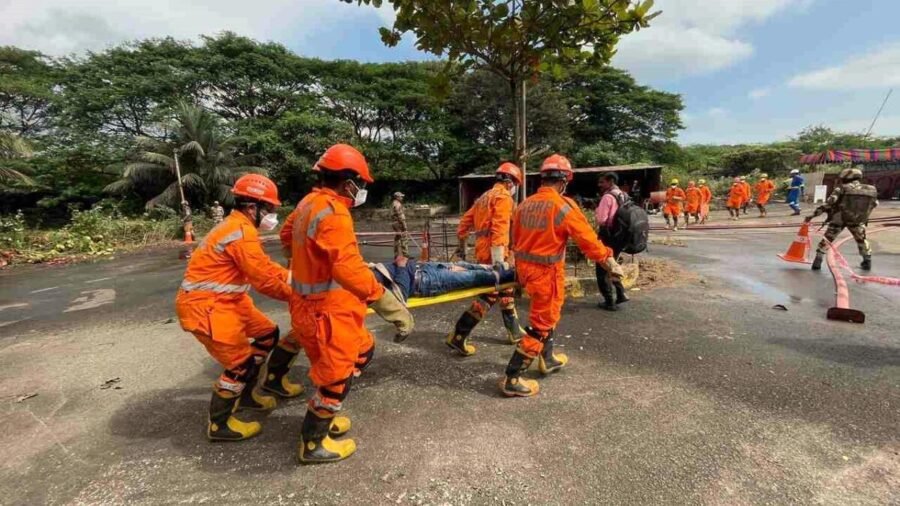
The CISF has been an integral part of that legacy since its deployment shortly after the plant’s inception in 1982. For over four decades, it has safeguarded the VSP’s sprawling, around 20,000-acre, complex, rail networks, raw material stocks and specialised blast furnaces. It has played a key role in rescue and firefighting operations in a number of major accidents, including the 2012 oxygen plant blast, in which about 11 persons lost their lives, and the one a couple of months ago in the steel melting shop, in which nine died.
Under the CISF Act, deployed units operate on a 100% cost-recovery model. RINL pays the Union government directly for salaries, allowances, pensions and medical benefits, besides specialised armour, vehicle fleets and security equipment, and housing quarters and civic infrastructure within the plant township.
According to records, RINL’s annual outlay on this 1,300-plus force hovers between ₹150 crore and ₹200 crore.
CISF vs private agencies
While replacing the paramilitary force with private contractors will yield immediate cost savings for the VSP, but it raises critical questions about security efficacy and operational risk.
Private security contractors, even if combined with Directorate General Resettlement (DGR)-sponsored personnel, lack the statutory powers granted to the CISF under the CISF Act to arrest without a warrant, detain suspects and search individuals.
To bridge the temporary gaps, RINL management has deployed Andhra Pradesh Special Police (APSP) personnel at select key locations. However, relying heavily on the State police in the long term may prove unviable given the State’s own manpower constraints.
The CISF maintains a specialised industrial fire wing equipped for high-hazard emergencies such as molten metal explosions, chemical threats and hazardous gas leaks, capabilities that standard private agencies typically cannot match.
What does this signal?
An absolute shutdown of the VSP remains unlikely given its strategic coastal location, deep-water port access and massive land bank. However, the complete exit of the CISF serves as a clear structural signal: the plant may be transitioning away from the traditional PSU management model towards a lean, private or joint-venture operational model.

‘Shuddhikaran’ row: Haryana Congress protests over FIR against Rahul Gandhi
By Sohail Khan · 1 Sep


Leave a Reply