Why is the 2023 Election Commissioner appointment law controversial, and why did SC refer it to CJI?
The judges flagged the long delays in deciding Constitutional references. They noted that the Anoop Baranwal case (2023) took eight years to reach a final judgment and cited other references that remained pending for years. Calling such delays “a source of institutional embarrassment”, they urged the CJI to consider setting up a permanent five-judge bench for Constitutional cases.
Story continues below.
Subscribe to see fewer ads.
What is the ‘Anoop Baranwal’ case?
The challenge to the Chief Election Commissioner and Other Election Commissioners (Appointment, Conditions of Service and Term of Office) Act, 2023 traces its origins to the Supreme Court’s judgment in Anoop Baranwal v. Union of India in March 2023. In that ruling, a Constitution Bench had noted that Parliament had not enacted a law governing appointments to the Election Commission despite Article 324 of the Constitution contemplating one.
It laid down an interim mechanism under which appointments would be made by a committee comprising the Prime Minister, the Leader of Opposition in Lok Sabha and the Chief Justice of India — until Parliament enacts a law.
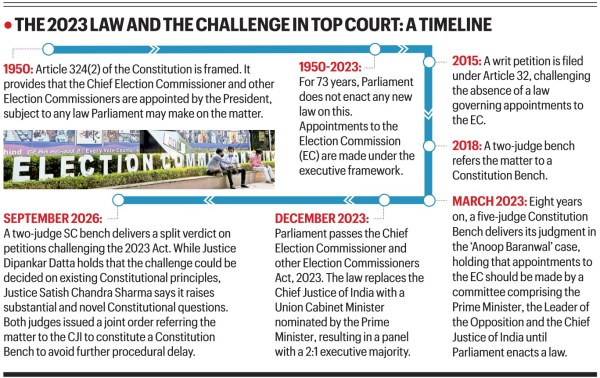 The 2023 law and the challenge in top court: A timeline.
The bench had underlined the importance of an independent Election Commission and observed that those entrusted with conducting elections must be insulated from executive influence.
Parliament subsequently enacted the Chief Election Commissioner and Other Election Commissioners (Appointment, Conditions of Service and Term of Office) Act, 2023.
Story continues below this ad
But the law replaced the CJI on the selection committee with a Union Cabinet minister nominated by the Prime Minister. The government, therefore, got two representatives on the three-member panel, alongside the Leader of Opposition.
Constitution Bench issue: What Justice Datta said
Justice Datta took the view that the petitions could be decided by the present bench itself. According to him, the top court had already settled the governing Constitutional principle in Anoop Baranwal, which held that appointments to the EC cannot remain under “exclusive executive control”. The question now, he said, was whether the 2023 law complies with that principle. That exercise was “no more than the application of the settled principles of law to the facts of the case” and did not require a Constitution Bench, he said. Justice Datta, therefore, held that “neither any Constitutional bar nor a precedent precludes hearing of these petitions by the present Bench”.
At the same time, Justice Datta expressed concerns about the structure of the selection committee under the 2023 law. Referring to the panel comprising the PM, a Cabinet minister nominated by the PM and the Leader of Opposition, he observed that a minister bound by collective responsibility “cannot be expected to defy his own nominator”.
Thus, the presence of the Leader of Opposition in the Selection Committee becomes “largely ornamental”, he said. He also emphasised the perception test — “it is not enough for the ECI to be independent, it must also appear to be independent”. On the petitioners’ argument that the law gives the executive overwhelming influence over appointments, he said it “does appear to have substance”, while stating that these were only prima facie observations.
Story continues below this ad
Justice Datta also rejected the government’s comparison between the EC selection process and the collegium system for judicial appointments. He said judicial appointments involve the executive at multiple stages and described the popular notion that “judges appoint judges” as a “myth”. He raised concerns about the selective implementation of Collegium recommendations and said the absence of a neutral member in the Collegium could not justify the absence of a neutral member in the EC appointment process. He described the comparison drawn by the government as “disingenuous, evasive and disquieting”.
Constitution Bench issue: What Justice Sharma said
Justice Sharma disagreed with Justice Datta and held that the challenge must be referred to a Constitution Bench. He said that the Supreme Court is examining the Constitutional validity of the 2023 Act for the first time. “There is no authoritative decision of this court till date pronouncing on the constitutional validity of the said Act,” he said adding: “The decision on these writ petitions would be the first of its kind and it is all the more necessary that a reference is made.”
The petitioners, however, had argued that the central legal question that the selection must be an independent process has already been decided by the 2023 Constitution Bench ruling.
For Justice Sharma, the key question was whether Parliament was justified in replacing the CJI with a Cabinet minister nominated by the PM. He said: “Whether or not Parliament was justified in not including a neutral selector in the selection committee” is “an important question arising for the first time before this court”. Since this question “has not been dealt with in any precedent”, he said, Article 145(3) left “no room for a decision on such question finally by the present combination” of two judges.
Story continues below this ad
He viewed the government’s arguments on separation of powers and the comparison with the collegium system as issues that required examination by a larger bench.
What is a Constitution Bench?
As per Article 145(3), a Constitution Bench of five or more judges decides a “substantial question of law” involving the interpretation of the Constitution. A case does not go to a larger bench merely because it involves the Constitution. The question must be “unsettled” — that is, one the court has never authoritatively answered before. Constitution Bench rulings also carry greater weight than ordinary judgments.
Split verdicts often trigger referrals. When two judges cannot agree, the matter goes to the Chief Justice, who decides whether to send it to a larger bench. But the split itself does not automatically warrant a Constitution Bench — the court must still be convinced the dispute raises a substantial Constitutional question requiring authoritative determination.
In October 2022, the SC delivered a split verdict on the Karnataka hijab case: Justice Hemant Gupta upheld the hijab ban in schools, while Justice Sudhanshu Dhulia struck it down. The matter was referred to a larger bench and remains pending over four years later.
Story continues below this ad
Earlier this year, another split verdict arose on Section 17A of the Prevention of Corruption Act: Justice K V Viswanathan upheld the provision, while Justice B V Nagarathna struck it down as one that “protects the corrupt rather than seeking to protect the honest”. That too went to a larger bench.
India should chase its own IP-led global standards
By Sohail Khan · 24 Sep
Germany’s political churn is about a shrinking centre
By Sohail Khan · 24 Sep
New cat in habitat, and some glimmer of hope
By Sohail Khan · 24 Sep
Leave a Reply