Why did Election Commission freeze TMC symbol and name, allot new ones to rival factions?
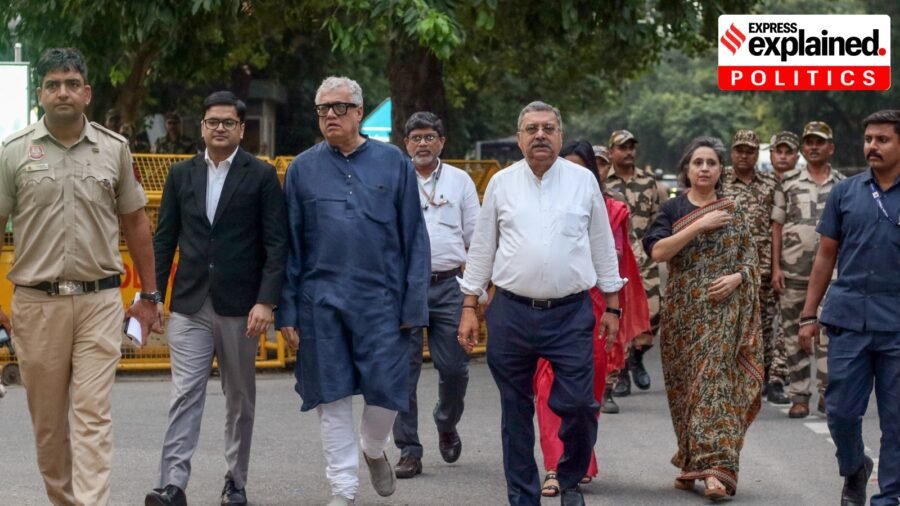
The Election Commission (EC) on Friday allotted alternative names and symbols to the two rival factions of the Trinamool Congress (TMC) for use in the two October 6 bypolls in West Bengal until it makes a final decision on the competing claims for recognition.
The Mamata Banerjee-led faction will be known as the Mamata All India Trinamool Congress and will have the ‘football player’ symbol. The Arup Roy-led faction, meanwhile, will be called Democratic Trinamool Congress, with the ‘envelope’ symbol.
This came a day after the EC froze the TMC’s name and “flowers and grass” symbol.
Story continues below.
Subscribe to see fewer ads.
It said in its interim order on Thursday: “… the Commission is of the opinion that there are two rival groups in All India Trinamool Congress… therefore the matter requires a substantive determination by the Commission under Para 15 of the Election Symbols (Reservation & Allotment) Order 1968.”
Splits in India’s political parties are not uncommon. Some prominent recent examples include the Shiv Sena dispute — in which the EC allotted the official name of the party as well as the ‘bow and arrow’ symbol to the Eknath Shinde faction — and the Nationalist Congress Party tussle — in which the Ajit Pawar faction got the original name and clock symbol.
In the Shiv Sena case, the EC had frozen the name and symbol before deciding which faction was the “real party”. In the NCP case, however, it directly awarded the name and symbol to the Ajit Pawar faction in its final decision.
So why does the EC freeze symbols until it makes a final decision? And how does it decide who gets the original name and symbol?
Why has the EC frozen the TMC symbol?
Story continues below this ad
When a prominent party splits, a tussle often ensues for its election symbol. This is because the poll symbol is one of the primary ways a voter recognises and identifies with a party. Indeed, Indian voters are commonly heard saying that they would vote “kamal ka pool” or “panja” or “jhadu” while indicating their preference for the BJP, Congress, or Aam Aadmi Party, as the case may be.
The last time the EC froze a party’s name and symbol was in October 2022, in the case of the Shiv Sena’s name and ‘bow and arrow’ symbol amid the Uddhav Thackeray–Eknath Shinde split.
In October 2021, it froze the Lok Janshakti Party’s name and ‘Bungalow’ symbol after the party split between Chirag Paswan and Pashupati Kumar Paras.
The intention in both cases was to ensure that neither faction could use it in Assembly by-elections.
Story continues below this ad
In the latest case, involving the TMC, the freeze has been put in place so that neither faction can use it in the Nandigram and Rejinagar Assembly bypolls.
Before that, tussles over the election symbol had been witnessed in 2017 after the Samajwadi Party (Cycle) and the AIADMK (Two leaves) split.
How does the EC decide on splits within parties?
On the question of a split in a political party outside the legislature, Para 15 of the Symbols Order, 1968, states: “When the Commission is satisfied…that there are rival sections or groups of a recognised political party each of whom claims to be that party the Commission may, after taking into account all the available facts and circumstances of the case and hearing (their) representatives…decide that one such rival section or group or none of such rival sections or groups is that recognised political party and the decision of the Commission shall be binding on all such rival sections or groups.”
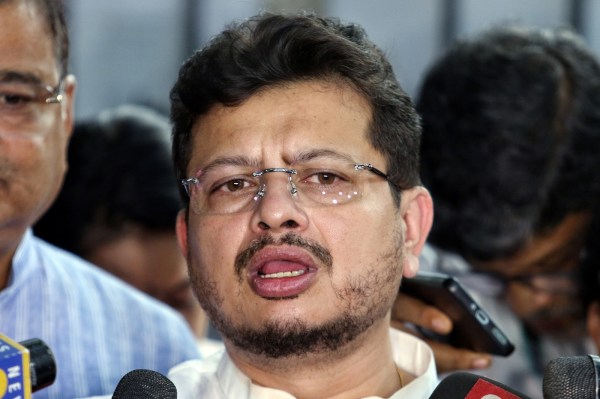 West Bengal Leader of Opposition Ritabrata Banerjee, a member of the Arup Roy faction, on Thursday. ANI
This applies to disputes in recognised national and state parties (like the TMC). For splits in registered but unrecognised parties, the ECI usually advises the warring factions to resolve their differences internally or to approach the court.
Story continues below this ad
The first case to be decided under the 1968 Order was the first split in the Indian National Congress in 1969. After the party old guard led by K Kamaraj, Neelam Sanjiva Reddy, S Nijalingappa, and Atulya Ghosh, known as the Syndicate, expelled Indira Gandhi from the Congress, and the party split into the “old” Congress (O) led by Nijalingappa and the “new” Congress (J) led by Indira. The “old” Congress retained the party’s official symbol of a pair of bullocks carrying a yoke; the breakaway faction was given the symbol of a cow with its calf.
What happened before 1968?
Before 1968, the EC issued notifications and executive orders under the Conduct of Election Rules, 1961.
The most high-profile split of a party before 1968 was that of the Communist Party of India (CPI) in 1964. A breakaway group approached the ECI in December 1964, seeking recognition as CPI (Marxist). They provided a list of MPs and MLAs of Andhra Pradesh, Kerala and West Bengal who supported them.
The ECI recognised the faction as CPI(M) after it found that the votes secured by the MPs and MLAs supporting the breakaway group added up to a significant amount in three states.
Story continues below this ad
Is there a way other than the test of majority to resolve a symbol dispute?
In almost all such disputes so far, a clear majority of party delegates/office bearers, MPs and MLAs have supported one of the factions. In the case of the Shiv Sena, the majority of the party’s elected representatives switched over to Shinde’s side.
Whenever the EC could not test the strength of rival groups based on support within the party organisation (because of disputes regarding the list of office bearers), it has sought to fall back on testing the majority only among elected MPs and MLAs.
And what happens to the group that doesn’t get the parent party’s symbol?
Story continues below this ad
In the case of the first Congress split, the ECI recognised both the Congress (O) and the breakaway faction, whose president was Jagjivan Ram. The Congress (O) had a substantial presence in some states and satisfied the criteria fixed for recognition of parties under Paras 6 and 7 of the Symbols Order.
This principle was followed up to 1997. However, things changed when the ECI dealt with the splits in the Congress, Janata Dal, etc. that led to the creation of Sukh Ram and Anil Sharma’s Himachal Vikas Congress, Nipamacha Singh’s Manipur State Congress, Mamata Banerjee’s West Bengal Trinamool Congress, Lalu Prasad’s RJD, Naveen Patnaik’s Biju Janata Dal, etc.
The ECI felt that merely having MPs and MLAs is not enough, as the elected representatives had fought and won polls on tickets of their parent (undivided) parties. It introduced a new rule under which the splinter group — other than the group that got the symbol — had to register itself as a separate party, and could lay claim to national or state party status only on the basis of its performance in state or central elections after registration.

Don’t let AI dictate your writing — keep the em dash
By Sohail Khan · 18 Sep
Can US deny visas to foreign officials attending UN General Assembly?
By Sohail Khan · 18 Sep
Not just food: Why blood sugar can rise even when you haven’t eaten
By Sohail Khan · 18 Sep
Leave a Reply