Can US deny visas to foreign officials attending UN General Assembly?
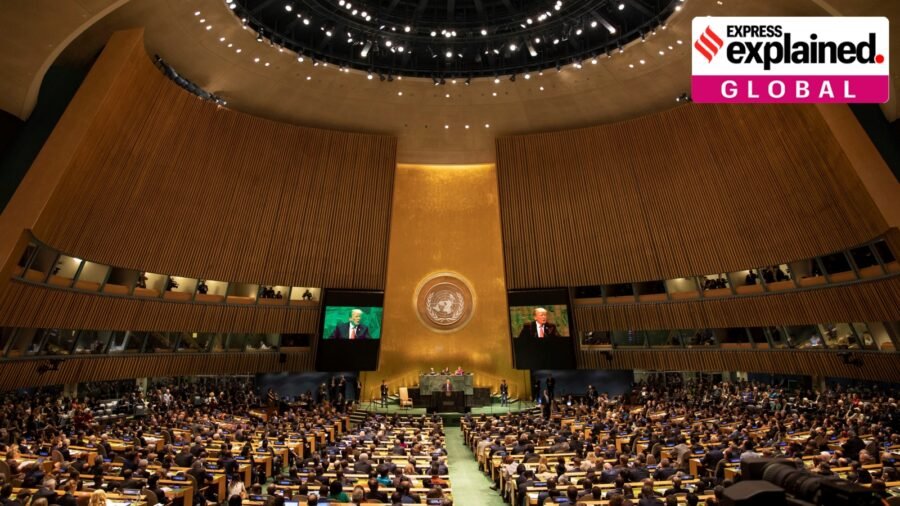
The United States has granted visas to Iranian President Masoud Pezeshkian, Foreign Minister Abbas Araghchi, and other members of the core Iranian delegation to attend the United Nations General Assembly (UNGA) next week at the UN headquarters in New York. This came even as the war in West Asia, ongoing since February, shows no signs of ending.
The US State Department, however, denied visas for a high-level delegation of Palestinian officials, including Palestinian Authority President Mahmoud Abbas, to attend the UNGA. The UNGA voted Thursday (September 17) to allow Abbas to address the body via a prerecorded statement.
The UN is an international body with its headquarters located on US soil. So, can the US approve or refuse visas to foreign leaders and officials visiting the UN on official business? Here’s what to know about what a 1947 agreement says about the extent of US jurisdiction.
The cases of Palestine and Iran
Story continues below.
Subscribe to see fewer ads.
According to the US State Department, the denial of visas to Palestinian officials — for the second year in a row — is owing to Palestinian officials failing to live up to their commitments under previous agreements to seek peace with Israel. In August 2025, the department had revoked visas for members of the Palestine Liberation Organisation (PLO) and the Palestinian Authority (PA) for “undermining the prospects for peace” ahead of last September’s UNGA, forcing PA chief Abbas to appear by video thereafter.
The PLO is a political coalition internationally recognised as the official representative of the Palestinian people, whereas the PA is the government body that exercises partial civil control over the Palestinian enclaves in the Israeli-occupied West Bank.
In a statement Wednesday (September 16), the department said the PA had continued to pursue legal action against Israel at the International Court of Justice and the International Criminal Court and kept paying stipends to the families of prisoners convicted of attacks against Israelis. It also mentioned officials tied to the PLO.
Story continues below this ad
In the case of Iran, although its leaders and top officials have been granted visas, State Department spokesperson Tommy Pigott said that the delegation will be placed under travel restrictions and will be banned from purchasing certain American products.
“We will not let the Iranian regime’s elites exploit UNGA for a luxury retail splurge paid for by the Iranian people’s suffering, all while the regime funnels Iran’s wealth to support its terrorist proxies,” Pigott posted on X. He also told New York shops to “be on guard” against selling goods to the delegation.
The 1947 Agreement
According to the “Agreement regarding the Headquarters of the United Nations” signed by the UN and the US government on June 26, 1947, the US is generally required to allow access for foreign diplomats to the UN in New York.
Under Article IV governing “Communications and Transit”, Section 11 states that the federal, state or local authorities of the US “shall not impose any impediments to transit to or from the headquarters district of (1) representatives of Members or officials of the United Nations, or of specialized agencies as defined in Article 57, paragraph 2, of the Charter, or the families of such representatives or officials…”
Story continues below this ad
Section 12 reiterates the provisions under Section 11, saying they “shall be applicable irrespective of the relations existing between the Governments of the persons referred to in that section and the Government of the United States”.
Also, Section 13(a) says: “(a) Laws and regulations in force in the United States regarding the entry of aliens shall not be applied in such manner as to interfere with the privileges referred to in Section 11. When visas are required for persons referred to in that section, they shall be granted without charge and as promptly as possible.”
In the past, however, Washington has said it can deny visas for “security, terrorism, and foreign policy” reasons. For instance, the previous Joe Biden-led US administration had initially delayed granting visas to Russian Foreign Minister Sergey Lavrov and his delegation ahead of the UNGA in September 2022, before it relented with days to go for the annual gathering. At the time, relations between the US and Russia had nosedived after the latter invaded Ukraine in February 2022.
Story continues below this ad
Last year, when the US denied PA chief Abbas a visa to attend the UNGA, it had cited “national security interests”. Also, the PA, which represents the Palestinian people at the UN, where the delegation is officially known as the State of Palestine, is not a full member and has no vote in the UNGA. It is an observer state, holding the same status as the Vatican. The Palestinians will now be represented at the UNGA by their diplomats who are already accredited to the UN.

Don’t let AI dictate your writing — keep the em dash
By Sohail Khan · 18 Sep
Not just food: Why blood sugar can rise even when you haven’t eaten
By Sohail Khan · 18 Sep
In India’s private hospitals, MRP means ‘Manipulated Raised Price’
By Sohail Khan · 18 Sep
Leave a Reply