Why are Indian rifle shooters missing out on gold at Asiad? It’s in how they begin their finals
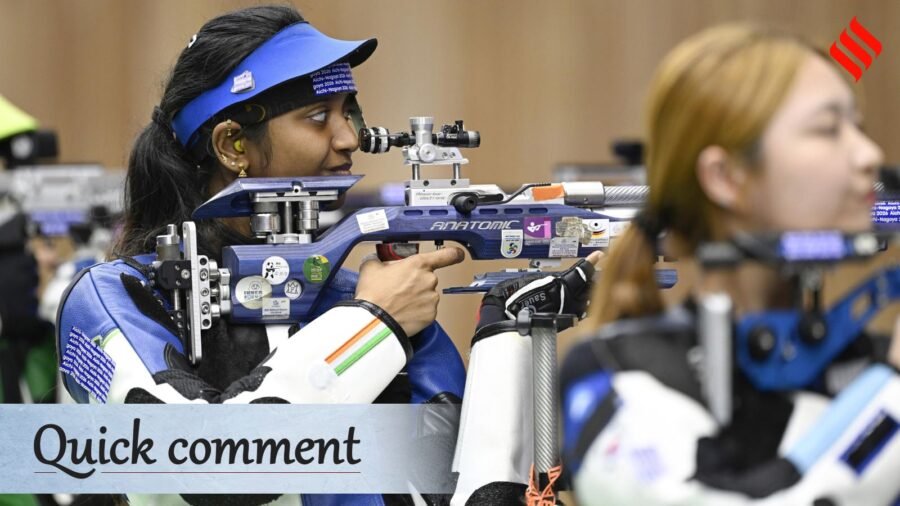
It’s easy to look at the 10.1 final shot that Elavenil Valarivan hit on Sunday, and the 9.7 that blurted out of the rifle of Rudrankksh Patil in the men’s event today and diagnose both those attempts with the oft-used, but rarely understood word, pressure. India’s wait for a 10m air rifle gold continued as the medals kept flowing but that elusive yellow metal was not found.
Both shooters were in gold-medal winning positions but ended up not hitting the calibre of shots that they were producing through qualification and the finals. What went wrong in those final eight shots for Ela and Rudrankksh?
The answer might be down to how some top Indian shooters pace themselves during a final.
Story continues below.
Subscribe to see fewer ads.
Both Elavenil and Rudrankksh started off lightning quick in the finals, registering scores of 106 in their first ten shots. To average 10.6 over the first ten shots in the final of a multi-sport event is an incredibly good base to assure yourselves a medal. But keeping that same pace, and the intense mental concentration it requires, especially in a high-stakes event, is often unsustainable. The result is that while enough has been accumulated for a medal, fighting for gold becomes a matter of just how much is left in the tank.
After her finals yesterday, Ela spoke about some of the minor things that went sideways in her quest for gold. “I mean, I could have been a little more patient in taking my shots and possibly worked a little more on my breathing.
Later when elaborating on what she needs to work on, she added, “I think finding my pace of shooting in the finals is something that I am still working on. And that is something that I really want to learn and tune it down more.”
There is also the quality of the shooters chasing them. Both Elavenil and Rudrankksh lost out on gold to generational Asian Games performances by Japan’s Hinata Taichi and China’s Sheng Lihao.
Story continues below this ad
Lihao, at 21, has already established himself as one of the best shooters to ever have emerged from China. He is an all-weather, freak talent who will win most of the events he finds himself in. On Monday, his chasedown of Rudrankksh was spectacular. After starting ‘slow’ with 104.9 in his first ten shots, Lihao went nuclear. His next six series of shots – 21.4; 21.4; 21.1; 21.4; 21.4; 21.4 – displayed absurd, almost robotic ability, to thread the barest of margins. His ability to hit the highest 10s at clutch has given him Olympic championships, as also the last Asiad title.
Lihao averaged near 10.7 in that series of twelve shots and finished the finals with a score of 254.2. His final shot average: 10.59. Essentially, every shot that Lihao landed in Aichi-Nagoya was close to a 10.6 – which is the kind of consistency that’s rare for all shooters to achieve, barring himself.
India’s best showing in individual air rifle has come through Gagan Narang (2010) before Elanevil and Dhillon matched him this time. But the gold has been elusive.
But it was the position that Lihao was in that helped as well. Shooters who start slow but chase down the leading marksman have the advantage of momentum on their side. The shooter leading has to switch their mindset from trying to keep the lead to suddenly finding themselves attempting to win gold with a shot or two to decide the outcome. Usually in those situations, the result goes in favour of the person wielding the momentum of the final.
Story continues below this ad
Finals format not fancied?
There is also the format of the sport. If a comparison has to be made, Lihao is as good as making two shots in a row with an interruption following, as the Indians are at making five in a row with an interruption following after.
Stylistically Indian shooters seem to work better when there are five shots with a set time on the board for them. It mirrors the qualification format and there seems to be a causality between the intense domestic competition that has shaped the psyche of an Indian shooter to be better at qualification and the last fourteen shots of a final where a few decimal points lost end up being the difference between a silver and a gold.


‘Didn’t agree with the decision’: Suchika Tariyal explains her controversial MMA semifinal
By Sohail Khan · 21 Sep
‘I think we should let Sanju Samson be’: Anjum Chopra
By Sohail Khan · 21 Sep
Leave a Reply