Who is Subhash Chandra Garg, ex-Finance Secretary now criticising GDP numbers?
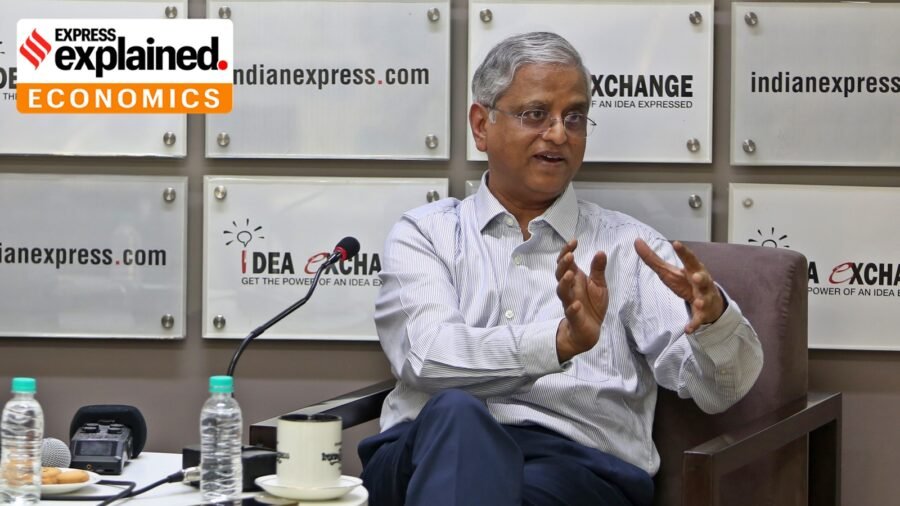
Following the release of India’s Q1 GDP growth data earlier this week (August 31), former senior government official Subhash Chandra Garg has found himself in the middle of a raging debate on the numbers.
The 7.8% growth figure for the April to June period has been read as better than expected, also coming at a time when India and the world were dealing with the fallout of the Iran War and the Strait of Hormuz crisis.
Garg, however, has claimed that nominal GDP growth (including the effect of inflation) in this period should have been 2.6% and “in real terms close to 0”. After his criticism was widely circulated online and supported by several Opposition politicians, political parties and economists, the Ministry of Statistics and Programme Implementation (MoSPI) stepped in with a six-point rebuttal, asserting that its methods and the numbers released on Monday were correct.
Story continues below this ad
A former Finance Secretary (the designation given to the seniormost of the six secretaries of the Union Ministry of Finance), Garg is not new to controversies.
IAS officer who took voluntary retirement
A 1983-batch IAS officer of Rajasthan cadre, Garg came to the Centre in 2014 and was appointed Executive Director at the World Bank. He held the post until he was appointed as the Department of Economic Affairs Secretary (under the Finance Ministry) in June 2017.
In March 2019, he was elevated to Finance Secretary. Just a day after he was transferred to the Ministry of Power in July 2019, Garg applied for voluntary retirement from IAS, more than a year before his scheduled retirement in October 2020.
Gujarat-cadre officer Atanu Chakraborty, who later became HDFC Bank Chairman, replaced Garg as the Economic Affairs Secretary.
Friction with RBI
Story continues below this ad
Garg played a pivotal role in seeking a review of the Reserve Bank of India’s (RBI) economic capital framework for the government to access the regulator’s reserves — an area where the Finance Ministry and the regulator saw major differences.
As the Economic Affairs Secretary, Garg’s approach often resulted in friction with regulators, as well as disagreements with power centres within the government, including the Prime Minister’s Office, on the fiscal targets versus growth debate.
In the middle of 2018, the Department of Economic Affairs under Garg started internal discussions with the RBI over the latter’s economic capital framework and assessed that the central bank had around Rs 3.6 lakh crore of excess capital that could be shared with the Centre.
This debate had then snowballed into a major controversy, when the then RBI Deputy Governor Viral Acharya warned the government in October 2018 against the pitfalls of raiding a central bank’s reserves. He argued that “governments that do not respect their central bank’s independence sooner or later incur the wrath of financial markets”.
Story continues below this ad
Garg responded to Acharya’s remarks on Twitter (now X): “Rupee trading at less than 73 to a dollar, Brent crude below $73 a barrel, markets up by over 4% during the week and bond yields below 7.8%. Wrath of the markets?”
The disagreement dragged on as the government found the then RBI Governor Urjit Patel not relenting on many of its suggestions. These included a discussion on capital reserves, pulling some public banks out of the Prompt Corrective Action (PCA) framework for banks’ financial health and providing a specific liquidity window for the Non-Banking Financial Companies.
The Finance Ministry then invoked a provision under Section 7 of the RBI Act of 1934 — a power never used since Independence — to direct the RBI to start consultations. Patel’s later resignation on health grounds and the appointment of Shaktikanta Das as RBI Governor helped build some bridges with the RBI.
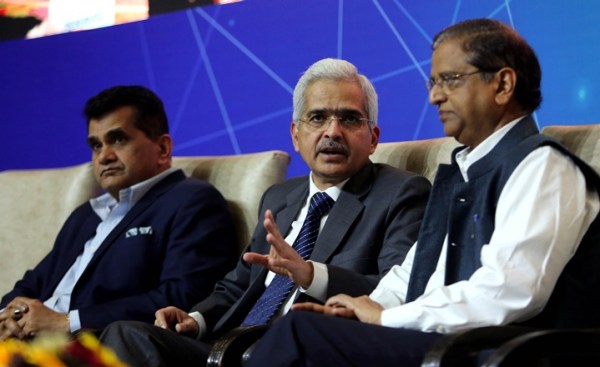 RBI Governor Shaktikanta Das with then Economic Affairs Secretary Subhash Chandra Garg and then NITI Aayog, CEO, Amitabh Kant.
He was also the Finance Secretary when the controversial 2019-20 Union Budget proposal to issue sovereign bonds in foreign currency in overseas markets was announced. It was opposed by influential sections of the government, and the government ultimately never moved ahead on the proposal.
Differences with minister, books
Story continues below this ad
In November 2020, Garg in a blog said he had decided to take voluntary retirement from public service as the government’s reform agenda to deliver high growth “was slipping away after the general elections” and he did not share “a productive relationship” with Finance Minister Nirmala Sitharaman.
He said he had developed “serious differences over key policy matters” with Sitharaman, who asked for and insisted on his transfer from the Ministry of Finance in June 2019 — within a month of her taking over as minister.
Later, in 2023, Garg released his book We Also Make Policy: An Insider’s Account of How the Finance Ministry Functions, followed by No, Minister: Navigating Power, Politics and Bureaucracy with a Steely Resolve in 2025.
In his 2023 book, Garg wrote that a meeting convened on September 14, 2018, to review the state of the economy amid a difficult economic situation and considerable strain between the government and the RBI saw Prime Minister Narendra Modi lose his cool at the then RBI Governor Urjit Patel and compare him to a “snake who sits over a hoard of money”.
Story continues below this ad
He also detailed the government’s problems with the then Chief Economic Advisor (CEA) Arvind Subramanian’s research and recounted how the CEA was pressured to paint a more favourable picture of the economy. With reference to the Economic Survey of 2017, he wrote: “Finally, I was able to persuade Arvind to leave out the FRBM dissent note and improve his GDP forecast.”
“Arvind was increasingly restless. At one stage he told me he would rather leave the government than see his survey mauled in such a manner,” he wrote.
Garg reserved his most critical opinions for Sitharaman. While his 2023 started with a glowing dedication to Arun Jaitley, the first FM he worked with, he ended it in stark contrast, by attributing his decision to seek early retirement to Sitharaman: “Nirmala Sitharaman is the principal reason for making this book happen. Her unease with me in the ministry, led her to create conditions for me to take voluntary retirement from the IAS in October 2019.”

This is what happens to the body when you frequently take painkillers and antibiotics
By Sohail Khan · 30 Sep
Modern ways to style a sari without a traditional blouse
By Sohail Khan · 30 Sep