Who is a ‘distinguished jurist’, and why has India never appointed one to the Supreme Court?
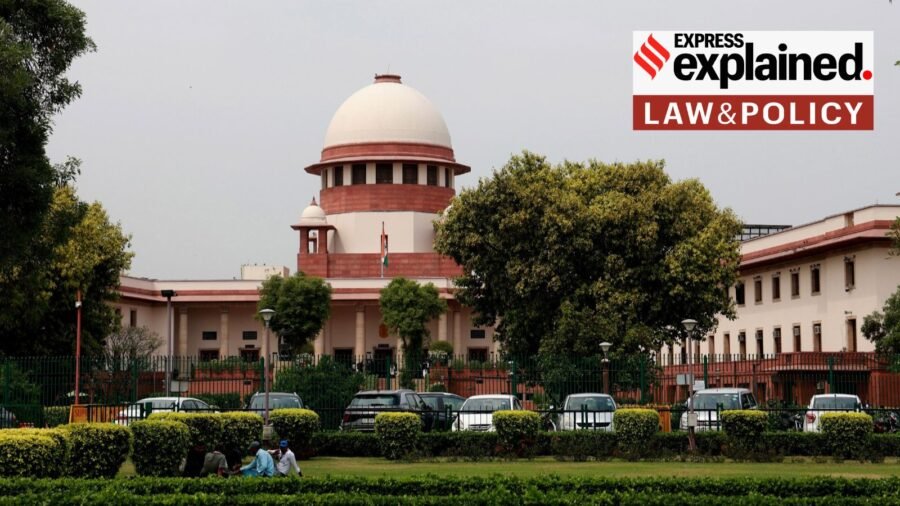
Decades after the Constitution came into force, one route to becoming a Supreme Court judge has never been taken. Delivering the 13th convocation address for the LL.M programmes at National Law University Delhi on August 30, Supreme Court judge Justice Ujjal Bhuyan pointed to Article 124(3), which allows the appointment of a “distinguished jurist” as a Supreme Court judge, and called it an “unused mandate” of the Constitution that “needs our serious attention.”
He said, “While our Constitution has a provision for appointment of a jurist as a judge of the Supreme Court, no jurist has been appointed so far to the Supreme Court though the Constitution has completed more than 76 years.”
He said that having a distinguished jurist on the bench would “diversify the Bench” and that they “would not remain constricted by narrow technicalities thereby being in a stronger position to deal with public law issues.” He added that such a person “can make a visible contribution to the decision-making process at the top level” and that the “participation of…legal academia and scholars would have a defining impact on the judicial functioning of the Supreme Court.”
What the Constitution states
Story continues below this ad
Article 124 sets out how the Supreme Court is constituted. Article 124(3) lists who can be appointed as a judge, ie., a citizen of India who has either served as a High Court judge for five years, practised as an advocate for ten years, or “is, in the opinion of the President, a distinguished jurist.”
The first two routes are how the court has always been staffed. Most judges have been elevated from the High Courts, while a smaller number of lawyers have been appointed directly from the Bar. The most recent was Justice V Mohana, recommended by the collegium in May 2026 and sworn in the following month. The third category, the appointment of distinguished jurists, has simply never been used.
Article 217 lays down the conditions for the appointment of a High Court judge. The 42nd Amendment, enacted during the Emergency, added a provision allowing the appointment of a “distinguished jurist” as a judge of the High Court. However, the provision was eventually repealed by the 44th Constitutional Amendment.
Where the clause came from
The clause was added during the Constituent Assembly debates on May 24, 1949, after H V Kamath moved an amendment saying the pool of candidates shouldn’t be “necessarily confined to Judges or Advocates.” He said that India needed a way to bring in “men or for that matter, women who are possessed of outstanding legal and juristic learning,” even if they had never practised law. He pointed out that judges of the International Court of Justice at The Hague are chosen on similar terms.
Story continues below this ad
M Ananthasayanam Ayyangar backed the idea, arguing that a practising lawyer “barely comes across constitutional problems” as the SC routinely does. He referred to the appointment of a Harvard law professor to the US Supreme Court by President Franklin D Roosevelt, calling it “a novel experiment” that had gone on to work out well.
B R Ambedkar didn’t object to the idea itself. His only hesitation was over the word “distinguished”, and he wondered whether “eminent” would be a better fit. He, however, left the final call to the Drafting Committee. The amendment eventually went through.
Who qualifies and why no one has
In his speech, Justice Ujjal Bhuyan offered two possible explanations for why the clause remains unused. “The first is that earlier in the view of the Central Government and thereafter of the collegium, there is not enough depth in the Indian academia to be considered for elevation as a judge of the Supreme Court. The second is that both the Central Government and the collegium have not seriously explored this provision thus far,” he said.
A “distinguished jurist’ is generally understood to be anyone engaged in serious work in the practice, teaching or research of law, including those who do not require courtroom experience to fit the description. But this interpretation runs into a separate problem in India, where the Bar Council rules generally prevent full-time law teachers from practising law.
Story continues below this ad
A further complication is the process of Supreme Court appointments itself. Appointments today are initiated through the collegium system, meaning that a jurist would first have to be recommended by the Supreme Court collegium before the appointment goes to the government.
In an interview in 2015 with LiveLaw, Upendra Baxi recalled being addressed as “Judge Baxi” by a professor, who had been told by Justice P N Bhagwati that Baxi would be made a judge within a few months. That appointment never materialised. Addressing the matter, Baxi said that “the Presidents of India have been looking with a telescope and have not found any jurist worth appointing as a Supreme Court Judge” and thus called the issue “a dead issue.”

How Indian stocks saw highest monthly FII inflow in nearly 2 years
By Sohail Khan · 1 Sep
How IITs and IISc are redefining medical education in India
By Sohail Khan · 1 Sep
What goes on behind the screen when you pay through UPI? | Explained
By Sohail Khan · 1 Sep
Leave a Reply