Where time stopped
“I’ve reached near Syabrubesi.”
Those were the last words truck driver Ang Thung Tamang said to his family over the phone at 8.10 a.m. on August 26.
A few minutes later, a glacier collapsed in the Lhende Khola valley near Langtang Lirung on the Nepal-Tibet border. Snow, rock, and water thundered down the mountainside, swelling the Bhotekoshi and Trishuli rivers into a deadly torrent that buried villages under boulders, sand, and mud. Almost everything in its path disappeared.
Soon after that final phone call, Ang Thung’s family heard reports of a massive flood in the Bhotekoshi river. They called him again.
His phone was switched off.
For his family, time has remained frozen at 8.10 a.m.
Ang Thung was driving back from Rasuwagadhi after transporting goods across the Nepal-China border, a route he had travelled countless times as a regular truck driver. That morning, however, the sudden flood from Tibet swallowed roads, bridges and settlements along the river within minutes. Thousands of people went missing.
Ang Thung became one of them. On that day, he and his 11 trucks were swept away by the flood.
A search carried by hope
“There was only one hope,” said his younger brother, Rishi. “Maybe he escaped the flood and climbed somewhere higher.”
Holding on to that thought, Rishi left home on August 28 to search for his brother.
“I’ve been to every hospital in Kathmandu where the dead and injured were taken,” he said.
There was no trace of Ang Thung.
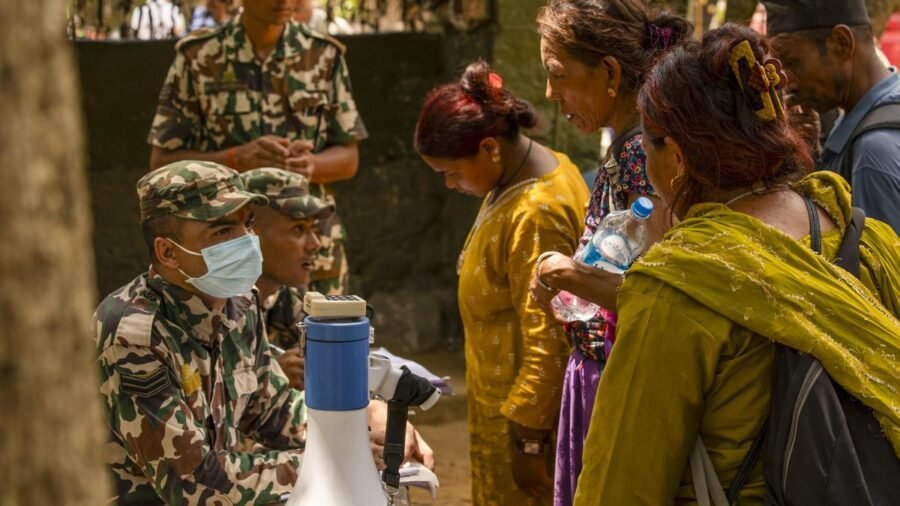
Unsure where to go next, Rishi travelled to Battar in Nuwakot, where the Nepal Army had turned its training centre into a rescue base. He stood before a list of rescued people pasted on the wall outside the barracks.
His brother’s name was not there.
He showed Ang Thung’s photograph to soldiers, Armed Police Force personnel, and Nepal Police officers.
No one recognised him.
“When I couldn’t find any information there, I decided to search on my own,” he said quietly.
Waiting at the helipad
The morning of August 30 in Dhunche was cold, with wind blowing down from the Langtang mountains.
From eight in the morning, helicopters kept lifting off towards Rasuwagadhi, Timure and Syabrubesi. Some carried rescue teams and relief supplies. Others returned with people who had survived the flood, many of them injured.
For the families waiting outside the two helipads above the town, every landing became another test of hope.
Maybe this one would bring their loved ones back.
Around 11 a.m., a green Mi-17 helicopter descended into the Nepal Army camp from the north. As its rotors thundered overhead, people waiting outside instinctively stood up.
Every face stepping out of the helicopter was searched with desperate eyes.
Somewhere among them, they hoped, might be someone they knew.
Rishi stood quietly in the crowd.
The previous night, he had ridden nearly 200 kilometres through muddy mountain roads, blocked repeatedly by landslides, just to reach Dhunche. He had come for one reason — to find his missing brother.
Each time a helicopter door opened, his eyes followed it.
One helicopter landed after another.
Ang Thung never stepped out.
The last-known location
After hours of watching helicopters come and go, Rishi walked to Rasuwa Hospital beside the helipad. He had heard that two bodies had been brought there.
There was no sign of his brother.
Everywhere he went, the answer was the same.
“We don’t know.”
So he headed towards Syabrubesi.
Ang Thung’s last phone signal had come from Lingling, a small village above Syabrubesi. Rishi believed that if his brother had survived, he might have climbed onto the hillside nearby.
He rode on the back of a motorcycle down nearly 15 kilometres to the banks of the Bhotekoshi.
The bridge had already been swept away.
There was no way to cross the river.
“I’ll stay in Dhunche tonight,” he said. “Tomorrow I’ll see if I can find another way to go further up.”
That night, he held on to only one hope — that the helicopters flying the next morning would find his brother alive somewhere on the mountainside.
Another family, the same clock
Rishi was not alone in Dhunche.
Many families there had their lives suspended by one final phone call, one last message or one last sighting.
Like the day before, on the morning of August 31, Chanchali Bishwakarma walked eight kilometres from her village to Dhunche.
She stood near the helipad with the same hope. Maybe her husband would step out of the next helicopter.
He had last called her at 7.30 a.m.
“I’m bringing the goods back,” he had said. “Get ready. We have to leave for Kathmandu.”
Chanchali was getting ready at home.
By then, the mud carried by the Bhotekoshi flood had already swallowed him.
Not just her husband — five other members of her family who worked in Rasuwagadhi and Timure also went missing.
Now, six members of her family walk eight kilometres every morning to the hill above Dhunche.
Every time a helicopter lands two minutes away, they run towards it.
They keep hoping someone will come home.
About 50 kilometres downstream from Dhunche, at Betrawati where the Trishuli and Falakhu rivers meet, the flood left behind another story.
On the morning of September 1, Sunil Nagarkoti was digging through the remains of his half-buried house.
Nearby, Manmaya Dangol leaned on a stick, searching for the place where her home once stood.
Two houses beside the Falakhu river had vanished.
Now she needs a map to show where they used to be.
“My house was there,” Nagarkoti said, pointing at a mountain of boulders piled beside the Trishuli river.
“Now I have nothing.”
Betrawati sits at the confluence of the Trishuli and Falakhu rivers, where Rasuwa and Nuwakot districts meet. It is a resting stop for travellers heading towards Langtang and the Nepal-China border at Kerung.
It is also known as Uttar Gaya, a sacred place where people perform shraddha, offering rice balls to honour their ancestors.
That morning, around 20 people had gathered by the river for the ritual.
“When I heard the river was rising, I pulled everyone out,” Nagarkoti recalled.
Then another phone call came.
“The flood is much bigger than you think.”
He began shouting through the market, urging everyone to run.
Pointing towards the main road to Rasuwa, he said, “If we’d escaped that way, we would all have been buried. We climbed these steps instead.”
His group carried an elderly woman and five children up the staircase to safety.
“The water still touched us,” he said.
“We weren’t even thinking then. But I believe my friends and I saved around 30 lives.”
Two elderly men who had been near the river were never seen again.
In Betrawati, the flood did not just change the river.
It changed the landscape itself.
Only the rooftops of four-storey buildings remain visible. Places where houses once stood have become open ground. Other houses have been carried away and dropped elsewhere. Giant trees lie across rooftops. Walls look as though they have been torn apart by explosions. A school bus stands buried nose-first in the Trishuli.
Scattered clothes. Mud-covered books. Courtyards buried beneath stone. These are the things that reveal the force of the flood more clearly than any measurement ever could.
The market of Betrawati, home to more than 17,000 people, has become a plain of rock, sand and mud. The Trishuli river, which usually runs about 30 metres below, flowed over the rooftops of people’s homes. Around 300 people there remain unaccounted for.
No one knows how many who came for shraddha, trekkers heading to Langtang, or travellers returning from the mountains were buried beneath the debris.
“I still haven’t found the bodies of my uncle and aunt,” Nagarkoti said.
“Four people from our neighbourhood on the Rasuwa side are still missing.”
He looked towards the settlement beside the Trishuli.
Then he spoke softly. “Too many people disappeared here.”
In the disaster-stricken area, 6,100 people from hundreds of households remain missing. Some of their families are waiting with a faint hope for their return.
For families like Ang Thung’s, Chanchali’s, and countless others waiting beside helipads and riverbanks, time has never moved beyond that final phone call.
prabhatkhanal.mj@gmail.com

Good foundation: on India’s strong industrial growth performance
By Sohail Khan · 1 Oct
Bitter pills: on Court’s intervention, drug pricing
By Sohail Khan · 1 Oct
Household debt, financing today against tomorrow
By Sohail Khan · 1 Oct
Leave a Reply