The India-EFTA partnership, one plus one equals three
On October 1, 2025, the Trade and Economic Partnership Agreement (TEPA) between India and the four European Free Trade Association (EFTA) states — Iceland, Liechtenstein, Norway and Switzerland — entered into force. One year on, the more useful question is not how many tariff lines have fallen, but what kind of partnership the agreement is making possible.
The tariff figures are substantial. EFTA states have offered concessions on 92.2% of their tariff lines, covering 99.6% of the value of India’s exports to them. India, in turn, is granting concessions on 82.7% of its tariff lines, covering 95.3% of the value of EFTA’s exports. Few market-opening exercises between India and a group of developed economies have been this ambitious.
Lasting partnerships, an India focus
Yet, the defining feature of TEPA lies elsewhere. It was the first trade agreement that India signed with a dedicated chapter on investment and job creation. Under it, the EFTA states aim to raise investment in India by $100 billion over 15 years and to facilitate one million direct jobs. An agreement based on that is designed to build lasting industrial and technological partnerships.
For a country of just under 4,00,000 people, Iceland’s contribution to that partnership was never going to be about scale. It is about experience, particularly in three areas where that experience speaks directly to India’s priorities.
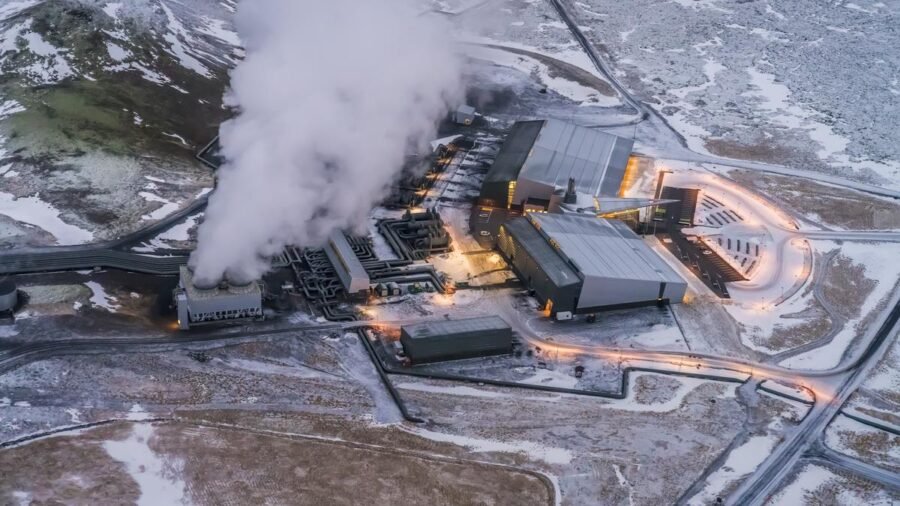
The first is geothermal energy, specifically a part of it that receives far less attention than power generation: the direct use of low- to medium-temperature heat. In Iceland, geothermal energy heats nearly every home, dries fish, warms greenhouses and keeps entire communities running through Arctic winters without burning fossil fuels. That century of experience in direct use is what the Himalayan geothermal belt of northern India can draw on.
Consider the apple growers of Himachal Pradesh. Many have long been forced to sell their harvest immediately, at the lowest prices of the season, because they lacked the means to store their crops.
That is now changing. At Tapri, in Kinnaur district, a geothermal facility operated by Geotropy, an Indian-Icelandic venture, uses heat drawn from the ground to dry fruit, and this harvest season, it is running round the clock as growers line up to use it.
A geothermal cooling facility at the same site is due to be completed by the end of the year. Farmers there can now process their produce and time their sales rather than remain price-takers at harvest, drawing on the same direct-use techniques that Iceland has refined over generations. Or consider the high-altitude communities and installations along India’s northern frontier, which depend on fuel hauled along supply lines that can close for months. Heat drawn directly from the ground beneath them offers something no convoy can: energy security that does not depend on the road remaining open.
The second area is carbon capture, utilisation and storage (CCUS). A NITI Aayog study in 2022 estimated that India could capture some 750 million tonnes of carbon dioxide a year by 2050. The scientific foundations are being laid by the Department of Science and Technology, which has steered India’s CCUS research for years and, in December 2025, published the country’s first dedicated research and development road map for CCUS in support of the 2070 net-zero goal.
The Union Budget followed in February with an outlay of ₹20,000 crore over five years to take these technologies towards scale in power, steel, cement, refining and chemicals, while public sector companies such as the Oil and Natural Gas Corporation, NTPC Limited (formerly National Thermal Power Corporation) and Indian Oil Corporation Limited are taking the work into the field through feasibility studies, pilot projects and subsurface assessments.
This pre-commercial stage is exactly where Iceland’s experience is most valuable, on both sides of the equation. On storage, CarbFix has shown that when carbon dioxide is dissolved in water and injected into basalt, more than 95% of it turns to stone within two years; India’s Deccan Trap basalts share striking geological similarities with Iceland’s volcanic rock.
New frontiers
On utilisation, Iceland was home to the world’s first industrial-scale plant to turn captured carbon dioxide into fuel: Carbon Recycling International’s George Olah plant at Svartsengi, which began producing methanol in 2011-12. Its technology now operates on a far larger scale abroad, including in projects involving steel-sector emissions. In May, Carbon Iceland signed a memorandum of understanding with JSW Steel and Bharatia to explore a 3,00,000-tonne-a-year e-methanol project in Raigad, Maharashtra, converting steel-plant emissions into fuel using green hydrogen. The opportunity, therefore, lies less in exporting equipment than in sharing knowledge and building partnerships through technology licensing, storage assessment, monitoring and verification, and the co-development of projects as India’s pilots scale up.
The third area is the ocean. Iceland’s economy was built on the sustainable management of North Atlantic fisheries, and with it came deep expertise in seafood quality, cold-chain logistics and value-added processing. Icelandic companies are already exploring how to bring further processing of North Atlantic catch to Indian shores, creating local jobs and transferring technology under the TEPA concessions.
Iceland has also shown that the greatest gains may lie in what is usually thrown away. Where most fishing nations use only 40% to 60% of each fish, Iceland now uses around 90% of every cod landed, turning skin, liver and bones into medical products, oils and feed. India does not need to catch a single additional fish to create new value, jobs and exports. It needs only to look differently at what its fleets already bring ashore.
All of this sits within a wider frame. Nearly six years of working on energy access at the United Nations, along with a seat at the table during the Paris Agreement negotiations, taught this writer that climate and energy policy are, at their core, exercises in patient and practical partnership between nations. That same spirit defines Iceland’s and India’s engagement in the Arctic. Iceland is a founding member of the Arctic Council; India has been an Observer since 2013 and has taken that role seriously, publishing its Arctic Policy in 2022 and operating the Himadri research station in Svalbard. As one of the eight Arctic States, Iceland offers India a direct and trusted bilateral channel into Arctic governance and research, complementing its multilateral engagement. For Iceland and India, energy, trade and Arctic stewardship are part of the same conversation.
Some Icelandic arithmetic
TEPA is young, but it is already showing what an ambitious, rules-based partnership between Europe and India can deliver in investment, technology and jobs, as well as in energy, fisheries and shared stewardship of a changing Arctic. It is not a rival to the European Union (EU)-India Free Trade Agreement (FTA) but a complement to it: a working model, already in force, of what the next chapter of Europe-India trade can look like. If readers will permit a small piece of Icelandic arithmetic, TEPA and the EU-India FTA are a case of one plus one equalling three. That is not competition but addition — and a rather good addition at that.
Benedikt Höskuldsson is the Ambassador of Iceland to India

Household debt, financing today against tomorrow
By Sohail Khan · 1 Oct
This is what happens to the body when you frequently take painkillers and antibiotics
By Sohail Khan · 30 Sep
Modern ways to style a sari without a traditional blouse
By Sohail Khan · 30 Sep
Leave a Reply