When scientist spotted once-in-century Moon crater
Benchmarks
Nifty23,346.4075.81
FEATURED FUNDS★★★★★
Motilal Oswal Midcap Fund Direct-Growth
5Y Return
22 %
Invest Now
Enter search text:
Business News›News›International›Global Trends›"I just stopped, dropped everything": NASA scientist recalls spotting a mysterious bright spot on Moon that turned out to be a once-in-century crater
Read Today's Paper
"I just stopped, dropped everything": NASA scientist recalls spotting a mysterious bright spot on Moon that turned out to be a once-in-century crater
Synopsis
A routine data-quality check took an unexpected turn when NASA scientist Robert Wagner spotted a mysterious bright spot surrounded by a dark halo on a giant map of the Moon. “I just stopped, dropped everything, and started looking into what that spot was,” Wagner said. His investigation led to the discovery of McGetchin, a newly formed Moon crater created by a powerful space-rock impact that scientists estimate happens only once in a century.
NASA scientist recalls spotting a mysterious bright spot on Moon that turned out to be a once-in-century crater
It was a routine data-quality check that no one know would turn into a remarkable NASA Moon discovery. The striking discovery came to light after scientist Robert Wagner noticed an unusual bright spot surrounded by a dark halo while scanning a massive map of the lunar surface. “I just stopped, dropped everything, and started looking into what that spot was,” Wagner said. At the first glance, it appeared likely as a strange mark eventually turned out to be a newly formed lunar crater, created when a comet or asteroid slammed into the Moon sometime in 2024. According to scientists, the impact impact capable of producing a crater of this size happens only about once every century or even longer. The discovery, reported in Science Advances, also shows how NASA's Lunar Reconnaissance Orbiter (LRO) continues to uncover changes taking place on the Moon.
ALSO READ: Lawrence Bishnoi gang threatens Canada police
NASA scientist notices strange spot on Moon
Wagner, an image-processing specialist from Intuitive Machines who works with data from the Lunar Reconnaissance Orbiter Camera (LROC), was not initially searching for a new crater. He was carrying out a routine data-quality check when something unusual caught his attention on a giant map of the Moon. A bright spot surrounded by a darker halo appeared to indicate that lunar surface material had been disturbed. Curious to understand what it was, Wagner began investigating it and comparing images of the same location taken at different times.

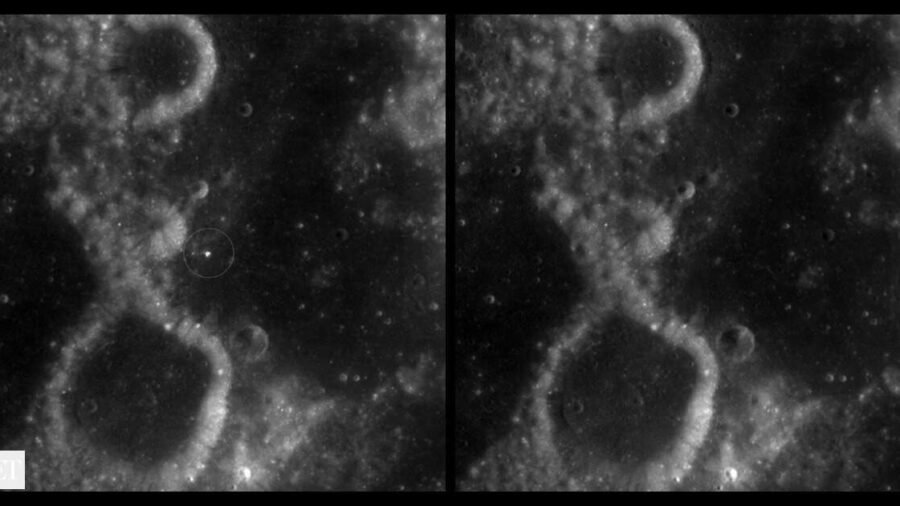
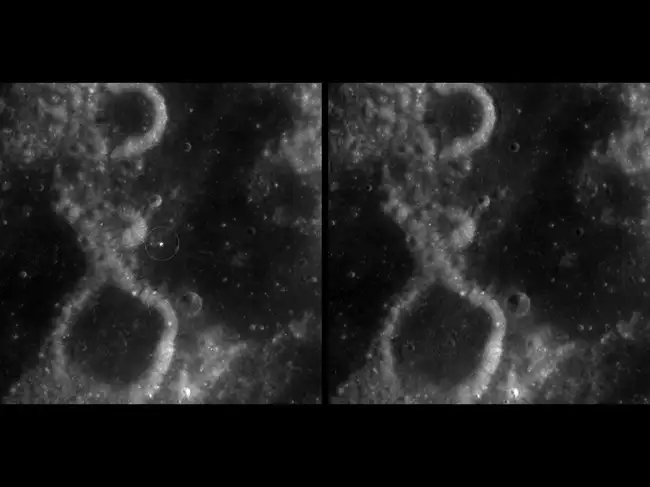
This animated image set shows an area on the eastern limb of the Moon before and after McGetchin crater formed there sometime between April 11 and May 22, 2024
“I just stopped, dropped everything, and started looking into what that spot was,” he said. The before-and-after images provided the crucial clue. The feature had not been present in earlier observations, meaning scientists were looking at a relatively recent change on the Moon.
ALSO READ: Robert De Niro breaks down in tears while discussing Donald Trump on Amy Poehler’s podcast
The crater has officially been named McGetchin, after Tom McGetchin, a pioneering lunar scientist. Scientists determined that the impact happened on the eastern edge of the Moon sometime between April 11 and May 22, 2024. The object responsible was likely a comet or asteroid measuring roughly the size of a three- to six-story building.
When it struck the lunar surface, it created a crater approximately 728 feet wide and 141 feet deep. For perspective, the crater is about as long as two football fields. Its depth would be enough to fit three yellow school buses stacked vertically. Scientists estimate that an impact capable of producing a crater of this magnitude occurs on the Moon approximately once every 100 years or longer.
Why so many objects hit the Moon
The Moon has no atmosphere capable of significantly slowing down incoming space rocks or burning them up before they reach the surface. That leaves the lunar landscape exposed to impacts from asteroids, comets and other objects traveling through space. Most of these collisions are much smaller than the one that created McGetchin crater. NASA's Lunar Reconnaissance Orbiter has been circling the Moon for more than 17 years, using seven instruments to study the lunar environment.
During that time, scientists have identified at least 1,000 new impact craters and detected about 100,000 other surface changes caused by impacts or debris thrown outward during collisions. The smallest craters scientists can distinguish in LRO images are approximately 30 feet wide. They can be created by rocks around 43 inches across, roughly the size of a monster-truck tire.
A global view of the Moon made by stitching together hundreds of images from the Wide-Angle Camera aboard NASA’s Lunar Reconnaissance Orbiter (LRO)
Scientists estimate that impacts producing craters of this detectable size happen around 140 times a year across the Moon. However, many smaller impacts leave marks that are too tiny to identify in images captured from lunar orbit.
NASA's Moon orbiter found more clues
For more than 17 years, LRO has been circling the Moon and using its seven instruments to map the topography, surface composition, temperature, and radiation environment there. The spacecraft’s team has identified at least 1,000 new impact craters throughout the mission and flagged 100,000 more surface changes from an object smashing into the Moon or from the debris that flung out after.
With no atmosphere to slow them or burn them up, space rocks and other objects easily reach the lunar surface. Most are much smaller compared to the object that carved out McGetchin crater. The smallest craters scientists can distinguish from LRO images are about 30 feet wide, the length of a three-story building laid on its side, made by rocks about 43 inches wide, the size of a monster-truck tire. Scientists estimate that impacts of this scale produce about 140 new craters across the Moon each year. But most new ones are made by microscopic projectiles that leave holes too small to identify in orbital images.
With its numerous instruments, the spacecraft can observe changes to the lunar surface that aren’t apparent in the LROC images alone. After the crater was discovered, scientists working with LRO’s thermal instrument, Diviner, made follow-up observations of the site. They found a 4-mile-wide area around the crater that is about 16 degrees Fahrenheit cooler at night than its surroundings.
The large extent of this “cold spot” is striking, scientists say, because it shows that impacts can modify the Moon’s surface far beyond the crater itself. These physical changes could affect how rover wheels interact with the surface, for instance.
Because NASA's LRO had already been monitoring the Moon, scientists could compare older images with newer ones and identify exactly where the surface had changed. Such observations help researchers understand how quickly the Moon's landscape changes and how impacts reshape its surface.
The discovery also highlights the importance of long-term lunar monitoring. A feature that appeared unexpectedly during a routine data check could have been difficult to identify without years of observations covering the same areas.
Add 

(You can now subscribe to our WhatsApp channel)
(You can now subscribe to our WhatsApp channel)
Read More News on
NASA Moon craternew Moon craterLunar Reconnaissance OrbiterMcGetchin craterMoon impactNASA scientistlunar craterMoon discoveryLRO


Enter search text:
Continue reading with one of these options:
Limited Access
Free
Login to get access to some exclusive stories
& personalised newsletters
Login Now
Unlimited Access
Starting @ Rs120/month
Get access to exclusive stories, expert opinions &
in-depth stock reports
Subscribe Now
ET
Unlock Access to All Exclusives with ETPrime FREE TRIAL
15 Days Free: Unlock All ETPrime Exclusives, Market Tools & ePapers
Trial offer expiring in00 : 05 : 00
I'd rather pay ₹2599 now


Uh-oh! This is an exclusive story available for selected readers only.
Worry not. You’re just a step away.

Prime Account Detected!
It seems like you're already an ETPrime member with
Login using your ET Prime credentials to enjoy all member benefits
Log out of your current logged-in account and log in again using your ET Prime credentials to enjoy all member benefits.
Unlock ETPrime's Exclusive Stories Today!
Subscribe to gain powerful insights on business, stock market and industry trends.
Big Price Drop! Flat 40% Off
Student Only Offer
Already a Member? Sign In now
Already a Member? Sign In now
Already a Member? Sign In now
Offer Exclusively For You
Save up to Rs. 700/-
ON ET PRIME MEMBERSHIP
Avail Offer
Offer Exclusively For You
Get 1 Year Free
With 1 and 2-Year ET prime membership
Avail Offer
Offer Exclusively For You
Get 1 Year Free
With 1 and 2-Year ET prime membership
Avail Offer
Offer Exclusively For You
Get Flat 40% Off
Then ₹ 1749 for 1 year
Avail Offer
Offer Exclusively For You
ET Prime at ₹ 49 for 1 month
Then ₹ 1749 for 1 year
Avail Offer
Special Offer
Get flat 40% off on ETPrime
Avail Offer
Avail Offer
Claim NowAlready a Member? Sign In now
Need Assistance?
Connect with an ETPrime expert for personalized support and guidance
+91 9484700004
' + h3 + '
' + h4 + '
- ' + listing + '
What’s Included with

1Exclusive Insights That Matter
Uncover the truth with our investigative stories
Make strategic moves using the real-world case studies
Read industry-specific stories to identify emerging trends
Spot opportunities with in-depth insights that matter

Trump temper on H-1B visas is forcing Indians to do these things to stay put in US

What Adani’s US indictment means for India Inc’s overseas fundraising

Why veterans like Reliance, L&T are on acquisition spree? Aswath Damodaran has an answer.

Will China’s dollar bond sale in Saudi Arabia trump the US in financial world?

Huawei launches its own OS to compete with Google and Apple. But can it win beyond China?

The problem with lab grown diamonds

Why a falling rupee is a better option for the economy

A list of top 20 momentum stocks that have delivered massive returns in one year
2Invest Wisely With Smart Market Tools & Investment Ideas
Alpha Trade

Get daily trade ideas from SEBI-registered research analysts.
Investment Ideas

Grow your wealth with stock ideas & sectoral trends.
Stock Reports Plus

All-in-one stock research with Stock Score, peer comparison & key signals.
BigBull Portfolio

Get to know where the market bulls are investing to identify the right stocks.
Stock Analyzer
Check the score based on the company's fundamentals, solvency, growth, risk & ownership to decide the right stocks.
Market Mood

Analyze the market sentiments & identify the trend reversal for strategic decisions.
Stock Talk Live at 9 AM Daily

Ask your stock queries & get assured replies by ET appointed, SEBI registered experts.
3Stay informed anytime, anywhere with ET ePaper
ePaper – Print View

Read the PDF version of ET newspaper. Download & access it offline anytime.
ePaper – Digital View

Read your daily newspaper in Digital View & get it delivered to your inbox everyday.
Wealth Edition

Manage your money efficiently with this weekly money management guide.
4Times Of India Subscription (1 Year)
ePaper

Read the PDF version of newspaper. Download & access it offline anytime.
Deep Explainers

Explore the In-depth explanation of complex topics for everyday life decisions.
Health+ Stories

Get fitter with daily health insights committed to your well-being.
Personal Finance+ Stories

Manage your wealth better with in-depth insights & updates on finance.
New York Times Exclusives

Stay globally informed with exclusive story from New York Times.
5Enjoy Complimentary Subscriptions From Top Brands
Docubay Subscription

Stream new documentaries from all across the world every day.
Stories you might be interested in

Gondhal pooja: Marathi ritual behind Oscar pick
By Sohail Khan · 18 Sep
Marathi film ‘Gondhal’ is India’s pick for Oscars
By Sohail Khan · 18 Sep
Renault India resumes Sri Lanka exports
By Sohail Khan · 18 Sep
Leave a Reply