What will new Ladakh body be called, and other questions Centre asked at key meeting
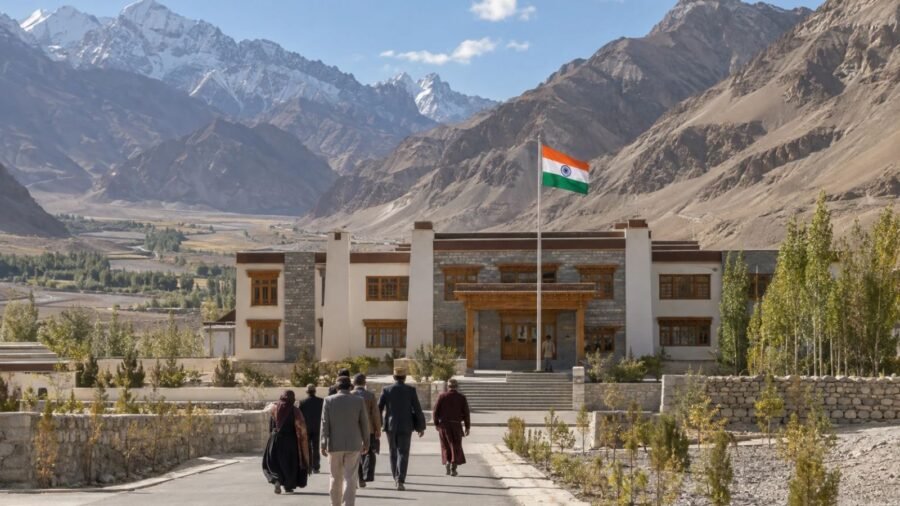
The name of the new Union Territory-level legislative body, its composition, its representation and the distribution of powers with the Ladakh Autonomous Hill Development Councils are some questions that the Ministry of Home Affairs has asked Ladakh representatives as negotiations continue over governance, land rights and constitutional protections for the Union Territory.
The questions, asked as part of a meeting held on September 9 between officials of the MHA and Ladakh representatives, urged them to deliberate on the shape, form and composition of a Union Territory-level governance body with executive and financial powers.
This comes after the Centre offered the addition of a constitutional provision, Article 371(K), and proposed a new governance arrangement that would give Ladakh neither statehood nor the status of a UT with a legislature, but a special constitutional amendment that will need the approval of Parliament.
Story continues below.
Subscribe to see fewer ads.
The questionnaire extended to the group seeks specifics from the Kargil Democratic Alliance and the Apex Body Leh on seven key issues. These include queries on the formal name of the UT-level legislative body and its executive body; their composition and representation; and their relationship to the already existing Ladakh Autonomous Hill Development Councils.
MHA has also asked Ladakhi representatives to consult each other on the functions that “should necessarily be exercised” at the UT-level body in the interest of uniformity, coordinated development and effective administration, and what functions should remain at the district level to protect local interests.
The ministry has also sought clarity on a broad spectrum of concerns, such as what “principles” would guide the allocation of powers between the UT-level body and LAHDCs. Additionally, members of the sub-committee have also been asked to specify which subjects should fall within the law-making/policy-making domain of the UT-level elected body, “in tune with the basic structure of the Constitution”, and underscored that setting up such a unique model for Ladakh would necessitate legal opinion.
After Wednesday’s meeting, Ladakh Chief Secretary Ashish Kundra said that the discussions were aimed at “taking forward the process of securing appropriate constitutional and legislative safeguards for Ladakh relating to its land, culture, heritage, natural resources, environment, employment and other concerns”.
Story continues below this ad
He also stated that in the September 9 meeting, the participating leaders from Ladakh were requested to prepare a draft document examining the structural relationship and distribution of powers between the LAHDCs and the proposed UT-level body as per their requirements.
The Chief Secretary emphasised that the constitutional changes required to bring about the existence of such a governance system would require political consensus and a two-thirds majority in Parliament.
Last month, the KDA and ABL had submitted a list of “non-negotiables” to the MHA, wherein they outlined their key demands — including a UT-level elected legislature that is directly elected and constitutionally empowered. Since the agitation for greater democratic control over Ladakh for the Ladakhi people took hold, representatives from the region have pushed a four-point agenda — statehood for Ladakh, safeguards under the Sixth Schedule of the Constitution, reservation of jobs for the youth of Ladakh and creation of separate parliamentary constituencies for the two parts of the region. It is this agenda that has been the driving force of agitations over the last three years.
However, on Thursday, the Ladakh administration ruled out statehood or the provision of a legislature, while stating that the proposed “sui generis” arrangement under Article 371 is “more” than the protections under the Sixth Schedule.

Navodaya to law college: How a programme is powering rural dreams
By Sohail Khan · 14 Sep
Leave a Reply