What Russia brings to BRICS and India
India-Russia ties co-exist with India’s expanding partnerships with US, Europe, Japan, others. This is neither confusion nor hedging. It's strategic autonomy.
Updated on: Sep 13, 2026, 07:18:42 IST
Prefer HTon Google
Share via
Copy link
Russia brings to the 18th BRICS summit in New Delhi something few other partners can claim: a relationship with India that has repeatedly adapted to changing times without losing its strategic core. Its roots can be traced back to long before the establishment of diplomatic ties on April 13, 1947, four months before India’s Independence.
In 1469, Russian merchant Afanasy Nikitin travelled to India, spending three years in Bidar. His travelogue, Journey Beyond the Three Seas, was the first published Russian account about India and attracted wide interest. In the 17th century, Gujarati traders built a thriving community in Astrakhan, at the mouth of the Volga, supplying fine textiles to the Tsar. By the mid-19th century, Sanskrit was being taught at three leading Russian universities. In the 1890s, Vladimir Haffkine developed and self-tested cholera and plague vaccines in Bombay that saved countless Indian lives. The 1909-1910 Leo Tolstoy-MK Gandhi correspondence influenced India’s non-violent freedom struggle. By the time India became independent, the two countries were building on deep historical and human ties.
Following initial ideological caution, ties between the two evolved after 1947 into a well-grounded partnership that was neither transactional nor episodic. Soviet aid contributed to India’s industrialisation, symbolised by the Bhilai Steel Plant, while defence cooperation developed steadily. The partnership acquired a strategic dimension with the 1971 Indo-Soviet Treaty of Peace, Friendship and Cooperation. During the Bangladesh Liberation War, Soviet naval presence and the country’s repeated use of its UN Security Council veto helped deter western intervention.
The relationship survived the dissolution of the Soviet Union in 1991 as its underlying strategic logic remained intact. A Treaty of Friendship and Cooperation (1993) and the Moscow Declaration on the Interests of Pluralistic States (1994) followed. Moscow stood with New Delhi once the rationale for India’s 1998 nuclear tests was made clear. Russia became India’s first strategic partner in 2000. Ten years later, the relationship was elevated to a “special and privileged” strategic partnership.
India-Russia ties reflect extraordinary goodwill and trust. A unique political consensus, cutting across party lines in both countries, recognises their value. Neither perceives the other as a threat. A strong, secure, and prosperous Russia, fulfilling its international responsibilities, serves India’s interests, and vice versa.
That appreciation has extended beyond bilateral ties. The Russia-India-China (RIC) triangle publicly advocated first by Russian Prime Minister (PM) Yevgeny Primakov during his December 1998 visit to India reflected years of Russian academic thinking. Annual RIC foreign ministers’ meetings began in New York in 2002, with the format eventually giving rise to the BRIC grouping.
A new chapter opened on September 20, 2006, when BRIC was first convened, at Russian President Vladimir Putin’s initiative, on the sidelines of the UN General Assembly in New York. Expectations were modest. I recall discussions at that foundational ministerial meeting, hosted over a working lunch by Brazil, centred on issues that remain strikingly familiar: Iran, West Asia, energy security, reform of the global financial architecture, and a more representative international order. Twenty years on, much of that agenda remains unfinished. Meanwhile, BRIC has grown into BRICS, now comprising 11 major emerging economies and representing nearly half the world’s population and about 40% of global GDP at purchasing-power parity. This evolution has paralleled a deepening India-Russia strategic partnership.
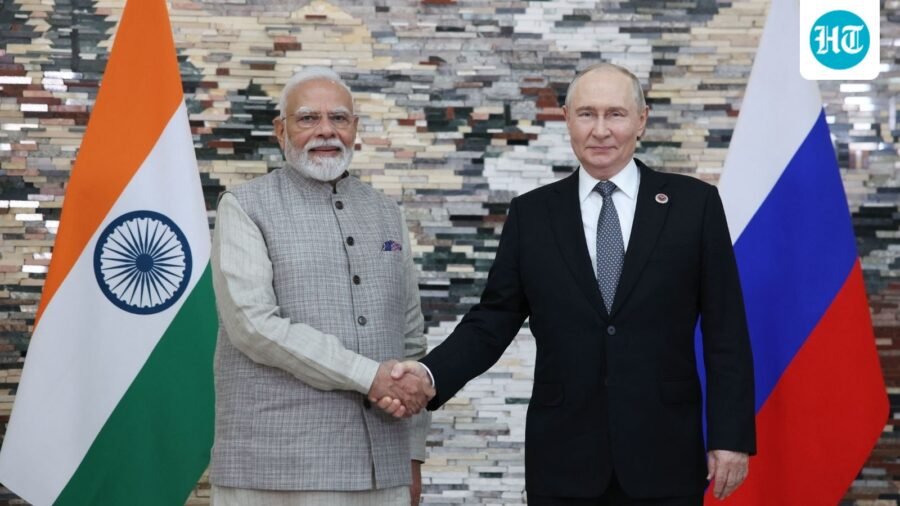
PM Narendra Modi met President Putin on September 11, on the eve of the 18th BRICS summit. It was their second meeting this year, following the Shanghai Cooperation Organization Summit in Bishkek, Kyrgyzstan, on August 31, and their 24th overall. Their review covered political, economic, defence, energy, space, skill mobility, and people-to-people ties, apart from the conflicts in West Asia and the Black Sea region, which have affected maritime trade and seafarers. Modi accepted Putin’s invitation to visit Russia for the 24th India-Russia Annual Summit.
The present-day rapport between the two leaders has deeper roots in a quarter century of personal contact and mutual respect. They first met when Modi, then chief minister of Gujarat, accompanied PM Atal Bihari Vajpayee to Moscow for the second India-Russia annual summit in 2001, where he signed a sister-State agreement between Gujarat and Astrakhan.
The partnership, however, rests on more than personal rapport. The bilateral relationship is substantial and practical. Defence cooperation encompasses Su-30MKI fighters, T-90S tanks, S-400 air defence systems, stealth frigates and BrahMos missiles, with cooperation on the Su-57 and S-500 under consideration. Civil nuclear cooperation at Kudankulam is complemented by prospects for Small Modular Reactors, while space and science and technology remain important engagement areas. Russian crude is a significant component of India’s oil imports. Trade increasingly uses national currencies, while connectivity and Arctic engagement grow.
The defining strength of the India-Russia relationship today is that it coexists comfortably with India’s expanding partnerships with the US, Europe, Japan, and others. This is neither confusion nor hedging. It is strategic autonomy in practice: the freedom to work with different major powers according to India’s interests. As a re-emerging power, India has the confidence to maintain productive relations with both Russia and the US, guided by its own interests, not the preferences of either. There is much in common between India’s multi-alignment and Russia’s older concept of multi-vector diplomacy. Both favour a more multipolar world, including a multipolar Asia. India’s relationship with Russia and the US is not a zero-sum proposition: Stronger ties with one need not come at the expense of the other.
India sees Russia as a partner within BRICS, not as part of an anti-western bloc. Its relationship with Moscow is not defined by opposition to any third country. India is non-western without being anti-western, and an important part of the Global South while remaining fully engaged with the West. These distinctions matter as an expanded BRICS accommodates divergent interests without becoming an ideological counterweight to the West.
The India-Russia partnership demonstrates how countries with differing foreign policy orientations can sustain pragmatic cooperation in a contested global order. Its strength lies in the ability to adapt as circumstances change. For India, that is part of its enduring value: Russia remains a strategic partner, including within BRICS, while leaving New Delhi free to engage a changing world on its own terms.
Ajai Malhotra is distinguished fellow and senior advisor (climate change), TERI, and a former Indian ambassador to Russia. The views expressed are personal
Get Current Updates on India News, Elections 2024, Lok sabha election 2024 voting live , Karnataka election 2024 live in Bengaluru , Election 2024 Date along with Latest News and Top Headlines from India and around the world.
See Less

Navier-Stokes problem: The questions raised by OpenAI’s latest maths ‘breakthrough’
By Sohail Khan · 13 Sep
Listen to women in pain
By Sohail Khan · 13 Sep
Leave a Reply